Author: Román Leão

  • The Inexorable March [ficção]

    Jerome Michael Gonçalo parked his beater Toyota pick-up in the Vallejo Ferry Terminal garage, made the sign of the cross, and hustled off to the kiosk to pay. He always chuckled to himself when the machine asked how many days you wanted to stay; as if he would ever leave the vehicle—beat-up or not—overnight.

    Shit, only thing left would be the paint, he mused before the boat to San Francisco let out a warning blast that carried across the four lanes of Mare Island Way, telling all around that they had better get their asses in gear.

    Parking receipt in hand, Gonçalo checked for traffic—knowing that he, himself, was often coming in hot this time of morning—before sprinting across the expanse of asphalt against the light.

    “Jamoke! You almost missed it, brah,” an African-American ferryman half again his size shouted out from behind the aluminum plinth whose only discernible function was to shore up the man’s bulk as he pointed toward the waiting hydrofoil bobbing on the tide.

    One morning, Gonçalo made the mistake of introducing himself as “J-Mike,” which was immediately misconstrued as “Jamoke,” an appellation that gave the older, and much larger, man no end of amusement.

    “Devánte,” Gonçalo panted, disturbingly out-of-breath, “I knew you’d hold it for me, even if you had to grab that rope!”

    “No way, brah,” the man laughed, “we’re on a schedule. Very tight. Like your mom.”

    “Keep it professional, D.,” Gonçalo half-heartedly protested as he reached for the lanyard that held his transit card, only to realize that he wasn’t wearing it. He glanced toward the now-shuttered ticket windows at the terminal. Closed signs announced the inexorable march toward having every human interaction removed from one’s day. And yet, he silently bemoaned, Devánte persists.

    Gonçalo wondered what the folks that had worked those windows were waking up to today, having been replaced by a phone app. He weighed the odds of rushing back to the house for the card but quickly calculated that he’d never make it back in time for the next boat. That would mean driving into the City, a trip that took two maddening hours just days before.

    He had already come to terms with the fact that he would rather be skinned alive than undergo that ordeal again as he had barely made it to work the last time without pissing himself in traffic. Gonçalo had briefly thought about drinking less coffee in the morning and immediately realized that it would never actually happen. Public urination verses the murder charge that would surely follow going cold turkey was a steep, but manageable, price to pay.

    “Use the app, brah,” Devánte, having astutely read the situation, advised. “Your phone, Jamoke.”

    Gonçalo pivoted to attempting to use the very cell phone application that resulted in the sacking of the station agents and felt badly for a moment. The moment passed as the intended exchange failed with an abrasive electronic bleat.

    “Y-eaz-ou l-eaz-ose,” Devánte intoned, revealing a probable past spent somewhere on the midway. “Jump on, Jamoke. This cross must move.”

    Devánte’s counterpart on board the craft rattled off some half-heard, less-understood, instructions. Gonçalo stared blankly at the black rectangle in his hand as he moved toward an open seat and plopped down with a certain resignation.

    All morning, Cassandras on the local news gleefully warned of power blackouts and the possible closure of outdoor public spaces as an impending heatwave threatened to blanket the entire West. Gonçalo had chosen to wear a leaf-patterned Hawaiian shirt in a light fabric, although now he was feeling that perhaps it was sending the wrong message about his mood.

    As the engines below the craft begin to churn the cold morning waters of the Bay, he thought about stepping outside in the quickly warming air and slipping unseen over the rail, his cell phone dropping from his hand and sinking to the muddy bottom even quicker than he himself would.

  • The Path to Carson Falls [poema]

    I turned off the fire road
    Where I saw two foxes cavorting
    Among the chaparral and metamorphic rocks
    Slipping on schist I dropped

    Into the green, grey, and remaining garnet
    And heard the canyon breathing
    Countless hidden feeder creeks singing
    Along with naked aspens and pines in their breezes

    In the background, ever present
    Growing louder with each now careful step
    The falls crack precipitation
    Into mist, into pieces, into peace

    Photo/Ray Larsen

  • The Brautigan Question [poema]

    Careened on the hand-me-down couch
    Slowly sinking into a misshapen beachhead of cushions
    I was reading a slim volume of early writings of a dead poet
    When my wife came into the room asking,
    “How does it feel to wash your balls with a city?”

    Well now, that’s a question fraught with foam and froth
    One must take into account all sorts of surfactants
    Then I recalled that someone had gifted her
    A soap in the shape of the Emerald City
    All green towers, minarets, and flying buttresses

    I closed the book and put it down, knowing that nothing
    The dead poet had written up to that point in his career
    Was going to measure up to that question
    I thought about it for a second and had to admit
    “It was nice.”

  • The World Without Us—Alan Weisman

    Mr. McGuire: I just want to say one word to you—just one word.
    Ben: Yes sir.
    Mr. McGuire: Are you listening?
    Ben: Yes, I am.
    Mr. McGuire: Plastics.
    Ben: Exactly how do you mean?
    Mr. McGuire: There’s a great future in plastics. Think about it. Will you think about it?
    Ben: Yes, I will.

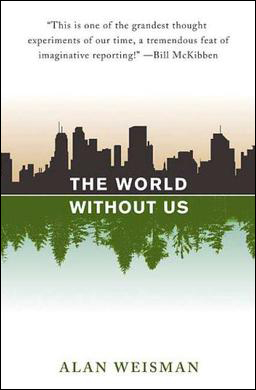
    While reading Alan Weisman’s fascinating book, The World Without Us, that scene from The Graduate kept playing in my head. Plastics. It turns out that there is a great, or at the very least, long future for all one billion tons of it as it never really breaks down—pieces just become smaller and smaller and by doing so can be swallowed by organisms at the very bottom of the food chain. Which is bad.

    It was frightening to read how quickly plastics have permeated every aspect of our lives (they’ve only been around since the end of World War II), and just how badly we manage what happens to them when we’re done using them. Weisman describes in detail the great wastes of floating plastic that circle the center of each of the world’s oceans.

    There was something about growing up in the waning years of the Cold War that left an indelible mark on the collective imagination of my fellow Gen Xers and myself. We are suckers for stories of our own destruction. Maybe it was the sight of the Statue of Liberty sticking out of the sand at the end of Planet of the Apes, or just the constant fear of nuclear destruction, but as kids, I think most of us had spent some time thinking about what would happen to the world once all of us were gone.

    Weisman looks at all of the things that may benefit from our demise (almost all other species except those that have been domesticated), and all of the things that will simply go to hell without us here to manage them (it turns out that nuclear reactors, refineries, and power plants don’t really run themselves for very long).

    As we all learned in science class and/or the Discovery Channel, water is the one unstoppable force on Earth. You can try to dam it, pump it, or redirect it, but whatever you choose to try and force it to do, you’ve created yourself a full-time job. Without us around to maintain the infrastructure, it will just be a matter of time before rivers undermine and retake the streets of New York, the delta washes away Houston, and, well, we’ve already seen what could happen to New Orleans.

    The book isn’t all doom and gloom, there are very interesting scientific tidbits scattered throughout that I have not encountered anywhere else. His glimpses of the last remaining piece of the primeval forest that once covered Europe made me want to book a flight to the border of Poland and Belarus.

    The human narrative emerging from the Eastern African Rift Valley really points up how we are all really the same, like it or not. For those that will never wrap their minds around that fact, there is the cold comfort that war is actually beneficial for some species, if only by reducing the number of people degrading the environment.

    The amazing return of several endangered animals to the Korean peninsula’s DMZ echoes an idea by environmentalists from The Rewilding Institute who are committed to developing naturalized corridors crossing each of the continents where wildlife could live, migrate, and hopefully, thrive.

    As for humankind, well… we had better get our house in order. To paraphrase Weisman, we choose not to see the biggest elephant in the planet-sized room, although it’s harder and harder to ignore it. Perhaps the last great hope for us is to reduce current population trends before we experience total environmental collapse. It wouldn’t be the first time the Earth has pushed the reset button, and it won’t be the last, it’s just that we are supposed to be the smart ones.

    Every four days, the population of our small planet rises by one million people. If things continue at the current rate of projection, we should reach a mind-blowing total of nine billion people by the middle of this century. According to Dr. Sergei Scherbov from the Vienna Institute of Demography of the Austrian Academy of Sciences and the World Population Program, if families were limited to having only one child, we would be back down to 19th century levels by 2100.

    However, with pronatalism promoters like Elon Musk—14 kids and counting—and Vice President JD Vance pushing the idea that (white) people should have more babies on behalf of the nation, I’m not going to hold my breath.

    Picador Paper

  • The Royal Nonesuch: Or, What Will I Do When I Grow Up?—Glasgow Phillips

    In his frenzied autobiography, Marin County native Glasgow Phillips invites us to peek behind the curtain of the ridiculous freak show that was Hollywood during the dot-com boom and bust years. Most of us who weren’t part of the fool’s gold rush that closed the 20th-century had a feeling the whole thing was smoke and mirrors, but to take that ride with Phillips driving is still a mind-bending rush.

    To his credit, Phillips paints an unvarnished self-portrait and I wasn’t sure that I liked him or even cared enough about what happened to him to read beyond the 100-page mark. On one level Royal Nonesuch is very much the story of a privileged screw-up who pisses away a sizable inheritance hanging out with his crazy friends. It does eventually become apparent, however, that there is something more going on with this guy.

    At one point, Phillips seeks to point up the tawdry truths that lie beneath modern media’s love of death and destruction by producing an online millennial hoax involving an Antichrist-related snuff film. Phillips wrestles with his conscience, and his demons, while frantically scheming for funding and freaking out everyone that comes in contact with the project.

    Tragically, the looming collapse of the mini-media empire that Phillips and his partners have struggled to keep aloft comes at the same time his mother is diagnosed with cancer. The prospect of real loss puts the perceived gains and losses of the boom/bust into tight perspective and Phillips grows, matures, and finally becomes a fully realized person because of it. Good on him.

    Grove Press, Black Cat

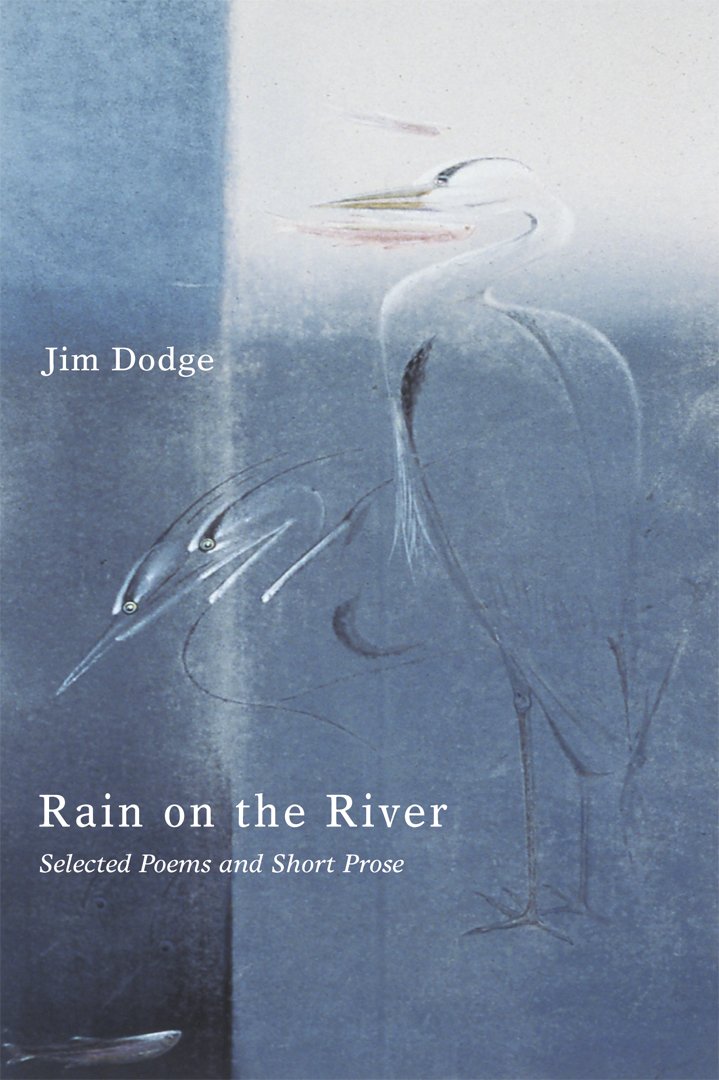
  • Rain on the River: New and Selected Poems and Short Prose—Jim Dodge

    Once and a while, if you’re lucky, you just might run into someone who seems like they have it all figured out; someone who by virtue of example shows you another way of looking at the world and your place in it.

    If you casually told them that you were tempted to follow his or her example (and that person wasn’t driven by ego or fanaticism) that person might look at you like you were crazy, then maybe laugh, and try to talk you out of it. That person might even explain to you why you shouldn’t write in second person narrative. For me that person was Jim Dodge.

    I had the extreme pleasure of taking Jim’s creative writing class at Humboldt State back in the early ’90s, and in retrospect, I should have dropped all my other classes and just hung out with him all day. Oh well, live and learn—which is also the message of much of Dodge’s output: any one of his three novels or the flurry of chapbooks and loose poems that follow in his literary wake might teach you that.

    Rain on the River collects Dodge’s short-form musings from the late ’80s through when it was published in 2002, and during which time, Dodge married his long-time companion and became a father. Many of the later poems deal with the incredible sense of amazement he seemed to be dialed into at that point in his life.

    Dodge’s poetry combines the wonder of some of Richard Brautigan’s more innocent works and the natural familiarity of Gary Snyder, a fellow traveler who Dodge attributes with changing the direction of his life. Dodge, a Humboldt fisheries major at the time, went multi-disciplinarian after reading Snyder’s Hay for the Horses. Dodge’s mixture of Zen awareness and working class perception mirrors Snyder’s own sensibilities.

    In Fishing Devil’s Hole at the Peak of Spring, Dodge relates an archetypical steep downhill battle through briar and bramble (and occasional unexpected flower-strewn meadow) to reach a secret fishing hole, only to lose his fish and end up ass-over-teakettle in the freezing water to which he exclaims:

    “Yarrrrrggggggggaaaaaahhhhhhhhhhh!”
    Yes. Yes by everything holy, yes!
    Even better.

    He writes at his most beatific in a bone-deep closing triptych/manifesto, Holy Shit.

    I believe every atom of creation
    is indelibly printed with divinity.
    I believe in the warm peach
    rolled in the palm of my hand.
    I believe God plays saxophone
    and the Holy Ghost loves to dance.

    Grove Press

    Also by this author:
    Always Something

  • The Confessions of Rick James “Memoirs of a Super Freak”—Rick James

    Jeesus. You cannot accuse Rick James of false advertising, although you probably could have charged him with just about anything else at anytime, and the charges would have stuck.

    It was hard to keep from copy editing James’ autobiography as I read along. Although after a while, the awkward repetition of sentences—and entire paragraphs—began to seem like part of the experience. It was easy to imagine him telling a story and adding the same crazy bit several times in a row.

    Me: “Erm, Mr. James, you just said that.”

    The imaginary Rick James that lives in my head: “Cocaine’s a hell of a drug.”

    The most interesting part of the book for me was the Zelig-like way that James was involved with so many of the people and bands that came to embody the late-’60s rock scene. Who knew?

    Rest in peace, super freak.

    Amber Communications Group

  • The Savage Detectives: A Novel—Roberto Bolaño

    The release of an English translation of Chilean author Roberto Bolaño’s novel The Savage Detectives went head-to-head with the appearance of Denis Johnson’s Tree of Smoke for 2007’s literary news of the year.

    Lucky for us, Bolaño’s novel turned out to be every bit as great as the hype. Long known and respected by Latin American readers, Bolaño was a bit of mystery for most English monolinguists who, if hip to his writings at all, had to subsist on a few slim volumes published by New Directions.

    With the heavyweight house of Farrar, Straus and Giroux picking up the mantle and feature-length articles in the New Yorker and The New York Review of Books touting the novel’s many charms, Bolaño was the toast of the literary world—four years after his death in Spain of liver failure.

    The Savage Detectives begins in a mid-1970s Mexico City where a young poet, Juan García Madero, is invited to join a mysterious fraternity of writers calling themselves “visceral realists.” To call the group a movement is a bit of a stretch as no one, García Madero especially, knows (or is willing to say) exactly what visceral realism is. This doesn’t stop the group’s leaders, Ulises Lima and Arturo Belano (a thin, thinly disguised Bolaño) from conducting purges that would make a Maoist nervous.

    The writers prowl the streets and back alleys of Mexico City, constantly writing, having sex, getting drunk, and ultimately running afoul of a killer pimp and his corrupt police buddies. As one does. Of course, this encapsulation does rough injustice to Bolaño’s kaleidoscope of richly drawn characters, some of which—like rare desert flowers—bloom once, fade, and are never seen again.

    The middle of the book picks up after the poets have returned from the desert where they had been searching for the mysterious poet who started the original visceral realism movement in the 1920s. For the next 400 pages, we see Lima and Belano through the eyes of people who cross paths with them in a 20-year span ending in 1996. This fractured faux-oral biography plays with the notion of identity while giving the disorienting, yet thrilling, feeling of looking at the pair through a many-faceted diamond.

    The final third returns to the Sonoran Desert to tell the story of what happened to Lima, Belano, García Madero, and wayward prostitute Lupe on their search for the elusive Cesárea Tinajero. To paraphrase García Madero: When it was all over, I felt like I knew every inch of that f’ing country. Even more, I felt I was born there.

    Picador

    Also by this author:
    The Insufferable Gaucho
    The Return
    The Romantic Dogs

  • The Message [poema]

    Tuesday morning the rain stops.
    Underneath the swinging bridge, the creek
    was awake all night and now

    runs rampant. Cross to the parlor where
    cool hands have built a roaring
    welcome. After endless summer days

    spent steeped in light, oak-bound heat
    is now released and supplants the gray.
    On the porch, the old men speak

    with tongues of fire, both spirited
    and holy. Inside, the wood
    relates the original story—

    an old celestial game of
    telephone. The message started out
    in violence—a roiling

    furnace burning since the sky began.
    Today, sitting by the hearth,
    the word has turned to love—and two hearts

    that were embers—are now suns.

    Photo/Ray Larsen

  • The Insufferable Gaucho—Roberto Bolaño

    In death, Chilean writer Roberto Bolaño has become the Tupac Shakur of the literary world. Since succumbing to liver failure in 2003, he consistently released books for years (including the 900-page masterpiece, 2666). I realize that this incredible feat is due more to the slow process of translation than any powers Bolaño may have developed from beyond the grave, but I really wouldn’t put anything past him.

    The Insufferable Gaucho is a slim but powerful offering of short stories as well as a pair of essays in which he elliptically explores his own approaching mortality and place in the pantheon of Latin American literature. Bolaño’s Police Rat revisits Franz Kafka’s hidden world of Josephine the Singer, or the Mouse Folk. Pepe the Cop, a nephew of Josephine’s who, like his famous aunt, has a sensitivity that raises him a cut above the common rat, is on the tail of a killer in their midst.

    Unfortunately for Pepe—and as we have learned through countless police stories—individuality isn’t necessarily a trait that is appreciated by superior officers. As Josephine’s star wanes, Kafka’s narrator muses, “She is a small episode in the eternal history of our people, and the people will get over the loss of her.”

    One has to wonder if Bolaño was winking at us from his own position as a singing rat of some renown and one fully aware of his own demise. Perhaps it was a poke back at his own growing fame in the years right before he died when he chose the epigram for this book from the end of Kafka’s story: “So perhaps we shall not miss so very much at all.”

    If Martin Scorsese ever decides to direct an animated movie for Pixar, I’d like to see Police Rat on the big screen. I could just imagine Robert De Niro doing the voice-over for Pepe: “Have you ever taken on a weasel? Are you ready to be torn apart by a weasel?” Maybe it’s time for the studio to leave behind Lady and the Trampist fare like Ratatouille, and get fucking real. But I digress.

    In Literature + Illness = Illness, a many-faceted facing of the terminal disease that cut his life short at 50, Bolaño writes, “Books are finite, sexual encounters are finite, but the desire to read and fuck is infinite; it surpasses our own deaths, our fears, our hopes for peace.” It is a shout back from the ragged edge of things, and about as true as anything I’ve ever heard.

    New Directions

    Also by this author:
    The Return
    The Romantic Dogs
    Savage Detectives: A Novel