Author: Román Leão

  • Failure to Appear [poema]

    Wednesday, the Sun forgot to come out
    As two million acres goes up in flames
    Smoke scatters the wavelengths of blue light

    From Plumas and Butte, suspended in the fog
    The ghosts of Berry Creek and Feather Falls
    Hang foreboding in a persimmon-colored sky

  • The Romantic Dogs—Roberto Bolaño

    By the time an English translation of Chilean author Roberto Bolaño’s novel The Savage Detectives was finally released in 2007, he had already passed like a glowing comet, having succumbed to a failing liver in 2003. Bolaño’s novel followed every drunken debauch and whim of a group of young Mexico City poets calling themselves visceral realists, but while the prose was beautifully crafted, the book was starkly short on actual poems.

    His biographers make a point of saying that Bolaño’s first love was poetry. Supposedly he only turned to writing novels at the age of 40 after the birth of his son forced him to give up a more bohemian lifestyle. This collection spans his career from 1980 through 1998, the year The Savage Detectives was first published.

    There are many allusions to the novel and, as in much of his work, some of the same territories are traveled, making this a good companion piece to the novel, or visa versa. Several poems deal with the enigmatic figure of a detective, questioning but never solving the seemingly random and unending violence of South America.

    I dreamt of frozen detectives; Latin American detectives who were trying to keep their eyes open in the middle of the dream. I dreamt of hideous crimes and of careful guys who were wary not to step in pools of blood while taking in the crime scene with a single sweeping glance.

    His fascination with forensics would find full flower in 2666, by many accounts, his crowning achievement. At nearly 900 pages, the book is a mammoth project that Bolaño struggled to finish before he died. It is rumored that he even went as far as to postpone a much-needed liver transplant so as to not break stride on his defining work. This struggle is reflected in one of the most moving poems near the end of The Romantic Dogs.

    Muse, wherever you might go I go. I follow your radiant trail across the long night. Not caring about years or sickness. Not caring about the pain or the effort I must make to follow you.

    New Directions

    Also by this author:
    The Insufferable Gaucho
    The Return
    Savage Detectives: A Novel

  • History Lesson [poema]

    In this narrow valley
    We are surrounded
    Smokestacks stand like Indians
    An assembly of whisperers
    Their stories stated and immediately stolen 
    Taken by the relentless wind

    Through the heart of it
    The lifeblood of the land
    Runs out westward to mingle
    Once again with Mother Ocean
    To be subsumed
    To be welcomed home

    Across the straits
    The hills stand silent much as they did
    One hundred years ago
    A thousand?
    Twenty thousand?
    Surely not a million

    On these shores
    The shell mounds of the Karkin are lost
    Covered by condominiums, the latest in a parade of indignities
    From here you could walk out on the water a fair distance
    Keeping those hills in sight, but I wouldn’t
    At least not barefoot

    Was it always like this?
    Do we stand on the mired remains
    Of gentle granite giants
    Washed down from the interior
    Or are we merely caught in an eddy
    Of slack tide and time?

    Photo/Ray Larsen

  • Heebie Jeebies [haicai]

    I don’t hear voices
    But sometimes when it’s quiet
    I hear faint swing jazz

    A radio plays
    Benny Goodman and Chick Webb
    In another room

    A haunting refrain
    A particular madness
    I don’t hear voices

    Photo/Ray Larsen

  • The Yiddish Policemen’s Union: A Novel—Michael Chabon

    I always feel a little sad upon finishing one of Michael Chabon’s novels. The Berkeley author weaves such wonderfully detailed tapestries of language and imagery that a feeling of loss is inevitable once the Big Finish has come and gone.

    That same feeling pervades The Yiddish Policemen’s Union from the jump as the world the characters have inhabited for 60 years is about to be flung on the trash heap of history. The alternative-history conceit is as follows: after the horror of World War II, and a collapse of the stillborn State of Israel, Jewish refugees were settled in an American Federal District hastily carved out of the Alaskan wilderness—and now the lease is up.

    As alcoholic policeman Meyer Landsman begins the search for who may have killed a fellow tenant of his own down-at-the-heels hotel, he heads toward the basement and this throw-away bit of narration: “[Landsman] checks behind the hot-water tanks, lashed to one another with scraps of steel like comrades in a doomed adventure.” The metaphor could be stretched to represent Landsman himself and his ex-wife/new-supervisor Bina Gelbfish who has been sent to tidy up all the loose ends at Sitka Central, and Landman’s investigation is one big throbbing nerve of a loose end.

    Drowning in the machinations of the District’s Hasidic mafia and a cold ocean of slivovitz, Landsman is haunted by a complex chess problem left by the dead tenant. Is it a clue? Is it just a reflection of his own hang-up caused by his chess champion father’s disappointment in him and resultant suicide? Chabon has explored these themes before. He revels in the arcane details of modern Judaica, and I was waiting past the 200-page mark for his patented Big Gay Character to show (he does, although posthumously).

    As Chabon has repeatedly shown—in his on-going bid to become a one-man Coen Brothers of the literary world, chewing up and spitting out genre after genre—it’s not the materials, plot points, or archetypes you start with, it’s how you play the familiar pieces that wins the game.

    Harper Perennial

    Also by this author:
    Gentleman of the Road: A Tale of Adventure

  • The Inexorable March [ficção]

    Jerome Michael Gonçalo parked his beater Toyota pick-up in the Vallejo Ferry Terminal garage, made the sign of the cross, and hustled off to the kiosk to pay. He always chuckled to himself when the machine asked how many days you wanted to stay; as if he would ever leave the vehicle—beat-up or not—overnight.

    Shit, only thing left would be the paint, he mused before the boat to San Francisco let out a warning blast that carried across the four lanes of Mare Island Way, telling all around that they had better get their asses in gear.

    Parking receipt in hand, Gonçalo checked for traffic—knowing that he, himself, was often coming in hot this time of morning—before sprinting across the expanse of asphalt against the light.

    “Jamoke! You almost missed it, brah,” an African-American ferryman half again his size shouted out from behind the aluminum plinth whose only discernible function was to shore up the man’s bulk as he pointed toward the waiting hydrofoil bobbing on the tide.

    One morning, Gonçalo made the mistake of introducing himself as “J-Mike,” which was immediately misconstrued as “Jamoke,” an appellation that gave the older, and much larger, man no end of amusement.

    “Devánte,” Gonçalo panted, disturbingly out-of-breath, “I knew you’d hold it for me, even if you had to grab that rope!”

    “No way, brah,” the man laughed, “we’re on a schedule. Very tight. Like your mom.”

    “Keep it professional, D.,” Gonçalo half-heartedly protested as he reached for the lanyard that held his transit card, only to realize that he wasn’t wearing it. He glanced toward the now-shuttered ticket windows at the terminal. Closed signs announced the inexorable march toward having every human interaction removed from one’s day. And yet, he silently bemoaned, Devánte persists.

    Gonçalo wondered what the folks that had worked those windows were waking up to today, having been replaced by a phone app. He weighed the odds of rushing back to the house for the card but quickly calculated that he’d never make it back in time for the next boat. That would mean driving into the City, a trip that took two maddening hours just days before.

    He had already come to terms with the fact that he would rather be skinned alive than undergo that ordeal again as he had barely made it to work the last time without pissing himself in traffic. Gonçalo had briefly thought about drinking less coffee in the morning and immediately realized that it would never actually happen. Public urination verses the murder charge that would surely follow going cold turkey was a steep, but manageable, price to pay.

    “Use the app, brah,” Devánte, having astutely read the situation, advised. “Your phone, Jamoke.”

    Gonçalo pivoted to attempting to use the very cell phone application that resulted in the sacking of the station agents and felt badly for a moment. The moment passed as the intended exchange failed with an abrasive electronic bleat.

    “Y-eaz-ou l-eaz-ose,” Devánte intoned, revealing a probable past spent somewhere on the midway. “Jump on, Jamoke. This cross must move.”

    Devánte’s counterpart on board the craft rattled off some half-heard, less-understood, instructions. Gonçalo stared blankly at the black rectangle in his hand as he moved toward an open seat and plopped down with a certain resignation.

    All morning, Cassandras on the local news gleefully warned of power blackouts and the possible closure of outdoor public spaces as an impending heatwave threatened to blanket the entire West. Gonçalo had chosen to wear a leaf-patterned Hawaiian shirt in a light fabric, although now he was feeling that perhaps it was sending the wrong message about his mood.

    As the engines below the craft begin to churn the cold morning waters of the Bay, he thought about stepping outside in the quickly warming air and slipping unseen over the rail, his cell phone dropping from his hand and sinking to the muddy bottom even quicker than he himself would.

  • The Path to Carson Falls [poema]

    I turned off the fire road
    Where I saw two foxes cavorting
    Among the chaparral and metamorphic rocks
    Slipping on schist I dropped

    Into the green, grey, and remaining garnet
    And heard the canyon breathing
    Countless hidden feeder creeks singing
    Along with naked aspens and pines in their breezes

    In the background, ever present
    Growing louder with each now careful step
    The falls crack precipitation
    Into mist, into pieces, into peace

    Photo/Ray Larsen

  • The Brautigan Question [poema]

    Careened on the hand-me-down couch
    Slowly sinking into a misshapen beachhead of cushions
    I was reading a slim volume of early writings of a dead poet
    When my wife came into the room asking,
    “How does it feel to wash your balls with a city?”

    Well now, that’s a question fraught with foam and froth
    One must take into account all sorts of surfactants
    Then I recalled that someone had gifted her
    A soap in the shape of the Emerald City
    All green towers, minarets, and flying buttresses

    I closed the book and put it down, knowing that nothing
    The dead poet had written up to that point in his career
    Was going to measure up to that question
    I thought about it for a second and had to admit
    “It was nice.”

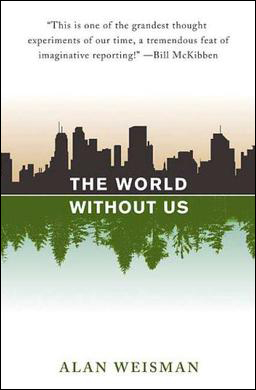
  • The World Without Us—Alan Weisman

    Mr. McGuire: I just want to say one word to you—just one word.
    Ben: Yes sir.
    Mr. McGuire: Are you listening?
    Ben: Yes, I am.
    Mr. McGuire: Plastics.
    Ben: Exactly how do you mean?
    Mr. McGuire: There’s a great future in plastics. Think about it. Will you think about it?
    Ben: Yes, I will.

    While reading Alan Weisman’s fascinating book, The World Without Us, that scene from The Graduate kept playing in my head. Plastics. It turns out that there is a great, or at the very least, long future for all one billion tons of it as it never really breaks down—pieces just become smaller and smaller and by doing so can be swallowed by organisms at the very bottom of the food chain. Which is bad.

    It was frightening to read how quickly plastics have permeated every aspect of our lives (they’ve only been around since the end of World War II), and just how badly we manage what happens to them when we’re done using them. Weisman describes in detail the great wastes of floating plastic that circle the center of each of the world’s oceans.

    There was something about growing up in the waning years of the Cold War that left an indelible mark on the collective imagination of my fellow Gen Xers and myself. We are suckers for stories of our own destruction. Maybe it was the sight of the Statue of Liberty sticking out of the sand at the end of Planet of the Apes, or just the constant fear of nuclear destruction, but as kids, I think most of us had spent some time thinking about what would happen to the world once all of us were gone.

    Weisman looks at all of the things that may benefit from our demise (almost all other species except those that have been domesticated), and all of the things that will simply go to hell without us here to manage them (it turns out that nuclear reactors, refineries, and power plants don’t really run themselves for very long).

    As we all learned in science class and/or the Discovery Channel, water is the one unstoppable force on Earth. You can try to dam it, pump it, or redirect it, but whatever you choose to try and force it to do, you’ve created yourself a full-time job. Without us around to maintain the infrastructure, it will just be a matter of time before rivers undermine and retake the streets of New York, the delta washes away Houston, and, well, we’ve already seen what could happen to New Orleans.

    The book isn’t all doom and gloom, there are very interesting scientific tidbits scattered throughout that I have not encountered anywhere else. His glimpses of the last remaining piece of the primeval forest that once covered Europe made me want to book a flight to the border of Poland and Belarus.

    The human narrative emerging from the Eastern African Rift Valley really points up how we are all really the same, like it or not. For those that will never wrap their minds around that fact, there is the cold comfort that war is actually beneficial for some species, if only by reducing the number of people degrading the environment.

    The amazing return of several endangered animals to the Korean peninsula’s DMZ echoes an idea by environmentalists from The Rewilding Institute who are committed to developing naturalized corridors crossing each of the continents where wildlife could live, migrate, and hopefully, thrive.

    As for humankind, well… we had better get our house in order. To paraphrase Weisman, we choose not to see the biggest elephant in the planet-sized room, although it’s harder and harder to ignore it. Perhaps the last great hope for us is to reduce current population trends before we experience total environmental collapse. It wouldn’t be the first time the Earth has pushed the reset button, and it won’t be the last, it’s just that we are supposed to be the smart ones.

    Every four days, the population of our small planet rises by one million people. If things continue at the current rate of projection, we should reach a mind-blowing total of nine billion people by the middle of this century. According to Dr. Sergei Scherbov from the Vienna Institute of Demography of the Austrian Academy of Sciences and the World Population Program, if families were limited to having only one child, we would be back down to 19th century levels by 2100.

    However, with pronatalism promoters like Elon Musk—14 kids and counting—and Vice President JD Vance pushing the idea that (white) people should have more babies on behalf of the nation, I’m not going to hold my breath.

    Picador Paper

  • The Royal Nonesuch: Or, What Will I Do When I Grow Up?—Glasgow Phillips

    In his frenzied autobiography, Marin County native Glasgow Phillips invites us to peek behind the curtain of the ridiculous freak show that was Hollywood during the dot-com boom and bust years. Most of us who weren’t part of the fool’s gold rush that closed the 20th-century had a feeling the whole thing was smoke and mirrors, but to take that ride with Phillips driving is still a mind-bending rush.

    To his credit, Phillips paints an unvarnished self-portrait and I wasn’t sure that I liked him or even cared enough about what happened to him to read beyond the 100-page mark. On one level Royal Nonesuch is very much the story of a privileged screw-up who pisses away a sizable inheritance hanging out with his crazy friends. It does eventually become apparent, however, that there is something more going on with this guy.

    At one point, Phillips seeks to point up the tawdry truths that lie beneath modern media’s love of death and destruction by producing an online millennial hoax involving an Antichrist-related snuff film. Phillips wrestles with his conscience, and his demons, while frantically scheming for funding and freaking out everyone that comes in contact with the project.

    Tragically, the looming collapse of the mini-media empire that Phillips and his partners have struggled to keep aloft comes at the same time his mother is diagnosed with cancer. The prospect of real loss puts the perceived gains and losses of the boom/bust into tight perspective and Phillips grows, matures, and finally becomes a fully realized person because of it. Good on him.

    Grove Press, Black Cat

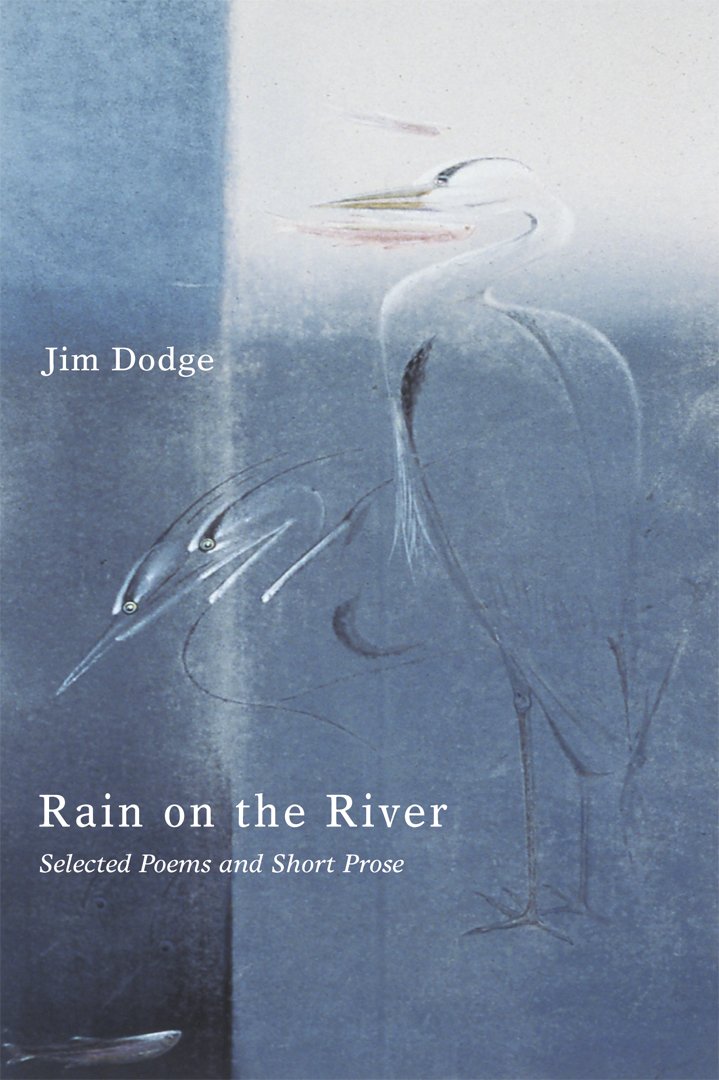
  • Rain on the River: New and Selected Poems and Short Prose—Jim Dodge

    Once and a while, if you’re lucky, you just might run into someone who seems like they have it all figured out; someone who by virtue of example shows you another way of looking at the world and your place in it.

    If you casually told them that you were tempted to follow his or her example (and that person wasn’t driven by ego or fanaticism) that person might look at you like you were crazy, then maybe laugh, and try to talk you out of it. That person might even explain to you why you shouldn’t write in second person narrative. For me that person was Jim Dodge.

    I had the extreme pleasure of taking Jim’s creative writing class at Humboldt State back in the early ’90s, and in retrospect, I should have dropped all my other classes and just hung out with him all day. Oh well, live and learn—which is also the message of much of Dodge’s output: any one of his three novels or the flurry of chapbooks and loose poems that follow in his literary wake might teach you that.

    Rain on the River collects Dodge’s short-form musings from the late ’80s through when it was published in 2002, and during which time, Dodge married his long-time companion and became a father. Many of the later poems deal with the incredible sense of amazement he seemed to be dialed into at that point in his life.

    Dodge’s poetry combines the wonder of some of Richard Brautigan’s more innocent works and the natural familiarity of Gary Snyder, a fellow traveler who Dodge attributes with changing the direction of his life. Dodge, a Humboldt fisheries major at the time, went multi-disciplinarian after reading Snyder’s Hay for the Horses. Dodge’s mixture of Zen awareness and working class perception mirrors Snyder’s own sensibilities.

    In Fishing Devil’s Hole at the Peak of Spring, Dodge relates an archetypical steep downhill battle through briar and bramble (and occasional unexpected flower-strewn meadow) to reach a secret fishing hole, only to lose his fish and end up ass-over-teakettle in the freezing water to which he exclaims:

    “Yarrrrrggggggggaaaaaahhhhhhhhhhh!”
    Yes. Yes by everything holy, yes!
    Even better.

    He writes at his most beatific in a bone-deep closing triptych/manifesto, Holy Shit.

    I believe every atom of creation
    is indelibly printed with divinity.
    I believe in the warm peach
    rolled in the palm of my hand.
    I believe God plays saxophone
    and the Holy Ghost loves to dance.

    Grove Press

    Also by this author:
    Always Something

  • The Confessions of Rick James “Memoirs of a Super Freak”—Rick James

    Jeesus. You cannot accuse Rick James of false advertising, although you probably could have charged him with just about anything else at anytime, and the charges would have stuck.

    It was hard to keep from copy editing James’ autobiography as I read along. Although after a while, the awkward repetition of sentences—and entire paragraphs—began to seem like part of the experience. It was easy to imagine him telling a story and adding the same crazy bit several times in a row.

    Me: “Erm, Mr. James, you just said that.”

    The imaginary Rick James that lives in my head: “Cocaine’s a hell of a drug.”

    The most interesting part of the book for me was the Zelig-like way that James was involved with so many of the people and bands that came to embody the late-’60s rock scene. Who knew?

    Rest in peace, super freak.

    Amber Communications Group

  • The Savage Detectives: A Novel—Roberto Bolaño

    The release of an English translation of Chilean author Roberto Bolaño’s novel The Savage Detectives went head-to-head with the appearance of Denis Johnson’s Tree of Smoke for 2007’s literary news of the year.

    Lucky for us, Bolaño’s novel turned out to be every bit as great as the hype. Long known and respected by Latin American readers, Bolaño was a bit of mystery for most English monolinguists who, if hip to his writings at all, had to subsist on a few slim volumes published by New Directions.

    With the heavyweight house of Farrar, Straus and Giroux picking up the mantle and feature-length articles in the New Yorker and The New York Review of Books touting the novel’s many charms, Bolaño was the toast of the literary world—four years after his death in Spain of liver failure.

    The Savage Detectives begins in a mid-1970s Mexico City where a young poet, Juan García Madero, is invited to join a mysterious fraternity of writers calling themselves “visceral realists.” To call the group a movement is a bit of a stretch as no one, García Madero especially, knows (or is willing to say) exactly what visceral realism is. This doesn’t stop the group’s leaders, Ulises Lima and Arturo Belano (a thin, thinly disguised Bolaño) from conducting purges that would make a Maoist nervous.

    The writers prowl the streets and back alleys of Mexico City, constantly writing, having sex, getting drunk, and ultimately running afoul of a killer pimp and his corrupt police buddies. As one does. Of course, this encapsulation does rough injustice to Bolaño’s kaleidoscope of richly drawn characters, some of which—like rare desert flowers—bloom once, fade, and are never seen again.

    The middle of the book picks up after the poets have returned from the desert where they had been searching for the mysterious poet who started the original visceral realism movement in the 1920s. For the next 400 pages, we see Lima and Belano through the eyes of people who cross paths with them in a 20-year span ending in 1996. This fractured faux-oral biography plays with the notion of identity while giving the disorienting, yet thrilling, feeling of looking at the pair through a many-faceted diamond.

    The final third returns to the Sonoran Desert to tell the story of what happened to Lima, Belano, García Madero, and wayward prostitute Lupe on their search for the elusive Cesárea Tinajero. To paraphrase García Madero: When it was all over, I felt like I knew every inch of that f’ing country. Even more, I felt I was born there.

    Picador

    Also by this author:
    The Insufferable Gaucho
    The Return
    The Romantic Dogs

  • The Message [poema]

    Tuesday morning the rain stops.
    Underneath the swinging bridge, the creek
    was awake all night and now

    runs rampant. Cross to the parlor where
    cool hands have built a roaring
    welcome. After endless summer days

    spent steeped in light, oak-bound heat
    is now released and supplants the gray.
    On the porch, the old men speak

    with tongues of fire, both spirited
    and holy. Inside, the wood
    relates the original story—

    an old celestial game of
    telephone. The message started out
    in violence—a roiling

    furnace burning since the sky began.
    Today, sitting by the hearth,
    the word has turned to love—and two hearts

    that were embers—are now suns.

    Photo/Ray Larsen

  • The Insufferable Gaucho—Roberto Bolaño

    In death, Chilean writer Roberto Bolaño has become the Tupac Shakur of the literary world. Since succumbing to liver failure in 2003, he consistently released books for years (including the 900-page masterpiece, 2666). I realize that this incredible feat is due more to the slow process of translation than any powers Bolaño may have developed from beyond the grave, but I really wouldn’t put anything past him.

    The Insufferable Gaucho is a slim but powerful offering of short stories as well as a pair of essays in which he elliptically explores his own approaching mortality and place in the pantheon of Latin American literature. Bolaño’s Police Rat revisits Franz Kafka’s hidden world of Josephine the Singer, or the Mouse Folk. Pepe the Cop, a nephew of Josephine’s who, like his famous aunt, has a sensitivity that raises him a cut above the common rat, is on the tail of a killer in their midst.

    Unfortunately for Pepe—and as we have learned through countless police stories—individuality isn’t necessarily a trait that is appreciated by superior officers. As Josephine’s star wanes, Kafka’s narrator muses, “She is a small episode in the eternal history of our people, and the people will get over the loss of her.”

    One has to wonder if Bolaño was winking at us from his own position as a singing rat of some renown and one fully aware of his own demise. Perhaps it was a poke back at his own growing fame in the years right before he died when he chose the epigram for this book from the end of Kafka’s story: “So perhaps we shall not miss so very much at all.”

    If Martin Scorsese ever decides to direct an animated movie for Pixar, I’d like to see Police Rat on the big screen. I could just imagine Robert De Niro doing the voice-over for Pepe: “Have you ever taken on a weasel? Are you ready to be torn apart by a weasel?” Maybe it’s time for the studio to leave behind Lady and the Trampist fare like Ratatouille, and get fucking real. But I digress.

    In Literature + Illness = Illness, a many-faceted facing of the terminal disease that cut his life short at 50, Bolaño writes, “Books are finite, sexual encounters are finite, but the desire to read and fuck is infinite; it surpasses our own deaths, our fears, our hopes for peace.” It is a shout back from the ragged edge of things, and about as true as anything I’ve ever heard.

    New Directions

    Also by this author:
    The Return
    The Romantic Dogs
    Savage Detectives: A Novel

  • Charges [poema]

    I wandered back to
    the shop, gunpowder
    and cement dust in
    my hair, grabbed a cup
    of burnt coffee and
    listened to old Ben
    Greenwood jaw a while.

    He was tomcattin’
    with some poor fool’s wife
    in Meridian,
    Mississippi, back
    in the tarpapered
    nights of roadhouses
    built on dirt levees.

    I listened awhile
    and nodded in all
    the right places then
    left him still talking
    to grab cartridges.
    Green ones have the punch
    of a .22.

    McElroy, he had
    a partner in ’Nam
    who would collect ears,
    which didn’t bother
    Mac till after work when
    his wine would whisper
    how fucked-up that is.

    Acceptance is part
    of pressing a gun
    up against a rock
    wall and pulling the
    trigger. Sometimes nails
    hit buried rebar
    and come shooting back.

    Or a big charge can
    shatter the concrete
    like a bomb. Most times,
    however, they stick
    in the rock like an
    exclamation point.
    Or a memory.

  • Asylum (Padrão dos Descobrimentos) [poema]

    Even as children, we suspected our world
    was broken—as if our hometown had been lifted
    and dropped from a much higher place.
    Everyday during the long summers we explored
    the edges of the pieces—the spots
    where the pattern no longer matched up.

    Thirty years later, it’s harder to get up
    the motivation to get out and map the world,
    to find the forgotten corners and secret spots.
    The veil of mystery has been lifted,
    and the edge of the continent explored.
    The great unknown now muffled by a sense of place.

    From Yerba Buena to Eureka, I thought I had found the place
    to put down roots—and as many times—I pulled them up.
    A privateer, up and down the coast I wandered,
    only to miss the hidden parts of the world.
    No longer lost, my spirits are still lifted
    when I think about those magic spots.

    Days spent in rapture until our eyes saw spots,
    we rode from place to place.
    As we grew, our dreams were lifted,
    until too soon—we just grew up.
    It’s every man’s destiny to make his way in the world,
    and every boy’s to forget the land he conquered.

    Down in the creeks and ravines we explored,
    searching for those perfect spots
    away from the bustle of the world.
    We were driven to find a mystic place,
    somewhere where the rules were not put up,
    and our pirate banner could be lifted.

    With found bits of lumber are battlements yet lifted
    into treetops no longer noticed or surveyed?
    The old men below don’t bother to look up,
    knowing that gazing into the sun pays nothing but blindness.
    With everything marked and in its proper place,
    wonder fades into the background of the world.

    If only the veil of maturity could be lifted up,
    and we could again see the world as an enchanted place.
    The places we knew as youth could provide asylum
    even for the grown.

    Published in The Hot Air Quarterly, Number Sixteen

    Photo/Ray Larsen

  • Rocket Science [poema]

    We are not standing still
    We sail the slender edge of a sphere
    Spinning through space
    At a thousand miles an hour

    What if when we die our spirits are merely flung
    Like a stone into the sky?

    Like feathers from a hawk ascending
    Like fireworks marking an epoch ending
    Like rockets, their trajectory bending

    Ultimately back to ground

    Photo/Ray Larsen

  • The River [poema]

    The shattered granite banks of the Klamath
    have been rounded by time—more time
    than I can imagine, though I try—and water.
    If the steelhead would show and were
    in a talkative mood, they would tell me
    something about patience, although perhaps
    through their absence, they are still trying to teach.

    This, I have down. I could stand in this cold
    current all day, all year, forever; what
    else could be this perfect? As an eagle
    flies overhead and a pair of black bears
    roam the far shore; all I am missing are things
    that don’t matter, and you. Where are you?
    How could days be so sublime and disconsolate?

    I still have a lot to learn from this river.
    The sharp edges of where whole escarpments
    have sheared off from my heart have yet to be
    smoothed over. Landslides neither foreseen
    or witnessed, but devastating in their force, await
    the healing touch of water. Meanwhile, distant stars
    are my cold companions.

    Photo/Ray Larsen

  • Tears Are Saltwater [poema]

    The bridge is at a standstill

    Protestors cast their keys before them
       Over the steel railing
          Into the bystander Bay
             To be swallowed by sturgeon
                And checked over by crabs

    Imagine that chirping in the background
       The unexpected result
          Of deep-water exoskeletal investigations

    Halfway across the world atrocities continue unabated

    As Dungeness poke at newfound fobs
       As headlights flash on and off unconsidered
          And batteries slowly die
             Their future corroding away
                By the minute

    We wait, hoping for the slack tide to return

  • Spirit (for Etel Adnan) [poema]

    Spirit is a river
    rolling relentless
    through the night,
    through the dark.

    Sometimes (like the Rouge,
    like the Buffalo,
    like the Schuylkill,
    like the Cuyahoga),
    the river catches
    fire.

  • Ameixeira (Plum Tree) [poema]

    Up on a high branch, ebony crows are at it;
    Fighting amongst themselves over the plump, ripe fruits
    That float in their bright green firmament, flashing
    Like Palerindas falling from a piñata at the park.

    Can’t those birds see there is more than enough for all?
    Such a wasted abundance that broken orbs squish
    Up between my toes in the cool mornings as I
    Move to water the strawberries and tomatoes.

    As a murder alights in the sycamore shade,
    I tire of the squall and squabble from above.
    Plucking a ripe bullet from its stem, I marvel
    At iridescent reds and purples.

    I’ve chosen my weapon to fit its flawless form.
    In the afternoon heat, the leather pocket smells
    Of sacred summers, of baseball mitts, and sandals,
    And even of old bears passing down on Castro Street.

    The yellow surgical tubing pulls tight and sings,
    Its potential energy not to be tied off.
    Today my cause is righteous and with careful aim
    And consideration for the wind, I let fly.

    Bang! The neighbors’ car windshield takes the hit. No harm,
    No foul; no one coming out, thank God. The corvos
    Grasp the sky in a black panic to continue
    Their argument elsewhere. All is right. All is plum.

    Published in California Quarterly, Vol. 35, No. 4

  • Sunset Park—Paul Auster

    New Yorker book critic James Wood once wrote an article about quintessential—and now sadly lamented—New York author Paul Auster that masqueraded as a synopsis of a new novel before revealing itself as a parody using the tropes that the writer was known for.

    Intellectual male protagonist with a dark sense of loss? Check. Violent accident? Check. Doppelgangers akimbo? Check Check.

    The back-and-forth argument as to whether Auster was merely doing what postmodernist writers do, i.e., borrow liberally from popular culture as to point out the foibles of modern life and paucity of new ideas in the face of existential crisis, or has succumbed to the greasy but comforting business of slinging familiar fare like a grizzled line cook on the graveyard shift had all but killed my desire to read another Auster novel ever since taking all that in. That was a shame.

    I discovered Auster late and had jumped into the deep end quite quickly, devouring In the Country of Last Things, Leviathan, The Book of Illusions, and Oracle Night in short order. Maybe Wood was right, and Auster had become somewhat of a one-trick pony, but if it’s a good trick, what the hell? The weird thing? Wood’s parody actually sounded pretty good. Which brings us to Sunset Park.

    Auster’s novel starts out like a parody of the parody, sort of a literary “fuck you” to the critics. We find twenty-eight-year-old Miles Heller mucking out foreclosures in Florida in his seventh year of self-imposed exile from his family after dropping out of college. Heller’s dark sense of loss stems from accidentally pushing his stepbrother in front of a speeding car while arguing on the side of a winding road in the Berkshires.

    Heller is pretty screwed up, and although characters male and female seem to be powerless before his supposed charms, he’s not a sympathetic enough protagonist to hang a novel upon. He may have actually offed his brother on purpose, and he is carrying on with—that is to say, sodomizing—a seventeen-year-old Cuban girl.

    It’s easy to see how Heller could have been emotionally stunted by his brother’s death, and the girl, Pilar Sanchez, is about the same age as he was when the break occurred. As hard as Auster tries to give their relationship credibility, gifting Sanchez with above-average intelligence and insatiable curiosity, it is unseemly when she refers to her various orifices as the off-limits mommy hole, and the A-OK funny hole.

    Given that this is an Auster book, this strange relationship is mirrored in the backstory of one of Heller’s roommates once he’s forced to retreat back to New York by a greedy, and possibly jealous, older Sanchez girl upon threat of incarceration for statutory rape.

    An old friend of Heller’s, the bearish Bing Nathan, and a group of like-minded twenty-somethings have opened up a squat in the seedy Sunset Park district just in time for Heller’s exile.

    Ellen Brice, a woman who “projected an aura of anxiety and defeat,” had been impregnated at twenty by a sixteen-year-old who she had supposed to be watching. Brice, while physically and emotionally understated, is perhaps the key to Sunset Park.

    Auster’s novel is ultimately about depression, both national and personal, and the poor judgment that can arise from being in that state of mind. He has placed his box of broken crayons smack down in the financial meltdown of 2008; the national malaise mirrors the feeling of Heller’s peers who have burned through their initial promise, and are now adrift.

    The third squatmate, Alice Bergstrom, is neck deep in her dissertation for Columbia. She has become obsessed by William Wyler’s 1946 film, The Best Years of Our Lives; a film that examines the difficulties soldiers returning from WWII had relating to domestic life once again.

    Heller and company don’t have the monolithic bummer of a world at war, but they do have the collapse of a system that was to provide each and every one of them a chance at the American Dream. It is interesting that among his peers, only the vindictive Sanchez sister, a recent immigrant, has the balls to grab a hold and squeeze what she can out of what little she is presented with.

    Within all this, Auster weaves a thematic thread involving baseball pitchers; especially those who showed great promise then flamed out, often tragically. For my money, if you’re a New York author and you’re going to use baseball as a metaphor to describe the human condition, then you’re going to have to go up against Don DeLillo’s masterful set piece that opens Underworld.

    That masterwork transcended any interest one might, or might not have, in the detailed ephemera of the national sport. In the shadow of DeLillo’s big game, Auster’s pitch falls low and outside. Or maybe that’s the point.

    Henry Holt and Co.

  • Which Brings Me to You—Steve Almond & Julianna Baggott

    After coming dangerously close to blowing hot coffee out of my nose while reading Steve Almond’s Not That You Asked, I decided to dive a little deeper into his (sure to be twisted) oeuvre. Swimming around, I bumped into this book, a novel of letters co-written by sometime (and, as quickly becomes apparent, sometimes not) children’s book author Julianna Baggott.

    It’s a conceit that could have ended up too clever by half, but is so well handled that I kicked myself for not thinking of it first. The story begins—like most Hugh Grant movies—at a wedding. I was hooked after the very first line, “I know my own kind. We’re obvious to each other. I suppose this is true of other kinds, too: military brats, for example, anarchists, mattress salesmen, women who got ponies as birthday gifts.”

    Jane ruminates while spying John standing under a white crepe paper wedding bell, “My own kind. I’m not sure there’s a name for us. I suspect we’re born this way: our hearts screwing in tight, already a little broken. We hate sentimentality and yet we’re deeply sentimental.” Sound like anyone you know?

    The two are drawn to each other like cracked magnets—repelling those they should be attracting, yet powerless to avoid the collision with their harmonious defect.

    After a furtive and aborted liaison in a cloakroom—the pair pulls apart long enough to realize that hooking up with a stranger under a bunch of outerwear would be a mutual mistake in two long, sad trains of mistakes—they hatch a plan to exchange letters confessing their respective tragic love lives. The sense that both of them know that this encounter just may be their last best chance permeates the already stuffy coat check.

    “No e-mail.”

    “Absolutely,” he says. “Real letters. Ink. Paper. The whole deal. We’ll be like the pioneers, waiting by our windows for the Pony Express. In bonnets.”

    John kicks things off with the story of Jodi Dunne, his first love at sixteen. Almond nails the tentative stirrings of romance fighting against the poison tide of peer and familial pressure, social awkwardness, and “erotic incompetence” that make up everyone’s high school years.

    Almond’s doppelganger proves his commitment to the spirit of full disclosure by recounting an unfortunate (and nearly geometrically impossible) incident wherein he ejaculates into his own mouth and gives himself, “as known in porn circles,” the Pirate Eye.

    Now, if I hadn’t read Almond’s harrowing tales of his own sexual awakening, I would have called gratuitous bullshit and might have given up on this character, but that would have been a mistake.

    Jane fires back with her tale of Asbury Park boys and a brooding and doomed muscle car driving boyfriend, and we’re off to the races. “Michael Hanrahan was something that I hoped would happen. In fact, I hoped he’s gone off like a bomb in my life, obliterating most everything except me, still standing, albeit charred and dizzy.”

    By the time we find them back at the wedding, “charred and dizzy” describes the state of both characters having weathered romantic disaster after romantic disaster. Will they be able to put it all behind them and start anew, one more time? Or are their respective personnel files too stuffed with abject failure to recommend advancement? Come to think of it, get Hugh Grant’s agent on the phone!

    Algonquin Books of Chapel Hill

    Also by this author:
    (Not That You Asked): Rants, Exploits, and Obsessions

  • Shit From an Old Notebook: Love is… Car Bombs and Margaritas

    When a milestone birthday approached like a runaway Peterbuilt on the downhill grade from Tahoe, my soul-daughter Annalise decided to either try and lessen the impending impact by helping me create a protective layer of fat, or mercifully take me out of the equation all together by means of a massive myocardial infarction.

    To this end she drove down from Ft. Bragg with a platter, a plethora, a platoon of the most amazing, delicious, and decadent to the extent of actually being depraved, cupcakes I have ever had the pleasure of stuffing into my gob.

    The bulk of my bulk will have been made of the incredible Irish Car Bombs—named after the drink which includes, as does the cupcake, Guinness stout, Bailey’s Irish cream and Bushmills Irish whiskey.

    When we illegally parked behind the Kentfield police substation for the handoff of these lil’ beauties (the last place the revenuers would look), the treats were still off-gassing enough alcohol fumes to warrant a breathalyzer test had I been pulled over.

    The unholy trinity of Guinness/chocolate cake, an actually explosive whiskey/chocolate “ganache” filling (which I have since learned is French for jowl, those goddamned French), and a Bailey’s buttercream frosting perfectly combine to warm the heart, and bloodstream, of any good Fenian gourmand.

    Unsatisfied with planting a giant plate of chocoholic IEDs in and around my personage, the payload came with a smaller satellite stack of margarita cupcakes. Just as strong. Just as tasty. Is this numbness in my arm bad?

  • Shit From an Old Notebook: One Man’s Manifesto, #1–36

    About 10 years ago I endeavored to jot what, if anything, I had learned in almost a half-century of not dying. Looking back, I think these “life squeezin’s” have not only held up, but are now cask-conditioned for your edification and/or pleasure.

    Contents may have settled. Objects are much, much closer than they appear. Personal application may cause serious rash and/or burning. If swelling, discoloration, or bleeding occurs, put down the list and notify your physician.

    #1 There is a line of energy from the center of the earth that travels through you and out to the stars. Stand up straight.

    #2 Do not eat anything out of a vending machine. Ever.

    #3 Original sin is a racket. Don’t take blame (or credit) for anything you are not responsible for. This makes you a dupe (or an asshole).

    #4 Everything in moderation. Except meth—that’s just a bad idea all around.

    #5 Sugar is poison. Use sparingly.

    #6 Whisky, despite the name—water of life—is also bad for you. Slightly less moderation, however, is called for.

    #7 Breathe.

    #8 Only travel with folks who think it’s funny when you fart yourself awake.

    #9 You aren’t drinking enough water, or Scotch, for that matter (see #6).

    #10 Know how to drive stick.

    #11 Do not blurt; think before you open your mouth. No one is called an idiot for carefully considering a well-measured response.

    #12 Declarations of love (or friendship, or solidarity), however, should not be postponed. Life is short.

    #13 Things that should never be lent out: guns, knives, and guitars… actually, anything that can kill or maim if used correctly.

    #14 Don’t curse so much, God damn it! What the fuck is wrong with you?

    #15 Be kind to others—even if they’re rude pricks. This will either show the error of their thinking or get them to drop their guard so you can punch them in the neck.

    #16 Admit when you are wrong. Eat crow, it will not kill you (although it could use some hot sauce).

    #17 Always carry a bottle of hot sauce.

    #18 Don’t subscribe to negativity. Bear witness to others’ pain but don’t make it your own, and—for fuck’s sake—don’t spread it around.

    #19 If you need to be somewhere out of your range at a particular time, bring a map. Don’t rely on technology or the kindness of others; they’re both fine but flawed.

    #20 If you have time to kill—get lost.

    #21 Stairs are nature’s Stairmaster. Use them whenever possible.

    #22 Always carry some cash, hidden even from yourself. Something between $20 and $50. Although nothing bigger than a $20, you won’t be able to break it when you need to.

    #23 Choose a day—Sunday’s a good one—and every week get rid of 10 things. Give them away, recycle them, set them on fire; it doesn’t matter. Live like the plane is going down. It’s time to jettison cargo.

    #24 A grown man needs a muffin like he needs a heart attack. Have some fruit you fat fuck.

    #25 Don’t be so hard on yourself, have the muffin once in a while.

    #26 Sweatpants are for sweating. Wearing them away from home for any other reason sends the signal that you’ve completely given up or are ill. Go change.

    #27 Coffee is magic.

    #28 Never trust a man who wears shoes with no socks, unless in the tropics, then avoid sock-wearers at all cost.

    #29 If asked to leave a job, do not burn it down on the way out; all parties may become desperate enough to revisit this relationship.

    #30 Do not, under any circumstances, return. This rule applies to women and bands* as well, only more so.

    #31 Pretend that you belong somewhere, and people will usually assume you do.

    #32 Never. Call. The. Cops. There is no bad situation that cannot be made worse by the addition of the authorities.

    #33 Stay limber. You will be glad you did when the cops show up and/or people finally realize that you do not belong.

    #34 For fuck’s sake, keep your hands off of your fucking face! Stroking your chin in a pantomime of deep consideration is, in reality, anything but. This is how you get sick all the time. (Wow, this one really played out.)

    #35 I was a smart kid but not very wise. Now, I’m wise as hell but still do things that aren’t very smart. Endeavor to be both and see where you end up.

    #36 There is a reflection of the divine in even the biggest ass hat you’ll ever meet. It is up to you to recognize it.

    *Unless you’re Ozzy, but you’re not.

  • Talk Talk—T.C. Boyle

    Like him or not, you can’t call T. Coraghessan Boyle lazy. Talk Talk, his 2006 novel about Dana Halter, a deaf woman who’s had her identity stolen and the resultant single-minded attempt to confront the man who did it, was his 11th novel since 1982’s Water Music.

    Coupled with the eight collections of short stories he had out at the time, that’s a lot of pages. For most of those pages, Boyle has shown himself to be a consummate wordsmith whose plots are always conveyed with an artisan’s sense of shade and nuance as well as a prankster’s sense of the ridiculous.

    Talk Talk starts out like it had been shot out of a cannon, and Boyle adeptly conveys Halter’s headlong crash into the brick wall of a jaded and overworked judicial system. From the time she leaves the house, Halter is behind the eight ball, and we are barely hanging on, along for the ride: “She was running late, always running late, a failing of hers, she knew it, but then she couldn’t find her purse and once she did manage to locate it (underneath her blue corduroy jacket on the coat tree in the front hall), she couldn’t find her keys.”

    Being thrown in jail after a traffic stop quickly reveals what Halter is made of, “she still worked harder than anyone she knew, driving herself with an internal whip that kept all her childhood wounds open and grieving in the flesh.” None of the veritable litany of bad behavior, of course, has anything to do with her. The real her.

    Up until this point, the book is a horrifying trip through a Kafkaesque nightmare of identity theft, incarceration, and the painful aftermath of both. Boyle shows how tenuous our grip on the information we rely on to define ourselves can be in the modern, data-driven era. Boyle further plays with the concept of identity by giving Halter’s nemesis everything that she has worked for her whole life. Deep down, she has always only ever wanted to belong.

    The other Dana Halter, a sociopath who started out as William Wilson, is accepted by the well-heeled Marin County society with whom he rubs elbows. Whether shopping with his Russian immigrant girlfriend, cooking up gourmet dinners in his Sausalito condo overlooking the bay, or going out to the best restaurants, his attitude is, “they knew him here—everybody knew him—and if there was a line of tourists or whoever, they always seated him the minute he walked in the door. Which was the way it should be. His money was good, he tipped large… and his girlfriend was a knockout—they should have paid him just to sit at the bar.”

    Halter soon sleuths Wilson out and enlists her somewhat immature boyfriend Bridger Martin into a half-baked scheme to find and confront the guy. Martin is not the vigilante type—all his life he’d cruised along, “living a video existence, easy in everything and never happier than when he was sunk into the couch with a DVD or spooned into a plush seat in the theater with the opening credits rolling,” but he rises to the occasion, putting his job as a digital effects jockey and, ultimately, his life on the line.

    Wilson, however, is more like Halter than either would ever care to admit. Both of them have a chip on their shoulder the size of a stolen BMW Z4, and both are tenacious as hell—Wilson puts as much sheer determination and willpower into maintaining his farcical life as Halter, or anyone, puts into their real ones.

    Boyle often enjoys giving his anti-heroes the choicest parts, the most glamorous lives. In Talk Talk, he seems to enjoy tossing even that convention on its head. Wilson’s living the good life, but he doesn’t seem to be enjoying it any more than Halter enjoyed mixing with the drunks and prostitutes in the county lockup. The two have finally found, in each other, the perfect foils to blame for their insecurities and frustrations. Of course, Martin and Wilson’s girlfriend Natalia soon get dragged into the maelstrom.

    After a cross-country chase that places the two principals back at the mercy of their respective mothers, Boyle seems to falter and becomes unwilling to bring the hunt to a suitable conclusion. At first I thought that, after embracing the thriller genre, Boyle got nervous about being perceived as a hack and decided to end his book not with a bang but a whimper. Was it the right move for integrity’s sake? Perhaps. Does it deliver the much-needed payoff? No, not all. In fact, it points out the glaring plot hole of what the hell did Halter expect to accomplish by chasing this guy across the continent?

    Then I read somewhere that Boyle’s Ur-moment, when he knew that he had to write fiction, was after reading Robert Coover’s Pricksongs & Descants.

    Coover’s stories are all about the unexpected, the set-up without the payoff we’ve come to anticipate—or all of them at once. Boyle simply left us a trail of breadcrumbs to follow into the forest, and while we were there, we got to think about the nature of identity and look at the scary trees.

    It’s not his fault if we weren’t tossed into an oven by some crazy bitch. Sometimes, shit doesn’t happen. And, that’s OK.

    Viking Adult

  • The Return—Roberto Bolaño

    This collection of the late Chilean author Roberto Bolaño’s short stories reads like a Cliff Notes introduction to the world he traveled in, and in his literature, populated. The Return is stuffed with whores and hit men, poets and porn stars, Communists and black marketers, ghosts and conjurers, and (obviously) detectives.

    The book kicks off with a pair of stories about misplaced foreigners in Russia, one by choice, and the other by bureaucratic snafu. In Snow, a Chilean ex-pat living in Barcelona tells the story of when he was “a trainer’s assistant for a man of dubious and disconcerting moral character” in post-Soviet Moscow.

    Rogelio Estrada falls in with a gangster called “Billy the Kid” Misha Pavlov and ends up procuring young women for him. “Pavlov’s taste in women was for athletes: long jumpers, sprinters, middle-distance runners, triple jumpers… but his real favorites were the high jumpers. He said they were like gazelles, ideal women, and he wasn’t wrong.”

    Herein lies the rub: one Natalia Chuikova, who Estrada lovingly describes as “five-foot-ten and can’t have weighed more than 120 pounds. She had brown hair, and her simple ponytail gathered all the grace in the world. Her eyes were jet black and she had, I swear, the longest, most beautiful legs I have ever seen.” Let’s just say, that’s not the healthiest attention to detail for a hired goon to have.

    Another Russian Tale follows a Spaniard captured while fighting with the Nazi Germans in a World War II footnote that I was completely unaware of. The Spanish Blue Division was a volunteer force sent by fellow fascist Franco on (according to Wikipedia) “condition they would exclusively fight against Bolshevism (Soviet Communism) on the Eastern Front, and not against the Western Allies or any Western European occupied populations.”

    Within such a historical anomaly lies the kernel of a tragic novel in its own right, but Bolaño purposefully crash lands the premise, turning the man’s fate on a linguistic misunderstanding of a sputtered epithet.

    Detectives, the piece in this collection that best shows off Bolaño’s singular talent is written entirely as an extended dialogue between two policemen pulling duty in a Chilean jail. Bolaño slips in exposition, politics, and world history all without letting the conversation seem forced or false.

    His own literary counterpart, Arturo Belano—co-founder of Visceral Realism and co-hero of The Savage Detectives—makes an appearance as little more than an apparition, but one real enough to shake one of the detectives out of his comfortable stupor.

    In one of the most heartfelt examples of Bolaño’s ability to bring the seedy underbelly of society to life and make it seem as valid a way to live as any other—perhaps even more valid, as hypocrisy must be one of the first vices to burn away in the fires of Earth-bound hell—he chronicles the story of an Italian porn star, Joanna Silvestri, who returns to Los Angeles in 1990 after AIDS has run rampant and rocked the industry. Its “biggest” star, a barely-disguised John Holmes, still haunts the valley, a walking shell of his former self.

    Silvestri knows “Jack” from the old days and looks him up in a tender scene that stands out no less for being surrounded by work-a-day debauchery. Her matter-of-fact accounting of her chosen trade is at first shocking but soon begins to make sense.

    Porn, for the professional who makes it, must end up being just another day at the office, and in the end (no pun intended) don’t we all whore ourselves out in search of the all-mighty dollar?

    And while we’re on the subject, Murdering Whores paints the gruesome picture of a prostitute who singles out a guy coming out of a soccer match, kidnaps him, and tortures him to death. I read somewhere that this collection was originally named after this story: Putas Asesinas. I think it sounds better in Spanish.

    Ghosts real and imagined flit thematically throughout these tales, some of them merely glimpsed and some of them fully present and pissed off. The way that the specter of death hangs over this book, one can’t help but wonder if Bolaño was working through his own approaching mortality, picking it up and observing it from every angle.

    One hopes that he didn’t become like the ghost that narrates the title piece. “I have good news and bad news,” he begins. “The good news is that there is life (of a kind) after this life. The bad news is that Jean-Claude Villeneuve is a necrophiliac.”

    I’ll leave it to the porn star to sum up what Bolaño finally discovered while turning his imminent death into The Return. “I’m tempted to tell him that we are all ghosts, that all of us have gone too soon into the world of ghost movies, but he’s a good man and I don’t want to hurt him, so I keep it to myself. Anyway, who’s to say he doesn’t already know?”

    New Directions

    Also by this author:
    The Insufferable Gaucho
    The Romantic Dogs
    Savage Detectives: A Novel

  • Ask the Dust—John Fante

    How is it that I never heard of quintessential Los Angeles author John Fante until now?

    St. Fante, the doomed Catholic romantic who presaged Kerouac as the steady-eyed chronicler among the invisible underclass of his generation.

    El Fante, the true spirit of LA, sitting up nights that refuse to cool down and typing madly in a white undershirt while his ashtray blooms and the smell of flowers on the hot wind makes the whole city smell like a funeral.

    Fante the Bulldog, Bukowski before Bukowski had thought of it, or had given in to it—his spirit resilient against cops, and beautiful/crazy Mexican girls, and poverty.

    I mean, what the hell were they teaching us in school? If I had my way, I’d have kids read this book over and over. This is life: mad, frantic, desperate, and ecstatic.

    Ecco

  • Radio Free Albemuth—Philip K. Dick

    In 1974, science fiction writer Philip K. Dick had what he would come to understand as a religious experience, or more specifically, a Platonic anamnesis—a loss of forgetfulness.

    Triggered by exposure to an ichthys, what is commonly known as a “Jesus fish,” he had a flash of the continued existence of Rome circa 70 AD and felt the certainty of the early Christians that their messiah had just left and would be right back. This experience was followed by several nighttime visions where a beam of pink light beamed information into his head from an alien satellite.

    Dick struggled to understand what had happened to him and wrestled with these themes, most comprehensively in the writing of his exegesis, the VALIS trilogy, and, in 1976, the creation of Radio Free Albemuth. Those that have read VALIS, The Divine Invasion, and The Transmigration of Timothy Archer will recognize this novel as a tentative first crack at the material that would define and consume Dick until his death in 1982.

    This is not to say that this book doesn’t stand on its own, in many ways it is the more down-to-earth take on a very complex and singular cosmology, however, the VALIS mythos did become richer as a result of the extra effort. A lot of the underlying schema in this early draft is pitched in the form of manic exposition.

    Dick would later recast himself as Horselover Fat/Phil and kept the gist of Radio Free Albemuth intact as the experimental film that forms the centerpiece of VALIS. Some characters, however, lose something in the translation. Cancer survivor Sadassa Silvia Aramchek comes across as a better-realized and motivated person than her later incarnation, Sherri Solvig.

    The thinly disguised Richard M. Nixon stand-in, Ferris F. Fremont, is a delightfully evil antagonist, doubly chilling as the portrait rings true in hindsight. All in all, Albemuth is not the place to start exploring later-period PKD, but it is a worthwhile read as well as a fascinating example of what a rewrite/re-imagining can do.

    Mariner Books Classics

  • Packing for Mars: The Curious Science of Life in the Void—Mary Roach

    With Elon Musk trying to gin up interest in “occupying” a planet that looks a lot like Nevada without the atmosphere, I figured it was time to see what the experts had to say on the subject.

    It wasn’t until nearing the end of Oakland journalist Mary Roach’s fun fact-finding foray that the five-year-old boy deep inside of me finally shut the hell up about going to outer space. The litany of the astro-indignities Roach gleefully, yet respectfully, outlines with her usual irreverent wit killed that dream as decisively as, well, trying to occupy Mars.

    Worse than horrible food? Check. Little opportunity for humane sanitation? Check. A decent likelihood of having one’s brain disengage from its stem in a g-force tilt-a-whirl clusterfuck? Ch-ch-check. And yet lil’ Román held on to his Apollo-era dreams of the uncharted void until the horrible truth was finally revealed: there will be no beer in space.

    Apparently, without gravity, the bubbles that provide beer’s carbonation don’t rise to the top of your pint or to the top of your stomach. Retired NASA food scientist Charles Bourland calls the results, “a foamy froth… often a burp is accompanied by a liquid spray.”

    The best the greatest minds in the country could offer as a substitute was to decant Paul Masson cream sherry into little plastic pouches. Hard pass. Of course, once the neo-prohibitionists got wind of it, even that exiguous libation was permanently grounded.

    And so it went. It seems the excitement of space exploration had died down before the Apollo program had even run its course. Roach quotes Apollo 17 astronaut Gene Cernan as deadpanning, “Funny thing happened on the way to the Moon: not much.”

    From this remove, it’s hard to believe that even going to the Moon could have ever seemed routine. Cernan summed up the feeling many Americans had toward the space race by 1972 with, “Should have brought some crossword puzzles.” Roach explains the sea change by stating; “The close of the Apollo program marked a shift from exploration to experimentation.”

    Even the luster associated with, in the words of Star Trek creator Gene Roddenberry, “Boldly go[ing] where no man has gone before,” tarnishes when you hear Shoichi Tachibana, the Chief Medical Officer of Japan Aerospace Exploration Agency (JAXA), reveal, “To tell you the truth, astronaut is a kind of college student.” Roach embellishes, “He is given assignments. Decisions are made for him. Going into space is like attending a very small, very elite military boarding school.” Hard, hard pass.

    Indeed, many of the tests that astronauts have to endure seem more like ritual hazing than science, but lest one forgets, they are not being prepped to survive in the great big world, but beyond it, where the very nature of the void wants to kill you.

    Astronaut Chris Hadfield explains the necessity of what often seems like sadistic torture. “That’s what we do for a living. We don’t fly in space for a living. We have meetings, plan, prepare, train. I’ve been an astronaut for six years, and I’ve been in space for eight days.”

    Roach ultimately considers whether all of the trouble is worth it. She quotes Benjamin Franklin who—upon the occasion of the first manned hot air balloon flight—was asked what use he saw in it. “What use,” Franklin replied, “is a newborn baby?” She dismisses the argument that the substantial amount of treasure spent on such an unlikely venture as traveling to Mars could better spent here on Earth by pointing out the truth that it probably wouldn’t.

    “I see a backhanded nobility,” she writes, “in excessive, impractical outlays of cash prompted by nothing loftier than a species joining hands and saying, ‘I bet we can do this.’”

    You kids have fun.

    W. W. Norton & Company

  • Poetry as Insurgent Art—Lawrence Ferlinghetti

    If any man alive can be still held responsible for the Beat movement and/or the poetry renaissance of the ’50s and ’60s, it is San Francisco poet and City Lights Booksellers & Publishers co-founder Lawrence Ferlinghetti. He was there from the very beginning, helping to create a scene in the Italian North Beach neighborhood that reverberated to this day.

    It was the publishing arm of City Lights that propelled East Coast writers such as Allen Ginsburg and Gregory Corso, as well as San Franciscans like Kenneth Rexroth and Ferlinghetti himself, into the national spotlight. The landmark Howl obscenity trial, sparked after San Francisco police seized the City Lights paperback, won more notoriety for what Ginsburg and friends were up to than any lame spot-the-beatnik tours could have ever brought to bear.

    The bibliographical note to this slim volume, Ferlinghetti’s own Ars Poetica, marks it as an on-going work in progress starting as a KPFA broadcast in the late ’50s. The main body of Poetry as Insurgent Art reads almost like a collection of daily affirmations, ranging from practical advice to writers, “If you call yourself a poet, don’t just sit there. Poetry is not a sedentary occupation, not a ‘take your seat’ practice. Stand up and let them have it,” to more philosophical and sensual musings such as, “Be a dark barker before the tents of existence,” and “Instead of trying to escape reality, plunge into the flesh of the world.”

    Some of Ferlinghetti’s aphorisms seem antithetical to a movement that worshiped the idea of Jack Kerouac spontaneously writing On the Road on a continuous roll of Teletype paper. Advice like, “Cultivate dissidence and critical thinking. First thought may be worst thought,” places him outside of the spur-of-the-moment crowd.

    Of course, Ferlinghetti always argued that he was never a “Beat,” but was rather a bohemian, sort of a proto-Beat, if you will. In her 2004 book, Bohemian Manifesto: A Field Guide to Living on the Edge, Laren Stover breaks down the evolution of bohemianism into five branches: Nouveau, Gypsy, Beat, Zen, and Dandy, any number and combination of which can still be found slouching around the City wherever hipsters congregate, leading to possibly my favorite of his bits of wisdom, “Stash your sell-phone and be here now.”

    The book veers into more abstract attempts to answer the burning question of What is Poetry? some of which bear the brand of the modern world, such as, “Poems are e-mails from the unknown beyond cyberspace.” ’Erm… why do I get the feeling that one may not make the cut in a future edition? Others are timeless, “It is private solitude made public,” psychedelic, “Poetry is Van Gogh’s ear echoing with all the blood of the world,” religious, “It is the street talk of angels and devils—It is made by dissolving halos in oceans of sound,” and, last-but-not-least, political, “The idea of poetry as an arm of class war disturbs the sleep of those who do not wish to be disturbed in the pursuit of happiness.”

    It takes him a while to get around to it, but toward the end of the book lies possibly the best definition of poetry I have ever read. “Poetry is making something out of nothing, and it can be about nothing and still mean something.”

    Ferlinghetti certainly knows what he’s talking about, and although the man is gone now, we’re truly lucky to still have his words around.

    New Directions

  • Downstream from Trout Fishing in America—Keith Abbott

    At one time, Richard Brautigan’s Trout Fishing in America held as prominent a place in the hearts and back pockets of America’s hipsters as Jack Kerouac’s On the Road, Allen Ginsberg’s Howl, or Ken Kesey’s One Flew Over a Cuckoo’s Nest. At least that’s how I imagine it.

    Of the four iconic writers, only Brautigan imparted a sense of innocence that may have doomed his work to become a forgotten artifact of a time that has undergone a Gaussian blur in the social consciousness. America forgets at her own peril.

    Writer and Brautigan confidant Keith Abbott paints a beautiful picture of a halcyon era in San Francisco just before everything exploded. “1966 recalls the wet touch of early morning fog and the perfume of eucalyptus,” he writes, “and I see again the smiling people in bright clothes who drifted around the Panhandle, nodding at the world so reassuringly. Such an aura of confidence, grace and mystery lasted only into 1967, but the communal sense of breaking through to a better world was there, and it was exhilarating.”

    Fellow oddball Abbott met Richard Brautigan in the Haight-Ashbury district in March of that year. Even though, at the time, eccentricity was quickly becoming the coin of the realm, Brautigan still managed to stand out from the crowd. Abbott describes the man who was to become an unwitting “voice of the counterculture” as a cross between Mark Twain and a heron.”

    At a notable six-foot-four, Abbott describes a man who seems to be eternally unfolding himself, sometimes physically, sometimes emotionally. “Despite his shyness,” Abbott writes, “Richard did have a great capacity to let people into his life. His fiercest allegiance was to the imagination. One he felt you shared that with him, then his loyalty was final.”

    Once Abbott was brought under wing, sharing hijinks and adventures with Brautigan and Price Dunn—the prototype for Lee Mellon, the hero of Brautigan’s A Confederate General in Big Sur—he was to quickly discern that his friend’s easy-going humor belied a deep sense of craftsmanship and self-actualization.

    “Because [his] fiction seemed to be simple fantasy, I assumed at first that his personality reflected this, too,” Abbott writes. “Richard was probably the most psychologically complicated and most willful person I’ve ever met. Even in his whimsical moments, he pursued his fantasies with determination.”

    As a writing professor at Naropa University, Abbott has had the benefit of time as well as the inclination to view his friend’s work with a critical eye. He lauds the comic timing that seemed to come naturally to Brautigan’s writing.

    “To give a realistic base for his fiction, Brautigan often started with mundane social situations and built from there, carefully placing one rhythmically neutral sentence on top of another. This lulls the reader into a false sense of security… a good first step for comic writing. Brautigan sensed the emotional vibrations that are inevitable in the simplest sentences, so he could then upset them and introduce the lovely sense of comic panic.”

    Abbott draws parallels between Brautigan’s fiction and that of Raymond Carver’s, with whom Brautigan shared a brutally hardscrabble upbringing in the Pacific Northwest. “The spare early stories … have always shown a strong connection, stylistically and culturally, to Brautigan’s first two novels and short stories. Both writers create a similar West Coast landscape of unemployed men, dreaming women, or failed artists trapped in domestic and economic limbos while attempting to maintain their distinctly Western myths of self-sufficient individuality.”

    Although by drawing on the lives of the underclass for material and inspiration is a traditional wellspring for American authors, Abbott noticed a fatal flaw in Brautigan’s ability, or willingness, to allow his characters to transcend their struggle with mainstream society.

    “He was drawn to the failed dreamers simply because they showed the most imagination. To possess imagination is to be in ceaseless conflict with social and economic worlds,” Abbott writes. “When Brautigan imagines a genius at work in the modern world, he can only come up with a slightly bitter comedy about the commercial trivialization of talent.”

    This bitterness and feeling of paranoia began to severely impact Brautigan’s work and ability to conduct his life as the first intense rush of fame waned. His pathology—in the ’50s he had been diagnosed with schizophrenia and clinical depression and treated with electroshock—was acerbated by alcoholism.

    “His attitudes were similar to those Mark Twain experienced late in his life,” Abbott relates. “Twain was enraged and disgusted with the state of society and with himself… until the death of his daughter shocked him back to reality.” Here, Abbott hits a tragic note, admitting, “I couldn’t imagine what shock could free Richard from his turmoil.”

    After reading Abbott’s memoir, Brautigan’s tragic suicide in 1984 seemed presaged by any number of details and anecdotes. Among the most telling was an odd piece of art that Brautigan had in his North Beach flat in the ’60s. A portrait of a stallion’s head surrounded by a lucky horseshoe and the words, “Fuck Death,” is, in retrospect, less of a quirky souvenir than a talisman to ward off the howling void.

    The genius of Brautigan’s imagination allowed him to create a world diametrically opposed to the one he grew up in—a world that, for a time, took on a physical manifestation larger than he, or mainstream America, could deal with. The person we recognize as Richard Brautigan was as much a product of his imagination as anything he constructed—and ultimately, just as doomed.

    “The curse and blessing of the imagination is that the mind wants to create an autonomous object, yet it can’t prevent itself from imagining that object’s eventual disintegration,” Abbott writes, “and it can’t fail to understand that by giving birth to something, that something’s death is assured.”

    In the end, it is Brautigan’s Kool-Aid Wino from Trout Fishing in America that provides the key to unlock his work, while providing a fitting eulogy at the same time:

    He created his own Kool-Aid reality and was able to illuminate himself by it.

    Astrophil Press

  • Suggestion Box [poema]

    Everyday upon entering the coliseum, I see it
    Well crafted from exotic hardwoods
    Stolen, I’m sure, from some forest primeval
    Hand-polished brass hardware makes certain
    All submissions remain confidential
    Goddamn thing probably cost more than I make in a week

    Passing by, I project poison through the smooth slot
    A gill of gall in your hogshead of cream
    The unspoken knowledge that if I told you what I really thought
    The linoleum floor would rend beneath your feet
    You would become helplessly entangled
    In basement chain and sour mop heads
    Things you know nothing about

    My first suggestion would be to get rid of that box

    Published in Poiesis #5, and winner of the second place Luminaire Award for Best Poetry in The Coil Magazine

  • Rapid Transit [poema]

    The black cars are already on their way
    I can hear tires screeching in the distance
    Staying tight in the corners and dead sticking the gears

    This one is driven by your friend’s mom
    High on gin and tonics, the way she looked back in the day
    When she still had a sense of humor and a great ass

    That one is driven by your first girlfriend’s father
    Looking like he’d just as soon kill you as breathe
    I would not climb in if I were you

    There’s one driven by cancer, that son-of-a-bitch
    The interior filled with nicotine as a bony finger points
    At the No Smoking sign with a tight fucking smile

    Do me a favor and call the dispatcher back
    Cancel my ride if it’s not too late
    I think I would rather walk the miles that I have left

    Photo/Ray Larsen

  • Call Me Burroughs: A Life—Barry Miles

    The latest biography by counterculture chronicler Barry Miles is a very thorough account of one of the most interesting writers of the 20th century—not that William S. Burroughs’ writing was the most interesting, not at least at first. The nascent outsider icon eventually falls into the trade, as much of his first three books reworked from recollections in letters to reluctant paramour Allen Ginsberg.

    His best-known book, Naked Lunch, began as routines made up in an attempt to seduce Ginsberg as well as shock and entertain his constant cadre of artists, junkies, and fellow ne’er-do-wells surrounding him in Moroccan exile.

    Anyone with the most cursory interest in the Beats (a sobriquet he never would acknowledge) knows the defining act of Burroughs’ early life is the accidental murder of his wife Joan. It is the struggle to understand what led him to such a horrible moment that finally gives him the courage/derangement to abandon straightforward narrative and jump into the literary deep end.

    Although Miles does a good job of placing Burroughs’ cut-up experiments in context of the mid-century avant-garde art movements, he counts on readers having navigated those texts and doesn’t provide examples of what he struggles to describe.

    In many ways, Burroughs was ahead of his time and really presaged the post-digital revolutionary world in which we now find ourselves buried neck deep. These days, AI chews through reams of supplied texts, spitting out surprising combinations, juxtapositions, and a whole lot of bullshit at the push of a virtual button. Burroughs did it first. With scissors. Like a boss.

    Junkies are not interesting in and of themselves. Of course, it was not surprising to learn the only thing that meant more to Burroughs than writing (and chasing young Arab boys) was heroin. It becomes tiresome and somewhat sad to think of all the work that could have been accomplished had he not spent so much time getting hooked, getting clean, getting hooked, getting clean… etc. Rather than going the rock star route and making the life seem glamorous, Miles’ extensive examination makes a good cautionary tale.

    When all 600 pages were said and done, what really came through, and was surprising, was what a gentle, big heart Burroughs had underneath the ultra-cool exterior, barring his rampant misogyny. He often tried to do the right thing—other times did not and would later regret it—but in the end, the junk always won out.

    To quote Neil Young from an equally dark place, “He tried to do his best, but could not.”

    Twelve Books

  • Falling Man—Don DeLillo

    In the aftermath of the 9/11 terrorist attacks on Manhattan, many were looking to quintessential New York author Don DeLillo to take on the unenviable task of explaining to us what it all meant.

    DeLillo’s stories have often dealt with the twin specters of terrorism and mass psychosis. It made perfect sense to want to search for deeper meanings lurking just under the surface of his latest novel at the time.

    To his credit, DeLillo didn’t exactly deliver what was expected of him. Instead of a myopic study of well-documented events, Falling Man is a deeper exploration of loss in all its subtle and insidious forms.

    When Lianne’s estranged husband Keith walks away from the collapse of the Twin Towers relatively unscathed and ends up on her doorstep, it is her volunteer work with elderly patients in the early stages of Alzheimer’s that helps her maintain some sense of normalcy. The intimate description of the slow erosion of what has defined those few lives actually threatens to emotionally eclipse the larger tragedy for all its wide-screen horror.

    That is, until the novel’s final act where DeLillo takes us inside a doomed plane and the resulting inferno to show us what those struggling to escape had to go through. DeLillo’s careful, claustrophobic depiction of the exodus from the north tower rivals Hampton Sides’ piece in Americana: Dispatches from the New Frontier for all its nightmarish immediacy.

    Scribner Books

  • No Country For Old Men—Cormac McCarthy

    I seem to be working my way backward through Cormac McCarthy’s oeuver. After the stark black-and-white desolation of his post-apocalyptic book, The Road, this novel’s sepia-colored (or is that dried blood?) Texas landscape seems like an English garden.

    That is not to confuse No Country For Old Men with a Jane Austen exhibition of manners. McCarthy’s main antagonist Anton Chigurh does follow his own code of ethics but it is so far divorced from quote/unquote normal human behavior as to render it unrecognizable.

    Or is it? McCarthy’s talent is to consistently cut away the rotten bandage of civilization revealing the festering wound beneath. This book lays out the path that led to the devastation of the next. There is evil among us. There is evil within us. Perhaps we are well doomed.

    ‎Knopf Doubleday Publishing Group

  • Trust [ficção]

    The lounge was a mine disaster: dark, no air, bad smells. Beer taps floated formless behind the bar. Some startled when a voice emerged to take their order.

    Not Thom.

    A regular, he knew what he wanted, and where it would be placed. He had his cash arranged into bundles of drink plus tip, understanding how important the bartender’s happiness was. He could pour anything. It was only mutual respect that kept Thom from lifting a glass of gall.


    (Written for Esquire’s 79-word challenge. Harder than I thought; I felt like Gordon Lish.)

  • Shit From an Old Notebook: Pour One Out For the 24

    Before the pandemic shook the world like a snow globe full of goat piss and tears, I was enjoying being chauffeured practically door-to-door from our home in the Mt. Tam watershed to the Big City and back by the 24 bus.

    Taking public transportation to and from San Francisco every day affords one a unique perspective on fellow travelers. Buses are, by nature, pretty big, but maybe because they’re so damn ubiquitous—like the proverbial elephant in the room—no one sees them.

    A casual glance out the window and down rewards even the mildly curious (or bored) rider with a veritable cross-section of humanity—a good portion of whom at any time will be engaged in every type of ill-advised behavior for a person operating a motor vehicle.

    Once I started leaving the truck back in the holler, I witnessed “drivers” texting, shaving, cutting their hair, doing their makeup, eating cereal, reading the paper, reading a book, and exchanging “pleasantries” (wink) with their passenger(s).

    This particular morning, however, took the cake. While rolling through the tony enclave of Ross, a driver pulled alongside the bus and started smoking dope off a piece of tinfoil with a blowtorch.

    I couldn’t tell what he was smoking, or which way he was headed—up or down—but he was actually driving better than eighty percent of folks on the road, so I’m guessing some kind of animal tranquilizer cut with raspberry ketones. It was Ross, after all.

    The thing about torches, however, is that they don’t go out if you drop them. Let that one sink in. That driver probably came through everything unscathed, the 24 didn’t. Once society lurched back to life after lockdown, the county pretended like it had never rolled at all. And don’t get me started about the 25.

    Perhaps it was all just a crazy dream.

  • All the Way to the Bank, Laughing [poema]

    She gets a text while sitting across from me
    Her device buzzes like a doorbell and demands
    “Ask him if he’s hungry enough to be a poet”
    Am I willing to commit to the last, best hope?
    That’s what we are going to address…

    While self-anointed apostles, solemn and monkish
    Are spiritually saturated with triviality?
    Is it not obvious by now that in secret moments
    They are dreaming of ravishing magnificent pumpkins?
    We can discuss whether or not I’ve got the juice…

    But to our right, there is a phalanx of bleach-haired women
    Scheming behind a six-foot wall of shrill dissonance
    Their deadened eyes reflect the same old news
    While on the live stream, a fire creeps across the horizon
    Why not ask if I’m hungry enough…

    To boil an oil oligarch while achieving viral visibility?
    Or to cook the books to mine own liking—still pink in the middle
    Without this rapacity, I would be busy dancing
    And following the scent of burning money
    All the way to the bank, laughing

    Photo/Ray Larsen

  • Angels of Gravity [poema]

    Above the quilted patchwork
    We fall upon the Earth
    Like sunshine—arching, laughing
    Breathing in the quick air and becoming
    (Screaming from the top of life)
    Angels borne on wings
    Of true gravity

    Under the endless blue
    Canopy of morning—adrenalized
    Yet dozing in the brief luxury of being
    Too alive to worry of things such as dying

         It is for the heavy

            Who never learn

               To fly

  • Shit From an Old Notebook: I Wish…

    Buried among my collection of black T-shirts emblazoned with sardonic sayings, an old favorite surfaced the other day. The well-worn shirt has a small graphic of a penguin helplessly flapping its wings while underneath it reads, “I wish I could fly.”

    I pulled it on without a thought before walking into town with the dog. I don’t know what it is about my sartorial sensibility—or overall personal vibe—that seems to invite comment, but I seem to encounter a disproportionate number of people who take an intense interest, and/or umbrage, toward what I wear when leaving the house.

    On this trip, I ran into a woman waiting at the ATM who turned to me, looked me up and down, and asked, “Do you?”

    Do I? I thought. Well that depends. Primarily on what the hell you are talking about. I might. Then again, I might not.
    “Excuse me?” I asked, not entirely sure if she was talking to me. It’s hard to tell, what with Blueteeth and schizophrenia both running rampant on the street these days.

    Do you?” OK, now I’m pretty sure I don’t, whatever it is, and if my dog wasn’t currently rolling around at your feet, I’d have her drive you off. “Do you wish you could fly?”

    What the… ? Oh, the shirt. “’Erm… sure, doesn’t everybody?”

    “Hmmmpf.” The woman turned away dismissively and ended the odd little philosophical tête-à-tête. Was that the wrong answer? Do I really wish I could fly?

    After walking and ruminating on it, I have to admit that, no, flying isn’t really on my short list of things I wish I could do. Understanding my fellow humans, for instance, would best flight in a heartbeat, although I realize that it is slightly less likely to actually happen.

    What do you wish you could do?