Category: Reviews

  • Put on This Record: hyphenated-man—Mike Watt & the Missingmen (2010)

    To be familiar with punk rock veteran Mike Watt is to know and appreciate his idiosyncrasies, moreover, to have learned to expect him to make those left turns that light out for the territories and sometimes veer into the weeds. The thing about left turns, however, is if you make enough of them, you end up heading in the same direction that you started.

    Ever since forming the seminal ’80s punk band, the Minutemen, with his boyhood chum and dueling partner D. Boon and surfer/rhythmatist George Hurley, Watt has consistently taken the road less traveled by. The Minutemen are infamous for incorporating jazz, funk, hard core, Beat poetry—along with the kitchen sink—into their own personal strain of musical and philosophical expression. For a group that eschewed branding and easy cut-and-paste sloganeering, if it could be said that they had a motto, it was, “Punk is whatever we made it to be.”

    Watt and his various co-conspirators have always viewed punk rock as a big tent sort of affair. The whole reason this type of music and scene appealed to three dudes from San Pedro, California was its lack of inherent rules. In keeping with that spirit, Watt recorded this, his third concept album, or “opera,” in 2010. The first opus, Contemplating the Engine Room, used his father’s experience on Navy submarines as a metaphor for his own life in an Econoline van, and the second, The Secondman’s Middle Stand, mapped his near-death sickness onto Dante’s The Divine Comedy. Both of these works were very personal in nature, and in the case of the last one, perhaps a little too personal at times—but, hey, nobody said punk is supposed to make you comfortable.

    This time out, Watt enlisted guitarist Tom Watson and drummer Raul Morales, collectively called the Missingmen, to help create a cycle of 30 “little songs” that were inspired in part by the proto-surrealist paintings of Hieronymus Bosch. On his website, hootpage.com, Watt wrote that the punchy, ultra-lean tunes owe much to the Minutemen’s econo credo of “no filler, right to point, and distilled down to the bare nada.” Specifically, it was the documentary, We Jam Econo: The Story of the Minutemen, that finally got this restless artist to slow down and take a look back, allowing him to recognize something beautiful and utterly vital in the short form.

    At the virtual needle drop, the album leaps out of your speakers/ear buds with arrow-pierced-egg-man. Clocking a mere 1:19, the song is a clarion call from the pit, a diseased chunk of meat thrown over the wall to help spread the contagion. Watt’s bass is greased up and firing on all cylinders. After playing the conservative sideman with the Stooges for a few years before this—as if anything Stooge-related could be called conservative—it’s great to hear him playing, if not more aggressively, then more dynamically.

    Interestingly enough, the bass was the last piece of this particular puzzle to be added. This time out, Watt wrote on D. Boon’s Fender Telecaster, showed the Missingmen how the songs went, then retreated to later respond to what they had come up with. If he didn’t “chimp” (or “write about” in Pedro-speak) this unorthodox method, I would have never guessed that this music was anything but organically grown. It sounds like three guys jamming in a sweaty-ass shed and hollerin’ about 16th century religious art from the Netherlands. As one does.

    The tendency to play “spot the influenced influence” as is hard to resist as Watt’s music has touched so many fellow artists over the years, just as playing within an ever-widening sphere of musicians has continued to color his own work. On bird-in-the-helmet-man, I hear echoes of Albert Bouchard and early Patti Smith-infected BÖC, while belly-stabbed-man’s “gut kicked – hard / truth hits – hard / emotions gush – but no word hole” is a Pop Group Amnesty Report from the depths of hell.

    If I had to call a break-out single for “alternative” radio play (as if there were anything resembling a valid record and/or radio industry anymore) it would have to be the Trees Outside the Academy-era Thurston Mooresque hollowed-out-man with its pleasant droning melody, relentless drive, and totally fucked-up lyrics. “Now the hat that’s worn is like a horse track / pairs of peckers promenadin’ ’round a sack / a swollen bagpipe waitin’ for the ear-knife / castrate hack,” makes a perfect Sonic flip side to Sister’sTuff Gnarl, a connection made more overt when one considers the cover on Watt’s own Ball-Hog or Tugboat record.

    The song that most evokes the spirit of Pedro for me is, appropriately enough, finger-pointing-man. Here, Watt’s lyrics sound like they could have been torn from his own Spiels Of A Minuteman folio. “Conviction’s like some affliction / without the clout of some doubt / it’s fuckin’ nonsense / ignorin’ content / and letting’ the mouth just spout.

    The sharp angularity of Tom Watson’s chording juxtaposed with the singsong delivery of funnel-capped-man, brings to mind San Francisco’s own Deerhoof, in fact, the first time I saw Raul Morales play, I was reminded of the ’Hoof’s Greg Saunier—if not stylistically, through their respective jazz-inflected approaches—in the giddy zeal that they both seem to take in playing drums.

    Over the years, Watt’s vocal delivery has become more like his bass playing, a distinctive and singular expression of his muse. Printing out the hyphenated-man lyrics from the hootpage may help you find your way inside Watt’s vision, or you can just let the Missingmen’s churning accompaniment propel you headlong down their peculiar rabbit hole.

    Using one of Bosch’s less fantastical icons as an avatar, Watt lays out the impetus for the opera in own-horn-blowing-man, while keeping one eye out for any hint of lurking solipsism. “Go figure the trigger / to really holler, fuckin’ holler / and hoist yeah, foist / expression from repression / not badge-buffin’ or baggin’ wind / but to get out what’s stuck within.

  • The Next Civil War: Dispatches from the American Future—Stephen March

    It has only been three years since Canadian writer Stephen March took a hard look at his country’s downstairs neighbor and found us… well, let’s just say that we aren’t going to get our deposit back. Like a tenant that has decided to start cooking meth in the kitchen at night, what the United States does affects the entire building, and March smartly surmised that the future of the American experiment would best be sussed somewhat from arm’s length.

    When one is fully immersed in the the circular firing squad of 21-century American politics, it is difficult to shift one’s eyes anywhere than your neighbor’s trigger finger. As an outsider, March peered through the front window, and what he found is disturbing.

    March walks us through traditional, and very familiar-sounding, lead-ups to civil conflict. Economic and environmental instability worsens every year? Check. Political gamesmanship overrides all other governmental concerns? Checkedy motherfuckin’ check. Under those sorts of strains, March points out that even long-established national identities can fracture with shocking speed. Iraq in 2006 had a “relatively high” Shia/Sunni rate of intermarriage. “The supposedly permanent and intractable religious rift was a relic from antiquity,” he writes. “Then it wasn’t.”

    Our Canadian judge sees the cleaving of national purpose as a done deal, a problem inherent in the very founding of the union. “There is very much a Red America and a Blue America,” he writes. “They occupy different societies with different values, and their political parties are emissaries of that difference.”

    “Democrats represent a multicultural country grounded in liberal democracy,” he illustrates. “Republicans represent a white country grounded in the sanctity of property. America cannot operate as both at once.” But, man, it is fun to point fingers. March points his own finger at media empires who make fortunes on what Friedrich Nietzsche called the pleasure of contempt. “Blaming one side offers a perverse species of hope,” March admits. “Such hopes are not only reckless, but irresponsible.”

    As a foreigner, March is in the position to say what would be unthinkable to the average American. “The U.S. system is an archaic mode of government totally unsuited to the realities of the 21st century. The forces tearing America apart are both radically modern and as old as the country itself… bloody revolution and the threat of secession are essential to the American experiment.”

    After detailing several scenarios that might touch off a conflagration—some of which, such as the movement of outside National Guard troops into another state’s territory, and assassination, albeit, still attempted and ancillary at this time—March warns that once started, civil wars are really hard to stop. He writes that in 50 years of counterinsurgency we still have not learned that “violence that imposes order to control violence produces more violence and more disorder.” You can not achieve pacification by murdering people. I think Bob Dylan said that.

    Even if you were compelled to go that route, the overwhelming force of the state is useless against stochastic resistance. “A succession of winning firefights makes exactly no difference.” Lt. General Daniel Bolger, author of Why We Lost: A General’s Inside Account of the Iraq and Afghanistan Wars writes. “The local people have to run their own government.”

    March goes further, saying that it is impossible to de-radicalize the next generation while at the same time taking away their most basic rights. “It’s hard to find youth so stupid that you can kill and imprison their parents and tell them you love them afterward. It didn’t work in Iraq and Afghanistan. It won’t work in the United States.” 


    “This is the other thing that would occur,” writes retired colonel Peter Manor, “massive detention centers across the United States where people who were suspected of being disloyal… would be warehoused on a massive scale.” The U.S. is already the most incarcerated society in the world. A civil war would explode those numbers. Who would support or pay for that? Let’s not even get into the political morass of donor states vs. recipient states.

    The traditional intractability of the American populace may be the key to avoiding this scenario all together, given the hopelessness of fighting it out. “If you’re in a situation where you’re using armed force to try and quell a population, you’re either going to have to kill a bunch of them, or you’re going to pull out and let them have local control,” writes Lt. General Bolger. “You’re never going to talk them into seeing it your way.” The typical conclusion of insurgency conflicts is not victory by either side but exhaustion by all.

    Even the paperwork is daunting. March points out that uncertainty over small questions of daily life is a major reason why Scotland and Quebec are not independent nations today. Pensions, passports, national debt, dual citizenship, the military… are all things that would quickly become a bureaucratic nightmare.

    Once again, March leans into his innate Canadianess to say what an American would not. “At this point in history… much of the U.S. Constitution simply does not apply to reality. Democrats and Republicans alike worship the document as a sacred text, indulging a delirious sentimentality that was the precise opposite of what the framers envisioned as the necessary basis for responsible government.”

    He goes on, “Americans worship ancestors whose lives were spent overthrowing ancestor worship; they pointlessly adhere to a tradition whose achievement was the overthrow of pointless traditions.” March, perhaps naively, calls for a new Constitutional Convention, not understanding the very real possibility for real chaos to ensue, not grasping that there is always more to lose.

    March does understand that the failure of the American experiment, and he does claim that it is failing, would left the world a lessor place. “The world needs America,” he writes. “It needs the idea of America… [a place] where contradictions that lead to genocide elsewhere flourish into prosperity.”

    He does believe that the problems that plague our society at this point in our history are not beyond the capacity of the American people to solve. “There is one hope, however, that must be rejected outright: the hope that everything will work out by itself, that America will bumble along into better times,” March warns. “It won’t.”

    “If history has shown us anything, it’s that the world doesn’t have any necessary nations,” March sounds the alarm. “Once again, the hope for America is Americans.” Let’s not let him, the world, and ourselves, down.

  • Put on This Record: The Wörld is Yours—Motörhead [2010]

    There are three things in life you can be sure of: death, taxes, and Motörhead. When this album dropped, it felt like the Devil’s favorite band was everywhere. A documentary, Lemmy: 49% Motherf**ker, 51% Son Of A Bitch, was burning cigarette holes in the screen, and this punishing new album was shredding speakers across the globe. Lemmy Kilmister and the lads were having quite a year, unbelievably, their 35th in existence.


    The Wörld is Yours roars out of the garage with Born to Lose, as classic a Motörhead trope as speed, sex, and well… death, preferably from too much speed and sex. Drummer Mikkey Dee’s pummeling double bass footwork underscores Lemmy’s proletariat philosophical musings: Right now / right here / lose your mind / but show no fear / Burn slow / no excuse / so unkind / born to lose. How the band waited 20 albums and 35 years to write a song called Born to Lose is an utter mystery.

    Road testing this album, I kept reaching for the volume knob, turning it up by turns through I Know How to Die, Get Back in Line, and Devils in My Head until the drivers of cars I started passing on the freeway were looking kind of scared.

    Motörhead has never been a “message” band, but if they ever had a point, it is this: everything eventually fails you except rock ’n’ roll. Get Back in Line, especially, showcases just what the band does better than just about anyone else standing: an unrelenting riff, a hypersonic beat, and a bass player that’s big, pissed off, and wired out of his warty skull.

    The trio does not slow down until the fifth track in, Rock ’n’ Roll Music. For any other band, this would be a highlight and probably the hardest song on the album. That’s Motörhead’s curse, they set the bar pretty high—high enough that a boilerplate boogie about rock, just doesn’t make the cut. Maybe Kilmister, et al., were still aiming at illusive, non-existent radio play, a strategy that dogged their 1992’s outing, March or Die. I don’t come to this table, however, looking for subtlety. No worries though, the band comes slamming back with the next track, Waiting for the Snake, which paints (what else?) a fatalistic picture of the state of modern society.

    The album takes an even darker turn with Brotherhood of Man. There’s no way to describe this song other than: Heavy as Fuck. When Lemmy grunts, Now your time has come / a storm of iron in the sky / War and murder come again / lucky if you die, you damn well get off your ass and lock the front door.


    Bye Bye Bitch Bye Bye is prototypical Motörhead, and just about the most perfect album closer I can imagine. Guitarist Philip Campbell, on board since 1986’s Orgasmatron, lets loose with everything he has left, leaving your speakers smoking, and your ears ringing. The way God, or Lemmy, intended.

    RIP Ian Fraser Kilmister (1945–2015)

  • Daytripper—Fábio Moon and Gabriel Bá

    Originally published as a 10-issue series, this compilation makes up one of the most imaginative, and ultimately moving, graphic novels I’ve yet encountered. The Brazilian twin bothers Fábio Moon and Gabriel Bá have delivered a truly heartfelt story that transcends the comic book genre, while taking advantage of the graphic format to capture the wonder of the human experience in line and masterful use of color.

    Daytripper is the story of Brás de Oliva Domingoes who, when we meet him, is an obit writer for the São Paulo Journal. He toils at the daily, smokes, and works on his novel—struggling under the shadow of his father, a famous author.

    When he stops in at a neighborhood bar, on his way to his dad’s speaking engagement, he blunders into a robbery and, as the brothers put it, “Just like Shakespeare, Brás died on his birthday. He was 32 years old.”

    That’s when things get interesting. Daytripper is all about false starts (and stops), might-have-beens, the roads taken and not taken. The ensuing chapters that flesh out the life of Brás jump forward and backward in time, each illuminating a day that is no less wonderful for all its tragedy.

    There is a feeling of destiny and a sense of magical realism that pervades the story and leads the reader to ask, “Is he dreaming? Am I dreaming?” The line between real and unreal is blurred, and in the end doesn’t matter. It’s all real. It’s all good.

  • The Song Mt. Tamalpais Sings—Lew Welch

    Scanning the used books over at the wonderful Book Passage in Corte Madera, I came across several faded paperbacks by Beat writer Lew Welch. One of the lesser-known Beats, Welch is probably best known as the other hopeless drunk in Jack Kerouac’s majestically depressing Big Sur.

    Flipping through his work, however, I found Welch to be a gifted poet with a value system more in line with the nascent hippie movement that was emerging in the mid-to-late-’60s. That Welch disappeared into the woods around Nevada City with his 30-30 after writing a goodbye note only adds to the mystery of this important writer I had somehow missed during my fascination with all things Beat.

    Welch’s brief, lyrical chapbook The Song Mt. Tamalpais Sings, originally published in 1969, and reprinted with three additional poems by Berkeley’s Sand Dollar in 1970, features a stunning wrap-around scratch board illustration of the Marin Headlands with a slightly more provincial San Francisco peeking (peaking?) over the hills.

    The title poem, the first in a pair of bookends that feature the mountain, intones the mantra: This is the last Place. There is nowhere else to go, as Welch boils down the western movement of humankind. Centuries and hordes of us, from every quarter of the earth, now piling up, and each wave going back to get some more. Buddy, you have no idea.

    The last poem, Song of the Turkey Buzzard, looks deeper into a riddle posed in a triptych of Zen-like koans (complete with commentary by Welsh’s literary alter−ego, the Red Monk): If you spend as much time on the Mountain as you should, She will always give you a Sentient Being to ride… What do you ride? (There is one right answer for every person, and only that person can really know what it is)

    Of course Welch, like anyone would, wishes for a cool totem animal like a mountain lion, but the mountain has other ideas: Praises, Tamalpais, Perfect in Wisdom and Beauty, She of the Wheeling Birds. Throughout the course of the poem, the mountain throws some pretty clear hints at him until in the second canto, he finally acquiesces, and given his final act two scant years later, it begs one to wonder if he hadn’t been planning it all along.

    With proper ceremony disembowel what I no longer need, that it might more quickly rot and tempt my new form NOT THE BRONZE CASKET BUT THE BRAZEN WING SOARING FOREVER ABOVE THEE O PERFECT O SWEETEST WATER O GLORIOUS WHEELING BIRD

    Sand Dollar

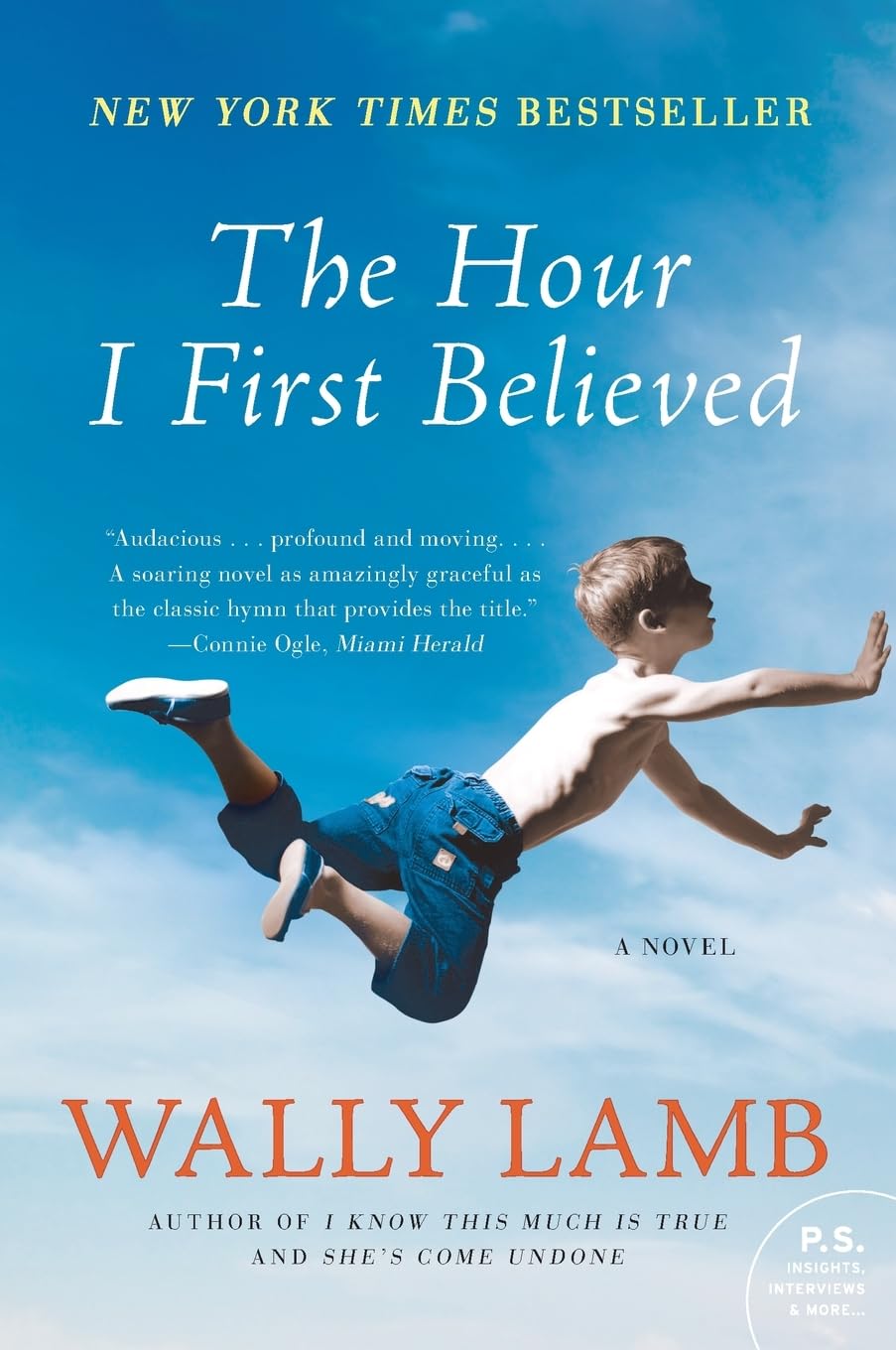
  • The Day I First Believed—Wally Lamb

    Former Oprah Book Club golden boy Wally Lamb took his time writing his third novel, The Day I First Believed, a harrowing look at violence and the effect it has on those caught in its collateral snare. Lamb’s much anticipated follow-up to 1998’s I Know This Much is True is an engaging, terrifying, and at times, nauseating rollercoaster ride, even going as far as to include the feeling when the ride suddenly stops and you kind of lurch out toward the parking lot, dizzy, discombobulated, and trying not to hurl.

    The first half of The Day I First Believed deals with the real world events of the 1999 massacre at Columbine High School. The novel’s protagonist, Caelum Quirk and his wife Maureen both work at the school, although Caelum is called away by the imminent death of an aunt on the East Coast and Maureen is left to live through the shooting on her own. She does survive, but is seriously psychologically traumatized by the experience.

    I remember when the shooting happened, and like everyone, I was shaken up, but I had already been out of high school for 15 years at the time and I think the immediacy of what happened was a little lost on me. Ten years later, I found myself back on campus, this time as a teacher, and the impact of Lamb’s narration scared the living shit out of me.

    Lamb uses snatches of diary entries, news reports, and transcripts of the taunting videos the two gunmen made before going on their rampage to good effect in the first half of the book, it’s in the second half when he resorts to a similar technique to introduce side plots dealing with the Quirk family history that the whole thing lurches to a halt.

    Dana and I saw Lamb speak at Corte Madera’s Book Passage after I had finished the novel, but she hadn’t. I was hoping to glean some sort of insight into what Lamb was trying to do with the second half of this novel, without standing up and asking him straight up, “What the hell?”

    We both found Lamb to be very personable, engaging, and a great storyteller. He mentioned the idea of the labyrinth as the story’s overarching metaphor, and personally, I think he became a little lost in his own maze.

    He mentioned how he inhabits his characters when he is writing, and if what I experienced just reading the first half of the novel is any indication of what that must have been like, perhaps he wandered a little off the reservation. I hope he makes it back.

  • Superworse—Ben Greenman

    If there is one thing you could say about this slowly aging, psychedelically dented, slightly cynical romantic, it’s that I likes me some metafiction. When Dave Eggers and his crew started up McSweeney’s back in ’98, I thought I had died and gone to a well-lighted, non-denominational heaven (which for some reason, looked a lot like Portland).

    Author Ben Greenman is an editor at the New Yorker and apparently indulges his non-monocled side writing for indie cred publications like McSweeney’s and Nerve. His 2004 novel, Superworse, is supposedly a paperback “remix” of his 2001 hardback effort, Superbad. It’s hard to know to what extent this is true as the novel itself is a Gordian knot of self-reference and too-clever-by-half literary winks and nods. Just the way I like ’em.

    Without giving too much away, the conceit of Superworse is that an old instructor of Greenman’s, one Laurence Onge, is asked to edit the original novel for the soft cover release by Soft Skull Press. Onge is a bit of a megalomaniac and sees references to his history with the author under every well-turned phrase. Onge had gone as far to impose a series of Greenman’s musical numbers onto the earlier version of the book, which have been removed here “at the request of the author.”

    When Greenman quits shuffling the cards and playing with the intricate structure of the 19 chapters of the book, he writes a good short story. Pieces like the twice-removed western, The Theft of a Knife, or the 13th century Florintine political drama, No Friend of Mine, show Greenman’s gift for set and setting, as well as psychological abstraction. Even the more traditionally structured stories in Superworse all leave the reader with a faint sense of unease. Nothing in Greenman’s stories is ever really resolved; we are only seeing as much of the drama as the author thinks we need to see.

    The feeling of vertigo is muted in shorter, McSweenyesque, sketches like, Notes on Revising Last Night’s Dream, and the superlative, What 100 People, Real, and Fake, Believe about Dolores, which masterfully maps the rise and fall of a relationship through short observations from friends, historical and literary figures, and… Superman, who simply believes “that the underwear she wore was the same as the underwear that Lois Lane wore.”

    To illustrate the extent that Greenman, or Onge, or Greenman/Onge has gone to tie all this together, the first nine chapters and the last nine are separated by a pivotal 10th chapter entitled Notes to a Paper You Wouldn’t Understand in which a series of footnotes thematically echo their corresponding chapters while they ostensibly relate minutiae about an absent piece about… well, who really cares, you get the idea. If this all sounds like your cup of mud, well, I’ll see you at the bar.

    Also by this author:
    What He’s Poised to Do: Stories

  • Put on This Record: Astral Weeks Live at the Hollywood Bowl—Van Morrison [2009]

    On the list of things I never thought I’d see (or hear), Van Morrison revisiting his seminal 1968 album, Astral Weeks, has lived at the top of the leaderboard for more years than I’d care to count.

    Over the years, the Man has developed a thick-skinned persona that holds stardom and the chasing of an easy buck at a disdainful arm’s length. He is not going to be your trained monkey, no matter how badly you might want it. You want another Moondance? Bollocks. I wouldn’t presume to ask Morrison to look backward any more than I’d ask for his autograph while getting ice cream at Fusco’s.

    However, a closer read of his journey reveals threads that tie disparate pieces of his career together, an ever-present turning toward certain tropes: the streets of Belfast, the green hills and mountain streams of an Irish dream state, a town called Paradise; it all weaves together to create one of the richest imaginary tapestries of any artist living or dead.

    Morrison has said he has always wanted to properly record this group of songs with a string section—the way he heard it in his head back in ’68. Right off the top, the violin prominently featured on the lead track, Astral Weeks, adds to the sonorous gravitas of the original.

    The master’s voice has deepened with age and has taken on more of the characteristics of a band instrument—at times honking like a tenor sax, at others, vibrating and humming low like a cello cradled between the legs of a ginger lass, or more appropriately, an aging Dublin transvestite.

    Which leads me to the most striking difference between the original album and the new performance: the sequence. Morrison has shifted around the order of songs, which fits the dream-like nature of the record. Astral Weeks always struck me as ephemeral, the more you tried to grab it on to it and put it in a box, the more likely it was to turn to smoke.

    To me, the two final songs after Madame George always felt like a coda, or a post-coital afterglow. In any case, coming right after such a masterful vision of humanity at its most exposed and fragile, they weren’t exactly in the best light to be recognized as the subtle masterpieces that they are.

    Slim Slow Slider and Ballerina are recast here as shamanistic trance state-inducing chants guiding the listener toward the heavy hitters of Sweet Thing and Madame George respectively and the state of bliss that Astral Weeks always promised.

    I’m not going to ruin the surprise of all of the little tweaks and changes that Morrison has made to these songs. The hungry 22-year-old singer-songwriter had become a 62-year-old veteran by this time, and some perspective was bound to creep in.

    Half the fun of diving into the updated versions is comparing them to old mental tapes earned from spinning the original record hundreds, or possibly thousands, of times over the years.

    It’s rare for an artist to fully grasp what a particular work means to its admirers—to be able to put his or herself outside a personal memory of the process and see what others see, hear what others hear. I’ve read interviews in which Morrison claimed to not know where these songs came from, and listening to these fresh interpretations, I tend to believe him.

  • Gun, with Occasional Music—Jonathan Lethem

    One of my favorite things about Jonathan Lethem’s work is the sense of fun he imparts when playing with the expectations of genre. His first novel, Gun with Occasional Music, takes the noir of Dashiell Hammett and Raymond Chandler and fuses it with the dystopian science fiction of Philip K. Dick and William Gibson, with a little William S. Burroughs thrown in for leavening.

    The life of Gun’s protagonist, futuristic flat foot Conrad Metcalf, gets complicated when his client on a simple peep job ends up murdered. The problem compounds exponentially when the number one suspect, after Metcalf himself, shows up to hire the detective to find the real killer.

    This brings unwanted heat from the Inquisitor’s Office, an all-seeing, not-so-secret police force that has the power to remove “karma points” from citizens as they see fit. To let one’s karma fall to zero is to become a non-person and awards the unlucky a trip to the (literal) freezer. Further complicating matters, is the fact that everyone is hooked on the government-supplied drugs “Forgettol” and “Acceptol” which makes getting a straight answer from anyone an interesting challenge.

    Not satisfied with a run-of-the-mill paranoid run through one of our possible paths, Lethem ups the ante with super-evolved talking animals, including a gun-toting kangaroo (inspired by a Chandler quote reproduced at the top of the story), a concubine sheep, and disturbing “babyheads,” human toddlers who have had the same mutagenic fast-forward applied to them, making them little alcoholic fatalist assholes. Which tracks.

    In 2020, literally moments before COVID fucked everything sideways, the movie trades were abuzz with news that the book was under development for a television series. Johan Renck, best known for his harrowing Chernobyl, was named as director, with Jason Bateman’s Aggregate Films producing. It has been crickets since then, however.

    Talking kangaroos and the like are tricky to pull off without looking ridiculous, and like the creatures in David Cronenberg’s 1991 take on Burroughs’ Naked Lunch, perhaps left to the individual widescreens in our heads.

    Also by this author:
    Chronic City: A Novel
    The Wall of the Sky, the Wall of the Eye

  • The Pill Versus the Springhill Mine Disaster—Richard Brautigan

    I was a huge Richard Brautigan fan in my early 20s and I spent many rainy days haunting the used bookstores of the Pacific Northwest looking for any of his books I might of missed. Come to think of it, I still can’t imagine a better way to spend a rainy day at any age. As anyone who has read at least one Brautigan can tell you, he can be fantastically whimsical, childishly naïve, brilliantly insightful, and seriously depressed; sometimes all at once.

    While some of Brautigan’s poetry reads very much like a product of its time (1957–68), it’s also quite often outside of time—almost Zen in its simplicity and directness. As I’ve gotten older I had almost let slip the sublime memory of giving a copy of Your Catfish Friend to a girl I figured needed to read it. I remember thinking that Brautigan had captured exactly how I felt and that he must have written the poem just to give me the words to express myself at that moment. Sadly, I don’t recall it having any great effect, which may have had something to do with why he was chronically bummed out.

    It’s a small step from recognizing the potential power of the right words and a little insight in someone else’s work and trying your own hand at writing. I can blame Brautigan as much as anyone for giving me the idea that I could write poetry, kind of the same influence that Mike Watt would have on my music a little later on.

    Start your own band. Write your own poem. Be someone’s catfish friend.