Tag: book-review

  • The Day I First Believed—Wally Lamb

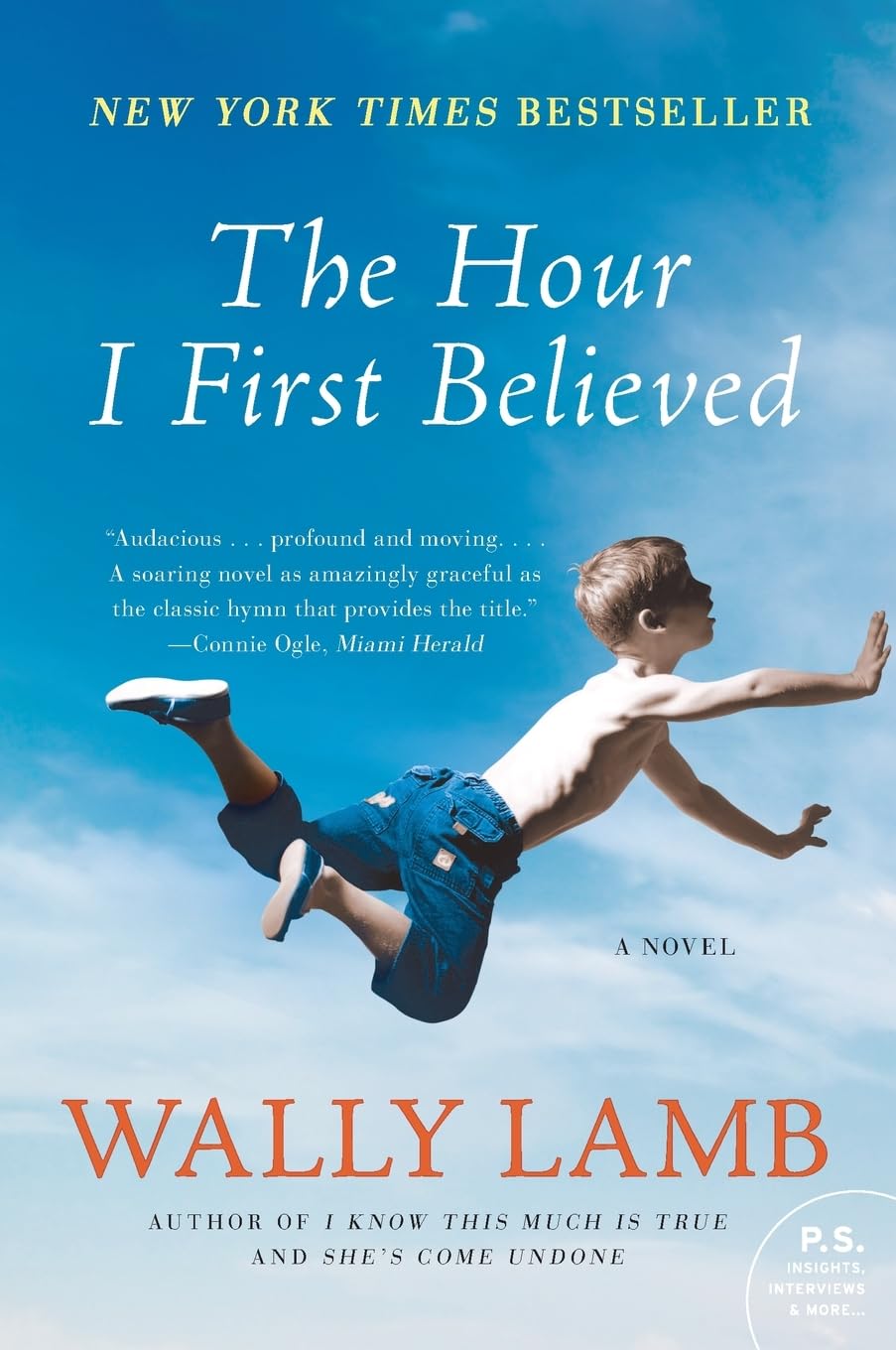
    Former Oprah Book Club golden boy Wally Lamb took his time writing his third novel, The Day I First Believed, a harrowing look at violence and the effect it has on those caught in its collateral snare. Lamb’s much anticipated follow-up to 1998’s I Know This Much is True is an engaging, terrifying, and at times, nauseating rollercoaster ride, even going as far as to include the feeling when the ride suddenly stops and you kind of lurch out toward the parking lot, dizzy, discombobulated, and trying not to hurl.

    The first half of The Day I First Believed deals with the real world events of the 1999 massacre at Columbine High School. The novel’s protagonist, Caelum Quirk and his wife Maureen both work at the school, although Caelum is called away by the imminent death of an aunt on the East Coast and Maureen is left to live through the shooting on her own. She does survive, but is seriously psychologically traumatized by the experience.

    I remember when the shooting happened, and like everyone, I was shaken up, but I had already been out of high school for 15 years at the time and I think the immediacy of what happened was a little lost on me. Ten years later, I found myself back on campus, this time as a teacher, and the impact of Lamb’s narration scared the living shit out of me.

    Lamb uses snatches of diary entries, news reports, and transcripts of the taunting videos the two gunmen made before going on their rampage to good effect in the first half of the book, it’s in the second half when he resorts to a similar technique to introduce side plots dealing with the Quirk family history that the whole thing lurches to a halt.

    Dana and I saw Lamb speak at Corte Madera’s Book Passage after I had finished the novel, but she hadn’t. I was hoping to glean some sort of insight into what Lamb was trying to do with the second half of this novel, without standing up and asking him straight up, “What the hell?”

    We both found Lamb to be very personable, engaging, and a great storyteller. He mentioned the idea of the labyrinth as the story’s overarching metaphor, and personally, I think he became a little lost in his own maze.

    He mentioned how he inhabits his characters when he is writing, and if what I experienced just reading the first half of the novel is any indication of what that must have been like, perhaps he wandered a little off the reservation. I hope he makes it back.

  • Superworse—Ben Greenman

    If there is one thing you could say about this slowly aging, psychedelically dented, slightly cynical romantic, it’s that I likes me some metafiction. When Dave Eggers and his crew started up McSweeney’s back in ’98, I thought I had died and gone to a well-lighted, non-denominational heaven (which for some reason, looked a lot like Portland).

    Author Ben Greenman is an editor at the New Yorker and apparently indulges his non-monocled side writing for indie cred publications like McSweeney’s and Nerve. His 2004 novel, Superworse, is supposedly a paperback “remix” of his 2001 hardback effort, Superbad. It’s hard to know to what extent this is true as the novel itself is a Gordian knot of self-reference and too-clever-by-half literary winks and nods. Just the way I like ’em.

    Without giving too much away, the conceit of Superworse is that an old instructor of Greenman’s, one Laurence Onge, is asked to edit the original novel for the soft cover release by Soft Skull Press. Onge is a bit of a megalomaniac and sees references to his history with the author under every well-turned phrase. Onge had gone as far to impose a series of Greenman’s musical numbers onto the earlier version of the book, which have been removed here “at the request of the author.”

    When Greenman quits shuffling the cards and playing with the intricate structure of the 19 chapters of the book, he writes a good short story. Pieces like the twice-removed western, The Theft of a Knife, or the 13th century Florintine political drama, No Friend of Mine, show Greenman’s gift for set and setting, as well as psychological abstraction. Even the more traditionally structured stories in Superworse all leave the reader with a faint sense of unease. Nothing in Greenman’s stories is ever really resolved; we are only seeing as much of the drama as the author thinks we need to see.

    The feeling of vertigo is muted in shorter, McSweenyesque, sketches like, Notes on Revising Last Night’s Dream, and the superlative, What 100 People, Real, and Fake, Believe about Dolores, which masterfully maps the rise and fall of a relationship through short observations from friends, historical and literary figures, and… Superman, who simply believes “that the underwear she wore was the same as the underwear that Lois Lane wore.”

    To illustrate the extent that Greenman, or Onge, or Greenman/Onge has gone to tie all this together, the first nine chapters and the last nine are separated by a pivotal 10th chapter entitled Notes to a Paper You Wouldn’t Understand in which a series of footnotes thematically echo their corresponding chapters while they ostensibly relate minutiae about an absent piece about… well, who really cares, you get the idea. If this all sounds like your cup of mud, well, I’ll see you at the bar.

    Also by this author:
    What He’s Poised to Do: Stories

  • Gun, with Occasional Music—Jonathan Lethem

    One of my favorite things about Jonathan Lethem’s work is the sense of fun he imparts when playing with the expectations of genre. His first novel, Gun with Occasional Music, takes the noir of Dashiell Hammett and Raymond Chandler and fuses it with the dystopian science fiction of Philip K. Dick and William Gibson, with a little William S. Burroughs thrown in for leavening.

    The life of Gun’s protagonist, futuristic flat foot Conrad Metcalf, gets complicated when his client on a simple peep job ends up murdered. The problem compounds exponentially when the number one suspect, after Metcalf himself, shows up to hire the detective to find the real killer.

    This brings unwanted heat from the Inquisitor’s Office, an all-seeing, not-so-secret police force that has the power to remove “karma points” from citizens as they see fit. To let one’s karma fall to zero is to become a non-person and awards the unlucky a trip to the (literal) freezer. Further complicating matters, is the fact that everyone is hooked on the government-supplied drugs “Forgettol” and “Acceptol” which makes getting a straight answer from anyone an interesting challenge.

    Not satisfied with a run-of-the-mill paranoid run through one of our possible paths, Lethem ups the ante with super-evolved talking animals, including a gun-toting kangaroo (inspired by a Chandler quote reproduced at the top of the story), a concubine sheep, and disturbing “babyheads,” human toddlers who have had the same mutagenic fast-forward applied to them, making them little alcoholic fatalist assholes. Which tracks.

    In 2020, literally moments before COVID fucked everything sideways, the movie trades were abuzz with news that the book was under development for a television series. Johan Renck, best known for his harrowing Chernobyl, was named as director, with Jason Bateman’s Aggregate Films producing. It has been crickets since then, however.

    Talking kangaroos and the like are tricky to pull off without looking ridiculous, and like the creatures in David Cronenberg’s 1991 take on Burroughs’ Naked Lunch, perhaps left to the individual widescreens in our heads.

    Also by this author:
    Chronic City: A Novel
    The Wall of the Sky, the Wall of the Eye

  • What He’s Poised to Do: Stories—Ben Greenman

    Ben Greenman’s wistful collection of short stories, What He’s Poised to Do, begins at a remove. For a book that both posits and ponders the importance of interpersonal communication, Greenman chooses to keep readers at arm’s length—at least until he’s gotten to know you better. His use of characters identified only by third-person pronouns in the title piece underlines the faceless isolation that an unhappy businessman out on the road feels as he engages in a cool affair with a woman who works at his hotel.

    There is an echo of the relationship between Lydia and Ricardo Reis in Jose Saramago’s The Year of the Death of Ricardo Reis in that even within an ongoing carnal relationship, Greenman’s guest remains alienated from everyone to a debilitating extent. The businessman’s one remaining open conduit of exchange is the series of postcards he writes the woman, his wife, and his son. Even this method of expressing his feelings stumps him at the end of the story, revealing that Greenman’s title is, if not ironic, then overly optimistic.

    “He sits down at the desk, finds a pen, and holds it over a postcard, uncertain exactly what he’s poised to do.”

    Greenman underscores this theme throughout the collection by postmarking the first page of each story, indicating the date and place from which it was sent. Even a cursory glance at the contents page gives the reader a pretty good idea of the breadth of Greenman’s stages for his universal passion play; settings range from North Africa, in 1851, to Atlanta, in 2015, and everywhere (and when) in between—including the imagined Lunar City, in 1989, and the confounding Australindia, in 1921.

    One standout piece, To Kill the Pink, is written from Harlem in 1964 at a time when both racial and personal boundaries were burning. Greenman writes as an African-American man who, after a tragic incident, decides to travel to Malawi to better understand his heritage and the extraordinary woman he loves. When he asks her how a “twenty-four-year-old black girl who’s never been out of New York City” knows so much about the world, she replies, “I always paid attention… while you were busy studying the human comedy, I was trying to figure out the human drama.”

    “You’re the sad mask; I’m the happy mask,” he answers. “Takes both of us to put on a play.”

    While Greenman’s gift for whimsy does surface from time-to-time, owing perhaps to the impossibility to cage such a formidable beast, he is wearing his sad mask for much of What He’s Poised to Do.

    “I write often about sadness and loneliness … the only cure, I think, is intimacy,” Greenman writes in About the Author, “which is what the people in my stories are struggling to achieve.”

    It is telling that Greenman’s stories revolve around written correspondence, a form of communication quite possibly in danger of becoming archaic. How will future generations understand us, or how will we ultimately understand ourselves, if our written interactions diminish to texts scattered on the digital wind?

    If there is a lesson to be had from this book, it’s this: Go write a letter to someone you love.

    Also by this author:
    Superworse

  • Gentleman of the Road: A Tale of Adventure—Michael Chabon

    Since he left the smoky environs of Pittsburg behind, transplanted Berkeley author Michael Chabon has evolved into quite a chameleon—trying out genres in the same way the rest of us might try on hats. His preceding novel, The Yiddish Policemen’s Union, was all about the fedora. With Gentlemen of the Road, Chabon was looking for something a little more… exotic.

    With a scant page count of 200-and-change, Gentlemen is no more than a palate cleanser by Chabonian standards. Its brevity does give the book a momentum that carries its relatively thin conceit forward, whereas a heavier tome may have collapsed under its own weight.

    Chabon’s inspiration for the story was outlined in his working title for the book: Jews with Swords. With Gentlemen, Chabon shoots for an adventure in the old-school style of Robert Lewis Stevenson or Burroughs (Edgar Rice, that is—decidedly not William S. or Augusten).

    The wonderfully rendered illustrations by Prince Valiant artist Gary Gianni help make that classic connection. His depiction of the gaunt, chapeau-obsessed Zelikman with his sword-sized surgical tool (since Jews, by Frankish law, weren’t allowed to bear arms in 950), and his partner in crime—the massive Abyssinian Amram and his ever-present Viking battle axe—took me back to the hours I spent lost in vintage editions of Treasure Island and Defoe’s Robinson Crusoe that my grandmother had stashed in her basement.

    My only complaint with Gentlemen is that Chabon seems to be writing by-the-numbers at times. Whereas, I have often been flat-out amazed by his imaginative plot twists, this project seems satisfied to inhabit an exotic landscape and then defer to the dictates of genre. Unless, and I don’t think this was hinted at, the spiritual leader of the Khazars foresaw the entire chain of events—from the fall of the original leader, or bek, onward—and orchestrated them to ensure… well, you’ll just have to read it yourself.

    Random House Books

    Also by this author:
    The Yiddish Policemen’s Union: A Novel

  • The Wall of the Sky, the Wall of the Eye—Jonathan Lethem

    This collection of short stories from Berkeley-by-way-of-Brooklyn writer Jonathan Lethem explores the same sort of absurdist science fiction landscape as his novel Amnesia Moon. These seven pieces show the depth and breadth of Lethem’s creativity as he explores the outer reaches of genre.

    The stories that were previously printed in Asimov’s Science Fiction magazine are among the standouts in this collection and speak both to the editor’s catholic (small c) tastes and Lethem’s ability to inhabit vastly different worlds and report back with chilling clarity.

    The Happy Man—the lead off tale of a guy who spends half his time in Hell and the other half trying to make up with his increasingly distant wife and troubled teenage son—sets the tone for the volume. In this troubling story, the reappearance of a ne’er-do-well uncle in his Earth-bound life begins to draw the two worlds into closer proximity. Lethem telegraphs his final blow but it is devastating all the same. The story stays with the reader and reveals the barely-disguised malice in our classic fairy tales.

    Vanilla Dunk, is a slightly futuristic story of professional basketball in a time where the sport is in an advanced state of atrophy and has begun to consume itself like a snake eating its own tail. Powered exosuits give players the sampled skills of the greatest athletes of all time, turning the game into a live fantasy league.

    Lethem uses the post-sport spectacle to probe the issues of race (when a white hotshot draws the much-vaunted skills of Michael Jordan) and fame like a tongue returning to the socket of a broken tooth. This is quite a different tale than The Happy Man and it’s a testament to Lethem’s deft touch that one doesn’t need an understanding, or fondness for that matter, of basketball to enjoy it.

    Not every story in The Wall of the Eye is a slam dunk, but the penultimate tale, The Hardened Criminals, shows what an incredible imagination Lethem possesses. To give away the story’s main conceit would be a crime in and of itself, but it ends up being a chilling indictment of the prison industry and the way that it is designed to strip away the humanity of those stupid, crazy, or unlucky enough to fall under its purview.

    Lethem is a prolific novelist as well as short story writer and at times his prose reads dangerously close to poetry as in this introduction of the prison in The Hardened Criminals:

    The prison was an accomplishment, a monument to human ingenuity, like a dam or an aircraft carrier. At the same time the prison was a disaster, something imposed by nature on the helpless city, a pit gouged by a meteorite, or a forest-fire scar.

    Harcourt Brace & Co.

    Also by this author:
    Chronic City: A Novel
    Gun with Occasional Music

  • Memory Wall: Stories—Anthony Doerr

    One of the elusive pleasures of reading is discovering an author that has somehow slipped through your own personal cracks, a writer that once found, seems to have been working just for you all along, you were just too busy or preoccupied to notice.

    The best part of finally finding each other, even if unbeknownst to the other party, is much the same as in any new relationship; there are stories to be told, histories to be learned—the literary equivalent of a new continent to be explored.

    In Anthony Doerr’s case, the quest covers the entire globe—poking into corners of the world you may have missed. Doerr’s collection of short stories, Memory Wall, wanders from South Africa to Wyoming, from a Korean no man’s land to a soon-to-be flooded Chinese village, and from post-Soviet Lithuania to the horror of World War II Germany.

    As far-flung as his narratives may be, there remains a common human thread that keeps all places from seeming alien, or so very different from home.

    This collection is bookended by two novellas dealing with two very different women at the end of their respective lives. The title piece carefully extends a toe into the realm of science fiction as a suburban Cape Town resident—suffering from Alzheimer’s—desperately tries to hang on to her memories by having them recorded on discs to be played back at will.

    The “memory wall” is both the disorganized map-cum-art project that she constructs in an attempt to make sense of a life quickly becoming a series of digitized vignettes as well as the literal rock cliffs that her late amateur paleontologist husband prowled, searching for proof of a deeper permanence.

    The story takes an unexpected turn when two men break into the woman’s house to play through her memories looking for clues to a major find that her husband may have made right before he died. The men soon figure out that it’s pretty easy to burglarize someone who isn’t going to remember that you were there. The subtext of a cultural power imbalance becomes glaringly apparent as the younger of the two men experiences the woman’s disconnected memories.

    We soon learn that she wasn’t all that nice of a person, which was an interesting way for Doerr to go since, up until then, we were feeling quite sorry for the woman. At that point, loyalties realign, and the young man becomes the hero/sacrificial lamb to root for.

    The final story, Afterworld, is a ghost story of sorts and deals with a Holocaust survivor whose epileptic fits have given her a window into another world that has both sustained and haunted her throughout her life. A Jewish orphan in Hamburg at the worst possible time to be either of those things, Esther Gramm’s out-of-body experiences afford her insights that the other orphan girls don’t fully appreciate until it is much too late.

    While having a fit, she has a vision of the bleak future and brings back an explanation of how other people’s memories keep us tethered to this world, “In another world, folded inside the living world, we wait. We wait until everyone who knew us as children has died. And when the last one of them dies, we finally die our third death.”

    Not everything is grim, however, as Esther also catches a glimpse of those ready to move on, an encampment of pilgrims in tents on the edge of a great forest, and sharing this vision ultimately saves her life. Of course, since she remains living, the girls who were murdered by the Nazis are stuck waiting around in a bombed-out limbo, trying in vain to contact her.

    Alone with the aged Esther, her nephew Robert gets her to share her memories of the war for a thesis project he is supposed to be working on, and finally becomes a hero in his own right at the end of the story and Esther’s life.

    Memory is the thread that connects all of the stories in Doerr’s book in much the same way it connects everyone in real life. Whether you cherish them, are losing them, or are haunted by them, memories are what make us who we are as well as what makes the world itself.

    “Every hour, Robert thinks, all over the globe, an infinite number of memories disappear, whole glowing atlases dragged into graves. But during that same hour children are moving about, surveying territory that seems to them entirely new. They push back the darkness; they scatter memories behind them like bread crumbs. The world is remade.” Poetry.

    Scribner

  • Chronic City: A Novel—Jonathan Lethem

    Jonathan Lethem, Brooklyn native and de-facto chronicler of life in the borough, caught a lot of flak for placing his novel Don’t Love Me Yet (gasp!) in Los Angeles. In Chronic City he casts his gaze back to the city that never sleeps, although his version of Manhattan is, as you might imagine, a little off beam.

    Lethem has a gift for blending literary genres. His fiction always has a smattering of science fiction; his noir, a shadow of the metaphysical. In between 2007’s geographically-maligned book and this novel, he even took a stab at reviving the forgotten superhero, Omega the Unknown for Marvel Comics, and it is the comic book that informs this novel; it’s characters are, by choice, two-dimensional, and play out all the necessary New York archetypes against a flat back drop of apartments, diners, taxi cabs, and improbable not-so-random violence.

    The novel’s protagonist is an empty vessel named Chase Insteadman, a former child actor who lives off of royalties and making the scene with Manhattan’s rich and even richer. His latest claim to fame, and the one that instills him at all the important parties, is his engagement to an astronaut who is marooned on the International Space Station due to a carpet of space mines that have been sowed underneath its orbit by the Chinese.

    Like a lot of things in the novel, this is taken for granted and nobody seems that interested in doing anything about it. Perhaps, and just perhaps, this is Lethem’s dig at the place the international community finds itself in relation to China’s rising prominence on the world stage. At this point, what could we do if they decided to mine the heavens? Write a strongly worded letter? Stop buying… oh, I don’t know, everything? Tariffs?

    Insteadman’s “lostronaut” writes him letters that are reproduced in The New York Times (albeit in the War-Free edition that seems to be favored by most) so that most people know more about what is going on than he does. Insteadman’s problem is that he can’t quite remember his fiancé or how he became an ornamental table setting.

    There are clues from the beginning that all is not right with Lethem’s island, for one, Lower Manhattan has been enveloped in a mysterious dense fog that never dissipates. Like Don DeLillo’s “air-borne toxic event,” there is a disconnect between what’s real and what is simulated. Infinite Jest by David Foster Wallace (whose position, as the Roy E. Disney Professor in Creative Writing at Pomona, Lethem inherited) has become Obstinate Dust by Ralph Warden Meeker, another overly long book that no one finishes.

    The Muppets have become Gnuppets, which may just be a wink at Gnosticism, loosely defined by Wikipedia as “consisting of various belief systems generally united in the teaching that the material cosmos was created by an imperfect god.” The root of Gnostic belief, gnosis, is further defined as “a form of mystic, revealed, esoteric knowledge through which the spiritual elements of humanity are reminded of their true origins within the superior Godhead, being thus permitted to escape materiality.”

    Insteadman’s catalyst, and a fount of esoteric knowledge, is Perkus Tooth, a stand-in for an aspect of Lethem’s own personality in much the same way as Kilgore Trout took the heat for Kurt Vonnegut. Tooth is a twitchy, well-stoned cartoon in the Lester Bangs mold, and although he bristles at being called a rock critic, is as remembered for a stint at Rolling Stone than for a series of intellectual commando-style broadsides that papered the Bowery back in the day.

    The chronic in the novel’s title, is an allusion to the high-grade marijuana that Tooth, Insteadman, and a former activist-turned-mayoral-fixer, Richard Abneg, imbibe with stunning regularity. The trio’s pot-driven cultural insights and conspiracy theorizing are either the best parts of the book, or the worst, depending on one’s own proclivities. I, for one, loved Tooth’s Marlon Brando obsession and manic drive to “connect the dots.”

    Almost exactly halfway through the book, a game-changing possibility is introduced that ties directly into Gnostic belief and, like religion, either explains everything or nothing at all. Tooth’s homeless associate, Biller, finds work designing “treasure” for a virtual universe called Yet Another World, created in turn by Linus Carter, a brilliant but socially inept designer—an imperfect god.

    A description of Carter’s online universe reads like a Lonely Planet guide to Manhattan itself, a “… paraphrase of reality which welcomed role-players, entrepreneurs, sexual trollers, whatever.” The line between real and unreal becomes even more blurred as Insteadman realizes that “Yet Another World wasn’t the only reality that was expansible. Money has its solvent powers…”

    In the end, our empty hero comes to realize it doesn’t really matter if the island that he knows is indeed real, or if anything actually exists on the other side of the Lincoln Tunnel. He learns the hard way that what is important is the real relationships that we form with other travelers.

    As for Tooth, he is finally permitted to escape the Material World through losing everything and finally finding a kindred spirit, in this case a massive three-legged pit bull named Ava. The dog continues to work healing magic on Insteadman after his own collapse into his own footprint.

    Having inherited the responsibility of walking her, he finally abandons Manhattan’s ubiquitous taxis for a street-level view of his realm. “… it occurred to me how Ava’s paces, her bold and patient pissings, must have been immensely comforting to Perkus, and in a sense familiar. Ava’s a kind of broadsider herself, famous within a circle of correspondents, invisible to those who don’t care.”

    Knopf Doubleday Publishing Group

    Also by this author:
    Gun with Occasional Music
    The Wall of the Sky, the Wall of the Eye
  • When That Rough God Goes Riding: Listening to Van Morrison—Greil Marcus

    Funnily enough, considering the subject and theme of this book, reading übercritic Greil Marcus is a lot like listening to Van Morrison. The experience can be illuminating, frustrating, transcendent, and solipsistic—often in the same paragraph or song.

    Like Morrison, Marcus has been following his own path for quite some time, and anyone who has a passing familiarity with either of them will always be able to find the gold hidden down a backstreet or way up top a flight of fancy.

    My struggle with Marcus is that his exhortations can be the definition of pedantic, referencing far-flung obscure artists and works in order to make a point that no one can truly argue with, having no idea who or what he’s is talking about.

    On the other hand, like listening to Morrison himself, if you’re willing to put in the work, you can be turned on to artists, books, movies, etc. that may later become indispensable to your life. What Marcus does here is doubly off-putting, as he spends a great deal of time extolling the virtues of tracks and performances of Morrison’s that are unavailable anywhere but bootlegs, a stream that Morrison spends a great deal of energy to dam, enlisting the services of Web Sheriff to scour the internet of any traces of illicit music.

    I was lucky enough to have a copy of the 1971 KSAN Pacific High Studios show which is referenced pretty heavily, but as far as Caledonia Soul Music, which according to Marcus is the key to the whole thing, I’ll just have to take his word for it.

    In this book, Marcus eschews most biographical information, much, I can imagine to Morrison’s relief, only pointing out pertinent signposts along the way. The whole focus is on those moments of unforced transcendence that Marcus believes paint a secret map through the jungle of Morrison’s work. As with any great artist—and to put my cards on the table, I believe Morrison to be one of the greatest singers of the last 40 years—what pieces resonate with your soul at any given time is completely subjective.

    I think Marcus is either trying to be cute, or is just being lazy to discount in one fell swoop everything Morrison put out between Common One in 1980, and Tell Me Something in 1996. Marcus talks about looking for the “yarragh” in Morrison’s performances, that moment that transcends language and artifice to, as Morrison once sang, “get down to the real soul, I mean the real soul, people.”

    To take a page from Marcus’ book if I may refer to a performance now out-of-print and unavailable, as a child of the ’70s I knew Morrison primarily as an AM radio hit maker and it wasn’t until PBS ran Van Morrison The Concert, recorded at New York’s Beacon Theater in 1989, that I was exposed to Morrison the mystic.

    I don’t recall which number he used to launch himself into the “yarragh,” but all of a sudden, he was growling and barking, not like a madman, but like a genius. I remember standing in front of the TV just slack-jawed; this was someone who warranted further investigation. All of a sudden I understood why someone like Morrison would rankle against cheap stardom. It wasn’t the fucking point. This, this is the point. And although Marcus’ examples are personal to his own experience, as far as catching the desperately vital point of it all, we really do see eye-to-eye.

    PublicAffairs

  • The Sirens of Titan: A Novel—Kurt Vonnegut

    I have to admit that the main reason I was aware of Vonnegut’s second novel, written in 1959 right after the launch of the space age, was the trivia night nugget that Jerry Garcia of the Grateful Dead owned the movie rights for years and had actually worked up a script with SNL alum Tom Davis.

    After discovering what an amazing feat of imagination this book is, I can see why self-styled hippie intellectuals like Garcia and Davis were drawn to it. It was quite unlike any other novel, even other Vonnegut books, I have read. At no time while devouring The Sirens of Titan could I ever say to myself, “Oh, I know where this is going.”

    Vonnegut sends up the whims of capitalism with the main character Malachi Constant, the richest man in the world. Constant is a playboy/bon vivant who, for reasons to be revealed, was born with the luck to maintain his lifestyle with very little effort on his part.

    At the beginning of the novel, he is summoned to the mansion of Winston Niles Rumfoord, the first man to fly a private rocket to Mars. Rumfoord is also, or so it’s understood, one of the last—having unwittingly flown into a chrono-synclastic infundibulum, which effectively spread his (and his dog’s) existence throughout sort of a wormhole between the Sun and Betelgeuse. (Now you can start to imagine the types of conversations Garcia and Davis must have had.)

    When Earth happens to transect the glitch, once every 59 days, Rumfoord and his dog materialize at the mansion for a short period of time where he alienates his wife, predicts the future (since he happens to actually be everywhere and when), and generally makes everyone uncomfortable.

    Vonnegut’s description of the first meeting of the two men is a good example of his wonderful use of language in this novel: “Winston Niles Rumfoord’s smile and handshake dismantled Constant’s high opinion of himself as efficiently as carnival roustabouts might dismantle a Ferris wheel.” Granted, this all takes place within the first 20 pages or so.

    Rumfoord (and I couldn’t stop substituting Rumsfeld, especially when we begin to find out how his motives, while being altruistic from his viewpoint, are seriously fucked up) goes on to tell Constant that he will end up traveling to Mars, Mercury, Titan, and end up having a son with Mrs. Rumfoord. Awkward.

    Vonnegut’s savaging of organized religion at the back end of this novel counterbalances his having peeled back the curtain hiding the machinations of the free market in the front. Along the way, Mars attacks, a shipwrecked alien manipulates all of human history in an attempt to get a part, and… just read the damned thing.

    I, for one, don’t need some infundibulated asshat to tell me that I will be revisiting this one again and again.

    Random House Publishing Group