Tag: book-reviews

  • Kingdoms of the Radio: Don’t Poke the Bear (Pt. 2) [ficção]

     “So there we were, at the Canadian border, five of us in a van crammed with instruments and two pounds of the best Humboldt County weed you could imagine,” Cole entertained a captive audience of very stoned fans with tales of adventure and debauchery on the road. “Chalky was the one driving as he hadn’t come on to the acid yet, and we were hoping to make it to Vancouver before he did.”

    Watching Cole from the corner of the dimly lit room through all the hash smoke, cigarette haze, and bullshit, sat a raven-haired 17-year-old with the unlikely appellation, Raenbeaux Starr. Blessed with an unerring sixth sense for trouble, Rosenda watched the girl watch from the opposite side of the room.

    “As soon as we drove up to the booth and the Mountie was giving Chalky the treatment, you know, ‘Where are you going in Canada? How long do you plan to stay? All of that—our fucking bass player lost his hold on reality. He lunged up between the front seats and starting raving and growling, “I’m a monster!”

    Caught up in pantomiming his story, Cole was oblivious to the girl staring a hole into the side of his face.

    “Now, Canadians have a very dry sense of humor,” Cole continued. “The Mountie simply looked at our bassist and asked, ‘Are you carrying any fruits or veg?’ It was all we could do not to just dissolve into maniacal laughter. Somehow, we got waved through and made it far enough down the road so that we could pull over and lose it. I actually pissed myself I was laughing so hard.”

    Rosenda noticed that while most of the assorted hangers-on were laughing at Cole’s story, the young girl in the corner had never shifted her gaze. She was, however, moving closer to the star, carrying with her a massive lit joint.

    The nymphean creature sidled up to Cole and took a huge hit before shotgunning the pungent smoke into his mouth, sensuously brushing his lips with her own. The crowd reacted with a mix of encouragement and bemusement, sparking Rosenda to question the act.

    “What?” she sputtered, the heady atmosphere in the room taking a toll on her faculties. “What’s wrong with that?”

    One of the heads that was sitting cross-legged under a massive purple batik mandala spoke up. “Oh, it’s groovy. It’s just that Raenbeaux’s trip is Angel Dust. You know, PCP? Your man there is gonna be engaged for the next few hours.

    “God damn it!” Rosenda raged. “You fucking idiots, I’m going to lose my job!”

    Back out on the curb, Shane’s thoughts had turned briefly toward wondering what he was going to do about dinner when the front door of the old house slammed open, straining the natural arc of its hinges. A totally nude and raving Lucious Cole took the wooden stairs three-at-a-time and took off down the middle of Webster, an enraged Rosenda in hot pursuit.

    “Bear, just don’t sit, there,” she panted, her legs furiously working her leather pumps in a futile attempt to overtake the flying Cole. “Catch him!”

    Shane took a second to take stock of the situation and then leapt into action. Stepping out of the Lincoln, it took several seconds for the uncharacteristically tall Irish-American to completely unfold his body, but when he did, he loomed in the throw of the streetlight like a pale, fire-topped menhir, or Celtic standing stone.

    “Cole!” he bellowed, his resonant baritone rattling the Navy glass in the loose window frames of the houses. “Not that way, mate! There be dragons!”

    The pinwheel-eyed rock star spun on his bleeding heels and headed straight for the driver who promptly clotheslined him, dropping him to the street.

    “I didn’t say kill him!” Rosenda gasped while catching up to both Cole and her breath.

    Shane quietly took stock of the situation and tossed the gasping woman the keys to the Lincoln’s vast trunk. “Get the rope.”

    “What? You can’t…”

    “Look, Karoline, do you want this guy around or not? In about 60 seconds, he is going to be up and back to playing Johnny-on-the-go. I don’t feel like driving around all night looking for him. Get me the rope.”

    Rosenda didn’t argue any further but retrieved a skein of yellow nylon cord. She began to ask why Shane carried rope, but immediately thought better of it. Besides, she was about to find out.

    With a weary grunt, Bear knelt down next to the unconscious Cole and placed one knee in his back while looping the rope around his wrists. With a deftness that suggested Bear might have either had some experience with animal husbandry or BDSM, he had the rock star hogtied so that no matter what superhuman strength he may temporarily possess; the man was going nowhere.

    “Hey,” a voice called out from the Victorian’s porch where a ragtag crowd had spilled out. “You can’t do that, man! That man has rights!”

    Bear chose to ignore the complaints and focused on wrestling the inert star into the backseat of the Lincoln.

    “Fascist!”

    That turned out to be the wrong tact to take with the former boxer. Although he had been too young to get drawn into the War, Shane had brothers that risked their lives to beat back the tide of extremism in Europe.

    Without saying a word, Shane gently shut the rear suicide door and walked around the front of the car. Once on the sidewalk, the streetlight threw his shadow across the entire front of the house, casting a pall on whatever meager protests were forthcoming.

    “Who said that?” He bellowed.

    “Hey man, you can’t just…” one of the heads started an objection and quickly ran out of steam as Shane stepped up.

    “So it was you?” He loomed.

    The wispy-bearded young man couldn’t have been a hundred and forty pounds soaking wet, but answered the big man’s question without too much tremor in his voice.

    “Yea, it was me… Man.”

    Shane took the young man’s measure as even the traffic on nearby Haight St. seemed to quiet down for once.

    “Good for you,” he finally spoke. “You should always stand up for those who can’t stand up for themselves. That’s what my brothers went to Europe and got their asses shot full of Nazi lead for. I applaud that sentiment, but in this instance, I promise you, your concerns are misplaced.”

    His reassurances delivered, Shane turned and walked back to the car, leaving the group on the porch speechless.

    “What are we going to do with him?” Rosenda asked, getting into the Lincoln’s passenger side.

    “We are going to sit on him until he gets his shit together. I know just the place.”

    “You really clocked him,” she said, peering at Cole over the headrest.

    “That’s why I get the big bucks,” Shane half-joked, while tied up on the backseat, an Englishman far from home dreamt of Elysian Fields.

    Follow the story:
    Kingdoms of the Radio: Serafina’s Gift
    Kingdoms of the Radio: Charlie Perigo 1
    Kingdoms of the Radio: Zongo Kumalo 1
    Kingdoms of the Radio: Karoline Rosenda 1
    Kingdoms of the Radio: Zongo Meets The Stick
    Kingdoms of the Radio: Ride a Painted Pony
    Kingdoms of the Radio: Fadeout (Rock Hound Magazine, 1970)
    Kingdoms of the Radio: Tibetan Bells & a Bird from Hell
    Kingdoms of the Radio: Enrique Bravocado 1

    Kingdoms of the Radio: Zongo Khumalo 2
    Kingdoms of the Radio: Karoline Rosenda 2
    Kingdoms of the Radio: Enrique Bravocado 2
    Kingdoms of the Radio: Don’t Poke the Bear (Pt. 1)

  • Superworse—Ben Greenman

    If there is one thing you could say about this slowly aging, psychedelically dented, slightly cynical romantic, it’s that I likes me some metafiction. When Dave Eggers and his crew started up McSweeney’s back in ’98, I thought I had died and gone to a well-lighted, non-denominational heaven (which for some reason, looked a lot like Portland).

    Author Ben Greenman is an editor at the New Yorker and apparently indulges his non-monocled side writing for indie cred publications like McSweeney’s and Nerve. His 2004 novel, Superworse, is supposedly a paperback “remix” of his 2001 hardback effort, Superbad. It’s hard to know to what extent this is true as the novel itself is a Gordian knot of self-reference and too-clever-by-half literary winks and nods. Just the way I like ’em.

    Without giving too much away, the conceit of Superworse is that an old instructor of Greenman’s, one Laurence Onge, is asked to edit the original novel for the soft cover release by Soft Skull Press. Onge is a bit of a megalomaniac and sees references to his history with the author under every well-turned phrase. Onge had gone as far to impose a series of Greenman’s musical numbers onto the earlier version of the book, which have been removed here “at the request of the author.”

    When Greenman quits shuffling the cards and playing with the intricate structure of the 19 chapters of the book, he writes a good short story. Pieces like the twice-removed western, The Theft of a Knife, or the 13th century Florintine political drama, No Friend of Mine, show Greenman’s gift for set and setting, as well as psychological abstraction. Even the more traditionally structured stories in Superworse all leave the reader with a faint sense of unease. Nothing in Greenman’s stories is ever really resolved; we are only seeing as much of the drama as the author thinks we need to see.

    The feeling of vertigo is muted in shorter, McSweenyesque, sketches like, Notes on Revising Last Night’s Dream, and the superlative, What 100 People, Real, and Fake, Believe about Dolores, which masterfully maps the rise and fall of a relationship through short observations from friends, historical and literary figures, and… Superman, who simply believes “that the underwear she wore was the same as the underwear that Lois Lane wore.”

    To illustrate the extent that Greenman, or Onge, or Greenman/Onge has gone to tie all this together, the first nine chapters and the last nine are separated by a pivotal 10th chapter entitled Notes to a Paper You Wouldn’t Understand in which a series of footnotes thematically echo their corresponding chapters while they ostensibly relate minutiae about an absent piece about… well, who really cares, you get the idea. If this all sounds like your cup of mud, well, I’ll see you at the bar.

    Also by this author:
    What He’s Poised to Do: Stories

  • What He’s Poised to Do: Stories—Ben Greenman

    Ben Greenman’s wistful collection of short stories, What He’s Poised to Do, begins at a remove. For a book that both posits and ponders the importance of interpersonal communication, Greenman chooses to keep readers at arm’s length—at least until he’s gotten to know you better. His use of characters identified only by third-person pronouns in the title piece underlines the faceless isolation that an unhappy businessman out on the road feels as he engages in a cool affair with a woman who works at his hotel.

    There is an echo of the relationship between Lydia and Ricardo Reis in Jose Saramago’s The Year of the Death of Ricardo Reis in that even within an ongoing carnal relationship, Greenman’s guest remains alienated from everyone to a debilitating extent. The businessman’s one remaining open conduit of exchange is the series of postcards he writes the woman, his wife, and his son. Even this method of expressing his feelings stumps him at the end of the story, revealing that Greenman’s title is, if not ironic, then overly optimistic.

    “He sits down at the desk, finds a pen, and holds it over a postcard, uncertain exactly what he’s poised to do.”

    Greenman underscores this theme throughout the collection by postmarking the first page of each story, indicating the date and place from which it was sent. Even a cursory glance at the contents page gives the reader a pretty good idea of the breadth of Greenman’s stages for his universal passion play; settings range from North Africa, in 1851, to Atlanta, in 2015, and everywhere (and when) in between—including the imagined Lunar City, in 1989, and the confounding Australindia, in 1921.

    One standout piece, To Kill the Pink, is written from Harlem in 1964 at a time when both racial and personal boundaries were burning. Greenman writes as an African-American man who, after a tragic incident, decides to travel to Malawi to better understand his heritage and the extraordinary woman he loves. When he asks her how a “twenty-four-year-old black girl who’s never been out of New York City” knows so much about the world, she replies, “I always paid attention… while you were busy studying the human comedy, I was trying to figure out the human drama.”

    “You’re the sad mask; I’m the happy mask,” he answers. “Takes both of us to put on a play.”

    While Greenman’s gift for whimsy does surface from time-to-time, owing perhaps to the impossibility to cage such a formidable beast, he is wearing his sad mask for much of What He’s Poised to Do.

    “I write often about sadness and loneliness … the only cure, I think, is intimacy,” Greenman writes in About the Author, “which is what the people in my stories are struggling to achieve.”

    It is telling that Greenman’s stories revolve around written correspondence, a form of communication quite possibly in danger of becoming archaic. How will future generations understand us, or how will we ultimately understand ourselves, if our written interactions diminish to texts scattered on the digital wind?

    If there is a lesson to be had from this book, it’s this: Go write a letter to someone you love.

    Also by this author:
    Superworse

  • The Wall of the Sky, the Wall of the Eye—Jonathan Lethem

    This collection of short stories from Berkeley-by-way-of-Brooklyn writer Jonathan Lethem explores the same sort of absurdist science fiction landscape as his novel Amnesia Moon. These seven pieces show the depth and breadth of Lethem’s creativity as he explores the outer reaches of genre.

    The stories that were previously printed in Asimov’s Science Fiction magazine are among the standouts in this collection and speak both to the editor’s catholic (small c) tastes and Lethem’s ability to inhabit vastly different worlds and report back with chilling clarity.

    The Happy Man—the lead off tale of a guy who spends half his time in Hell and the other half trying to make up with his increasingly distant wife and troubled teenage son—sets the tone for the volume. In this troubling story, the reappearance of a ne’er-do-well uncle in his Earth-bound life begins to draw the two worlds into closer proximity. Lethem telegraphs his final blow but it is devastating all the same. The story stays with the reader and reveals the barely-disguised malice in our classic fairy tales.

    Vanilla Dunk, is a slightly futuristic story of professional basketball in a time where the sport is in an advanced state of atrophy and has begun to consume itself like a snake eating its own tail. Powered exosuits give players the sampled skills of the greatest athletes of all time, turning the game into a live fantasy league.

    Lethem uses the post-sport spectacle to probe the issues of race (when a white hotshot draws the much-vaunted skills of Michael Jordan) and fame like a tongue returning to the socket of a broken tooth. This is quite a different tale than The Happy Man and it’s a testament to Lethem’s deft touch that one doesn’t need an understanding, or fondness for that matter, of basketball to enjoy it.

    Not every story in The Wall of the Eye is a slam dunk, but the penultimate tale, The Hardened Criminals, shows what an incredible imagination Lethem possesses. To give away the story’s main conceit would be a crime in and of itself, but it ends up being a chilling indictment of the prison industry and the way that it is designed to strip away the humanity of those stupid, crazy, or unlucky enough to fall under its purview.

    Lethem is a prolific novelist as well as short story writer and at times his prose reads dangerously close to poetry as in this introduction of the prison in The Hardened Criminals:

    The prison was an accomplishment, a monument to human ingenuity, like a dam or an aircraft carrier. At the same time the prison was a disaster, something imposed by nature on the helpless city, a pit gouged by a meteorite, or a forest-fire scar.

    Harcourt Brace & Co.

    Also by this author:
    Chronic City: A Novel
    Gun with Occasional Music

  • Memory Wall: Stories—Anthony Doerr

    One of the elusive pleasures of reading is discovering an author that has somehow slipped through your own personal cracks, a writer that once found, seems to have been working just for you all along, you were just too busy or preoccupied to notice.

    The best part of finally finding each other, even if unbeknownst to the other party, is much the same as in any new relationship; there are stories to be told, histories to be learned—the literary equivalent of a new continent to be explored.

    In Anthony Doerr’s case, the quest covers the entire globe—poking into corners of the world you may have missed. Doerr’s collection of short stories, Memory Wall, wanders from South Africa to Wyoming, from a Korean no man’s land to a soon-to-be flooded Chinese village, and from post-Soviet Lithuania to the horror of World War II Germany.

    As far-flung as his narratives may be, there remains a common human thread that keeps all places from seeming alien, or so very different from home.

    This collection is bookended by two novellas dealing with two very different women at the end of their respective lives. The title piece carefully extends a toe into the realm of science fiction as a suburban Cape Town resident—suffering from Alzheimer’s—desperately tries to hang on to her memories by having them recorded on discs to be played back at will.

    The “memory wall” is both the disorganized map-cum-art project that she constructs in an attempt to make sense of a life quickly becoming a series of digitized vignettes as well as the literal rock cliffs that her late amateur paleontologist husband prowled, searching for proof of a deeper permanence.

    The story takes an unexpected turn when two men break into the woman’s house to play through her memories looking for clues to a major find that her husband may have made right before he died. The men soon figure out that it’s pretty easy to burglarize someone who isn’t going to remember that you were there. The subtext of a cultural power imbalance becomes glaringly apparent as the younger of the two men experiences the woman’s disconnected memories.

    We soon learn that she wasn’t all that nice of a person, which was an interesting way for Doerr to go since, up until then, we were feeling quite sorry for the woman. At that point, loyalties realign, and the young man becomes the hero/sacrificial lamb to root for.

    The final story, Afterworld, is a ghost story of sorts and deals with a Holocaust survivor whose epileptic fits have given her a window into another world that has both sustained and haunted her throughout her life. A Jewish orphan in Hamburg at the worst possible time to be either of those things, Esther Gramm’s out-of-body experiences afford her insights that the other orphan girls don’t fully appreciate until it is much too late.

    While having a fit, she has a vision of the bleak future and brings back an explanation of how other people’s memories keep us tethered to this world, “In another world, folded inside the living world, we wait. We wait until everyone who knew us as children has died. And when the last one of them dies, we finally die our third death.”

    Not everything is grim, however, as Esther also catches a glimpse of those ready to move on, an encampment of pilgrims in tents on the edge of a great forest, and sharing this vision ultimately saves her life. Of course, since she remains living, the girls who were murdered by the Nazis are stuck waiting around in a bombed-out limbo, trying in vain to contact her.

    Alone with the aged Esther, her nephew Robert gets her to share her memories of the war for a thesis project he is supposed to be working on, and finally becomes a hero in his own right at the end of the story and Esther’s life.

    Memory is the thread that connects all of the stories in Doerr’s book in much the same way it connects everyone in real life. Whether you cherish them, are losing them, or are haunted by them, memories are what make us who we are as well as what makes the world itself.

    “Every hour, Robert thinks, all over the globe, an infinite number of memories disappear, whole glowing atlases dragged into graves. But during that same hour children are moving about, surveying territory that seems to them entirely new. They push back the darkness; they scatter memories behind them like bread crumbs. The world is remade.” Poetry.

    Scribner

  • Chronic City: A Novel—Jonathan Lethem

    Jonathan Lethem, Brooklyn native and de-facto chronicler of life in the borough, caught a lot of flak for placing his novel Don’t Love Me Yet (gasp!) in Los Angeles. In Chronic City he casts his gaze back to the city that never sleeps, although his version of Manhattan is, as you might imagine, a little off beam.

    Lethem has a gift for blending literary genres. His fiction always has a smattering of science fiction; his noir, a shadow of the metaphysical. In between 2007’s geographically-maligned book and this novel, he even took a stab at reviving the forgotten superhero, Omega the Unknown for Marvel Comics, and it is the comic book that informs this novel; it’s characters are, by choice, two-dimensional, and play out all the necessary New York archetypes against a flat back drop of apartments, diners, taxi cabs, and improbable not-so-random violence.

    The novel’s protagonist is an empty vessel named Chase Insteadman, a former child actor who lives off of royalties and making the scene with Manhattan’s rich and even richer. His latest claim to fame, and the one that instills him at all the important parties, is his engagement to an astronaut who is marooned on the International Space Station due to a carpet of space mines that have been sowed underneath its orbit by the Chinese.

    Like a lot of things in the novel, this is taken for granted and nobody seems that interested in doing anything about it. Perhaps, and just perhaps, this is Lethem’s dig at the place the international community finds itself in relation to China’s rising prominence on the world stage. At this point, what could we do if they decided to mine the heavens? Write a strongly worded letter? Stop buying… oh, I don’t know, everything? Tariffs?

    Insteadman’s “lostronaut” writes him letters that are reproduced in The New York Times (albeit in the War-Free edition that seems to be favored by most) so that most people know more about what is going on than he does. Insteadman’s problem is that he can’t quite remember his fiancé or how he became an ornamental table setting.

    There are clues from the beginning that all is not right with Lethem’s island, for one, Lower Manhattan has been enveloped in a mysterious dense fog that never dissipates. Like Don DeLillo’s “air-borne toxic event,” there is a disconnect between what’s real and what is simulated. Infinite Jest by David Foster Wallace (whose position, as the Roy E. Disney Professor in Creative Writing at Pomona, Lethem inherited) has become Obstinate Dust by Ralph Warden Meeker, another overly long book that no one finishes.

    The Muppets have become Gnuppets, which may just be a wink at Gnosticism, loosely defined by Wikipedia as “consisting of various belief systems generally united in the teaching that the material cosmos was created by an imperfect god.” The root of Gnostic belief, gnosis, is further defined as “a form of mystic, revealed, esoteric knowledge through which the spiritual elements of humanity are reminded of their true origins within the superior Godhead, being thus permitted to escape materiality.”

    Insteadman’s catalyst, and a fount of esoteric knowledge, is Perkus Tooth, a stand-in for an aspect of Lethem’s own personality in much the same way as Kilgore Trout took the heat for Kurt Vonnegut. Tooth is a twitchy, well-stoned cartoon in the Lester Bangs mold, and although he bristles at being called a rock critic, is as remembered for a stint at Rolling Stone than for a series of intellectual commando-style broadsides that papered the Bowery back in the day.

    The chronic in the novel’s title, is an allusion to the high-grade marijuana that Tooth, Insteadman, and a former activist-turned-mayoral-fixer, Richard Abneg, imbibe with stunning regularity. The trio’s pot-driven cultural insights and conspiracy theorizing are either the best parts of the book, or the worst, depending on one’s own proclivities. I, for one, loved Tooth’s Marlon Brando obsession and manic drive to “connect the dots.”

    Almost exactly halfway through the book, a game-changing possibility is introduced that ties directly into Gnostic belief and, like religion, either explains everything or nothing at all. Tooth’s homeless associate, Biller, finds work designing “treasure” for a virtual universe called Yet Another World, created in turn by Linus Carter, a brilliant but socially inept designer—an imperfect god.

    A description of Carter’s online universe reads like a Lonely Planet guide to Manhattan itself, a “… paraphrase of reality which welcomed role-players, entrepreneurs, sexual trollers, whatever.” The line between real and unreal becomes even more blurred as Insteadman realizes that “Yet Another World wasn’t the only reality that was expansible. Money has its solvent powers…”

    In the end, our empty hero comes to realize it doesn’t really matter if the island that he knows is indeed real, or if anything actually exists on the other side of the Lincoln Tunnel. He learns the hard way that what is important is the real relationships that we form with other travelers.

    As for Tooth, he is finally permitted to escape the Material World through losing everything and finally finding a kindred spirit, in this case a massive three-legged pit bull named Ava. The dog continues to work healing magic on Insteadman after his own collapse into his own footprint.

    Having inherited the responsibility of walking her, he finally abandons Manhattan’s ubiquitous taxis for a street-level view of his realm. “… it occurred to me how Ava’s paces, her bold and patient pissings, must have been immensely comforting to Perkus, and in a sense familiar. Ava’s a kind of broadsider herself, famous within a circle of correspondents, invisible to those who don’t care.”

    Knopf Doubleday Publishing Group

    Also by this author:
    Gun with Occasional Music
    The Wall of the Sky, the Wall of the Eye

  • The Sirens of Titan: A Novel—Kurt Vonnegut

    I have to admit that the main reason I was aware of Vonnegut’s second novel, written in 1959 right after the launch of the space age, was the trivia night nugget that Jerry Garcia of the Grateful Dead owned the movie rights for years and had actually worked up a script with SNL alum Tom Davis.

    After discovering what an amazing feat of imagination this book is, I can see why self-styled hippie intellectuals like Garcia and Davis were drawn to it. It was quite unlike any other novel, even other Vonnegut books, I have read. At no time while devouring The Sirens of Titan could I ever say to myself, “Oh, I know where this is going.”

    Vonnegut sends up the whims of capitalism with the main character Malachi Constant, the richest man in the world. Constant is a playboy/bon vivant who, for reasons to be revealed, was born with the luck to maintain his lifestyle with very little effort on his part.

    At the beginning of the novel, he is summoned to the mansion of Winston Niles Rumfoord, the first man to fly a private rocket to Mars. Rumfoord is also, or so it’s understood, one of the last—having unwittingly flown into a chrono-synclastic infundibulum, which effectively spread his (and his dog’s) existence throughout sort of a wormhole between the Sun and Betelgeuse. (Now you can start to imagine the types of conversations Garcia and Davis must have had.)

    When Earth happens to transect the glitch, once every 59 days, Rumfoord and his dog materialize at the mansion for a short period of time where he alienates his wife, predicts the future (since he happens to actually be everywhere and when), and generally makes everyone uncomfortable.

    Vonnegut’s description of the first meeting of the two men is a good example of his wonderful use of language in this novel: “Winston Niles Rumfoord’s smile and handshake dismantled Constant’s high opinion of himself as efficiently as carnival roustabouts might dismantle a Ferris wheel.” Granted, this all takes place within the first 20 pages or so.

    Rumfoord (and I couldn’t stop substituting Rumsfeld, especially when we begin to find out how his motives, while being altruistic from his viewpoint, are seriously fucked up) goes on to tell Constant that he will end up traveling to Mars, Mercury, Titan, and end up having a son with Mrs. Rumfoord. Awkward.

    Vonnegut’s savaging of organized religion at the back end of this novel counterbalances his having peeled back the curtain hiding the machinations of the free market in the front. Along the way, Mars attacks, a shipwrecked alien manipulates all of human history in an attempt to get a part, and… just read the damned thing.

    I, for one, don’t need some infundibulated asshat to tell me that I will be revisiting this one again and again.

    Random House Publishing Group

  • A Supposedly Fun Thing I’ll never Do Again—David Foster Wallace

    While some authors make you feel stupid for even trying to read them, I’m looking at you, James Joyce, others seem to immediately give the ol’ noggin a boost. While working through this collection of “essays and arguments” by the late David Foster Wallace—sometimes referred to as our generation’s Joyce for his long and obtuse novel Infinite Jest—I made a list of 20 words I had been lamentably unaware of, as well as two that, apparently, he made up: ablated, anaclitic, appurtenance, belletristic, commissure, decoct, enfilade, erumpent, espial, exergue, frottage, hieratic, lalations, otiose, preterite, sedulous, threnody, titivation, ventricose, weltschmerz

    Of those 20 words, I have to say that the most amusing discovery for me was frottage, which I’m sure that some of you already know means, “the act of obtaining sexual stimulation by rubbing against a person or object.” I’m not here to judge; I’m just sayin’. Erumpent is also pretty fun to say, and could actually be onomatopoetic if you were to listen very, very closely.

    As for the two Wallacisms that don’t seem to exist in the English language, some DFW obsessives have pointed out that katexic could be derived from Freud’s katexis referring to “the process by means of which libido energy is tied or placed into the mental representation of a personality, idea, or thing.” In this respect, Wallace’s writing in toto could be viewed as katexic. The energy that must have gone into building such a vocabulary and the means to swing it around as effectively as he did—the creation and subsequent projection of “David Foster Wallace” as a literary force—could easily be imagined as a gloriously sublimated primal urge.

    Plumeocide is another matter. Wordnik member vbogard22 has postulated that “plumeo- could come from the Latin pluma, which means feather or pen [when] added to -cide (Latin, kill) would come to mean something along the lines of ‘death of the pen.’”

    Given Wallace’s tragic end by his own hand, the fact that he may have coined a word for the silencing of a writer is a bit prescient, although I am buoyed by the acknowledgment that the only way to get a writer to shut the hell up is by resorting to plumeocide.

    I was also beguiled, beleaguered, and besotted by Wallace’s use of language, often all at the same time. In much the same way that Wallace thought he was a decent tennis player until he got the opportunity to view the pros in action, I thought that I could, on occasion, craft a clever line. Now I’m reminded that there are players out there operating on a whole different plane.

    I almost forgot to mention that the book is really funny. Cheers to you, DFW, wherever you are.

    Now, about that Goddamned Jest

    Back Bay Books

  • The Romantic Dogs—Roberto Bolaño

    By the time an English translation of Chilean author Roberto Bolaño’s novel The Savage Detectives was finally released in 2007, he had already passed like a glowing comet, having succumbed to a failing liver in 2003. Bolaño’s novel followed every drunken debauch and whim of a group of young Mexico City poets calling themselves visceral realists, but while the prose was beautifully crafted, the book was starkly short on actual poems.

    His biographers make a point of saying that Bolaño’s first love was poetry. Supposedly he only turned to writing novels at the age of 40 after the birth of his son forced him to give up a more bohemian lifestyle. This collection spans his career from 1980 through 1998, the year The Savage Detectives was first published.

    There are many allusions to the novel and, as in much of his work, some of the same territories are traveled, making this a good companion piece to the novel, or visa versa. Several poems deal with the enigmatic figure of a detective, questioning but never solving the seemingly random and unending violence of South America.

    I dreamt of frozen detectives; Latin American detectives who were trying to keep their eyes open in the middle of the dream. I dreamt of hideous crimes and of careful guys who were wary not to step in pools of blood while taking in the crime scene with a single sweeping glance.

    His fascination with forensics would find full flower in 2666, by many accounts, his crowning achievement. At nearly 900 pages, the book is a mammoth project that Bolaño struggled to finish before he died. It is rumored that he even went as far as to postpone a much-needed liver transplant so as to not break stride on his defining work. This struggle is reflected in one of the most moving poems near the end of The Romantic Dogs.

    Muse, wherever you might go I go. I follow your radiant trail across the long night. Not caring about years or sickness. Not caring about the pain or the effort I must make to follow you.

    New Directions

    Also by this author:
    The Insufferable Gaucho
    The Return
    Savage Detectives: A Novel

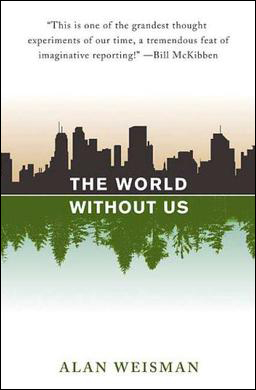
  • The World Without Us—Alan Weisman

    Mr. McGuire: I just want to say one word to you—just one word.
    Ben: Yes sir.
    Mr. McGuire: Are you listening?
    Ben: Yes, I am.
    Mr. McGuire: Plastics.
    Ben: Exactly how do you mean?
    Mr. McGuire: There’s a great future in plastics. Think about it. Will you think about it?
    Ben: Yes, I will.

    While reading Alan Weisman’s fascinating book, The World Without Us, that scene from The Graduate kept playing in my head. Plastics. It turns out that there is a great, or at the very least, long future for all one billion tons of it as it never really breaks down—pieces just become smaller and smaller and by doing so can be swallowed by organisms at the very bottom of the food chain. Which is bad.

    It was frightening to read how quickly plastics have permeated every aspect of our lives (they’ve only been around since the end of World War II), and just how badly we manage what happens to them when we’re done using them. Weisman describes in detail the great wastes of floating plastic that circle the center of each of the world’s oceans.

    There was something about growing up in the waning years of the Cold War that left an indelible mark on the collective imagination of my fellow Gen Xers and myself. We are suckers for stories of our own destruction. Maybe it was the sight of the Statue of Liberty sticking out of the sand at the end of Planet of the Apes, or just the constant fear of nuclear destruction, but as kids, I think most of us had spent some time thinking about what would happen to the world once all of us were gone.

    Weisman looks at all of the things that may benefit from our demise (almost all other species except those that have been domesticated), and all of the things that will simply go to hell without us here to manage them (it turns out that nuclear reactors, refineries, and power plants don’t really run themselves for very long).

    As we all learned in science class and/or the Discovery Channel, water is the one unstoppable force on Earth. You can try to dam it, pump it, or redirect it, but whatever you choose to try and force it to do, you’ve created yourself a full-time job. Without us around to maintain the infrastructure, it will just be a matter of time before rivers undermine and retake the streets of New York, the delta washes away Houston, and, well, we’ve already seen what could happen to New Orleans.

    The book isn’t all doom and gloom, there are very interesting scientific tidbits scattered throughout that I have not encountered anywhere else. His glimpses of the last remaining piece of the primeval forest that once covered Europe made me want to book a flight to the border of Poland and Belarus.

    The human narrative emerging from the Eastern African Rift Valley really points up how we are all really the same, like it or not. For those that will never wrap their minds around that fact, there is the cold comfort that war is actually beneficial for some species, if only by reducing the number of people degrading the environment.

    The amazing return of several endangered animals to the Korean peninsula’s DMZ echoes an idea by environmentalists from The Rewilding Institute who are committed to developing naturalized corridors crossing each of the continents where wildlife could live, migrate, and hopefully, thrive.

    As for humankind, well… we had better get our house in order. To paraphrase Weisman, we choose not to see the biggest elephant in the planet-sized room, although it’s harder and harder to ignore it. Perhaps the last great hope for us is to reduce current population trends before we experience total environmental collapse. It wouldn’t be the first time the Earth has pushed the reset button, and it won’t be the last, it’s just that we are supposed to be the smart ones.

    Every four days, the population of our small planet rises by one million people. If things continue at the current rate of projection, we should reach a mind-blowing total of nine billion people by the middle of this century. According to Dr. Sergei Scherbov from the Vienna Institute of Demography of the Austrian Academy of Sciences and the World Population Program, if families were limited to having only one child, we would be back down to 19th century levels by 2100.

    However, with pronatalism promoters like Elon Musk—14 kids and counting—and Vice President JD Vance pushing the idea that (white) people should have more babies on behalf of the nation, I’m not going to hold my breath.

    Picador Paper