Tag: books

  • Kingdoms of the Radio: Zongo Khumalo 4

    UNFINISHED DOCUMENTARY, KINGDOMS OF THE RADIO  |  1995

    Once we decided to renovate Girassol, I figured I ought to let Mrs. Chaves know what was going on; that way if we ran into a hassle, we would be coming from a place of righteousness.

    I had to go into town and call her from the payphone at Sammy’s. Once I told her that the big house was still standing and in amazingly good condition, she actually wept on the phone. I told her the other buildings were a loss, but she was cool with us building some new ones. There was no electricity out to the property, but the gas lines were somehow still intact and the same company that provided it back when Mrs. Chaves lived there was still around.

    I got her to call the company and let them know that she now owned the property and wanted the gas back on. They said it might take a while since they would have to check the hookups, but it would be all right to put it in my name so that we could pay the bill. In the meantime, we had plenty of firewood from the tear downs.

    In fact, when we finally finished loading in all of the salvaged building materials, a girlfriend of Enrique’s brought out a jug of morning glory wine she had made and we had a huge bonfire.

    The acid-like effects of morning glory seeds was one of those things I had always heard about but never tried as they had a bad reputation for making you really sick as well as really high. For me, there’s nothing worse than losing your lunch while tripping balls, but this chick had figured out a way to extract the good shit and filter out the part that makes you nauseous.

    We were all tired from schlepping salvage all week but also had the mellow feeling of a job well done. We built a big pile of lumber we knew we couldn’t use again and all took a big drink of the wine. She called it wine, but had actually used Everclear in her process so it packed a punch like a smack from a bat.

  • Kingdoms of the Radio: Down on the Mission [ficção]

    MEMORANDUM FOR: THE RECORD
    SUBJECT: Project MKULTRA, Subproject 3

    1. This project will involve the realistic testing of certain research and development items of interest to 
Chemical Division/Technical Services Staff.
    2. During the course of research and development, it is sometimes found that certain very necessary experiments and tests are not suited to ordinary laboratory conditions. At the same time it would be 
very difficult, if not impossible, to conduct these as operational field tests. This project is designed to provide discrete dedicated facilities to fill this intermediate requirement.
    3. This project will be conducted by REDACTED. Certain support activities will be provided by CD/TSS, APD/TSS, and when necessary, local law enforcement personnel.
    4. The total cost of this project for a period of one year will not exceed REDACTED.


    REDACTED
    CD/TSS

    APPROVED:
    REDACTED
    Chief, CD/TSS

    APPROVED FOR OBLIGATION OF FUNDS:
    REDACTED
    Research Director

    Date: 11 November, 1971

    SAN FRANCISCO, CALIFORNIA  |  1971

    Carol Davidson parked the 1963 Volkswagen Beetle she had been saddled with by the agency on Bartlett Street, around the corner from their clandestine office on Mission Street. Driving the drafty German “people’s car” always put her in a foul mood, but she couldn’t be seen cruising around in her own Mercedes-Benz 280S, especially when she was supposed to be a penniless 21-year-old hippie girl. Just the look of satisfaction on her face as she floated by in a luxury leather seat with more springs than a Barcalounger would surely raise an eyebrow from her supposed cohort.

    Davidson took a moment to look around the regularly busy neighborhood street before using her ID card to unlock the unmarked office door, another anomaly that would be hard to explain to anyone unfamiliar with the new technology. As soon as the door closed, sealing off the ubiquitous thrum of the Mission District in full midday bustle, the sound was replaced by another, more abrasive noise: the sound of her angry superior.

    “Davidson,” the orotund voice rattled the framed portrait of Richard Milhous Nixon hanging in the entry hall. “In my office. Now.”

    The woman took a beat to leave her purse at her assigned desk, strategically leaving her weapon behind on the long walk to the Operations Officer’s lair, lest she feel like putting a bullet in his fat head, or one in her own if she had to endure his post-lunch onion breath again.

    As soon as she crossed the threshold into what Urban Wyrzykowski had curated over time from a faceless bureaucratic office into something resembling the burrow of a large animal—which now that she thought of it, was exactly was it was—she was hit with a miasma of stale cigarettes, sour sweat, and… yes, onions.

    “Shut the door behind you,” Wyrzykowski belched.

    “Shut the door?” Davidson protested, giving a performative half-turn back toward the empty office. “Nobody works here but me and you.”

    “The door.”

    “Shit.”

    “Shit is right, Davidson. Would you like to explain how you ended up overdosing a very famous British subject, leading to his apparent suicide?”

    “Oh, that.”

    “Yes, that, goddamn it!” Wyrzykowski’s face empurpled.

    “Well, you see, it was really quite clever,” Davidson jumped into the deep end of the story, figuring that she was drowning either way. “It was simply the old magician’s trick of misdirection. When I blew a giant hit of some pretty good Acapulco Gold into his mouth, I gave him a quick injection of the substance.”

    Wyrzykowski sat silently rubbing his temples as if trying to coax enough blood into leaving his skull so that he might black out and not have to listen to the woman’s story for a moment longer. After a pregnant pause, he opened his desk drawer and removed a orange plastic prescription bottle and began to wrestle with the new child-proof cap.

    “Would you like me to help you with that, chief,” Davidson asked as innocently as she could manage.

    “Would I…? Fuck!” Wyrzykowski resisted the urge to throw the pills across the room and carefully placed them out of Davidson’s reach.

    “May I ask you a real question, Agent Davidson?”

    “Shoot.”

    “Would that I could,” the beleaguered senior agent tented his stubby fingers and stared at his single charge. “Are you trying to kill me?”

    “Sir?”

    “I’ll ask you again,” Wyrzykowski straightened in his chair, falling back on the well-worn interrogation skill set that got him into this mess in the first place. “Are you actually trying to kill me?”

    “Not in anyway that anyone would suspect,” Davidson allowed. “Or be able to prove.”

    “I see,” the man eased a bit, now that their relationship was finally coming into focus. “It’s like that.”

    “I would say that is isn’t personal, sir,” Davidson eschewed any hint of remorse, “but, you see, it kind of is.”

    “Agent Davidson, sometimes I can’t tell when you are kidding.”

    “Agent Wyrzykowski,” the woman sighed, “sometimes I can’t tell either. Isn’t that the gig?”

    “About the Brit,” Wyrzykowski changed the topic, at this point not really caring if the crazy broad wanted him gone or not, “is he really dead?”

    “Lucious Cole?”

    Wyrzykowski began to chuckle, realizing that the agent’s plan was probably to make him want to kill himself before their conversation finally found its finish. “The same.”

    “He is safe as houses, as they seem to like to say.”

    “Are you going to enlighten me as to his current whereabouts?”

    “OK,” Davidson rubbed her hands together in misplaced glee, “I know this opportunity just kind of fell in our laps, but I do have a plan.”

  • Kingdoms of the Radio: Tibetan Bells & a Bird from Hell [ficção]

    BOONVILLE, CALIFORNIA  |  1995

    Joaninha pulled her 1982 Honda Accord up to the high curb in front of the Boonville Mercantile and killed the engine. The weary mid-size sedan, however, had its own ideas and continued to diesel as if it was having an epileptic fit as the young woman gathered up the items that rattled out of her purse on the bumpy drive over from Ukiah.

    She was glad that she was almost finished with making the daily trip over to the college, but wasn’t looking forward to sinking money that she didn’t have into the aging car to ensure that she could achieve escape velocity from her hometown. Graduation was coming up fast and Joaninha was hoping that the Accord and her journalism degree would get her at least as far away as the East Bay, maybe Humboldt County.

    “Just a moment!” A cheerful voice from the Mercantile’s backroom called out as she triggered the tiny bronze Tibetan bells hanging on the shop’s front door.

    “It’s just me,” Joaninha called back. “I can take over if you want, Mom.” The familiar earthy smell of Nag Champa incense filled her senses as the stress of upcoming finals melted away, at least for the moment.

    “Sera, thank goodness,” a lively gray-haired woman in her early 50s bustled out from the stockroom, wrestling herself into a wool sweater as she walked. “Where is Kiḍa today?” Joaninha’s mother asked, using her native Marathi translation of a name she found, frankly, ridiculous.

    “He drove over the mountain today, mom. He is finally starting the interviews for his project.”

    “I don’t know why your boyfriend wants to talk to those idiots,” an old-timer shopping with a female eclectus parrot on his shoulder chimed unbidden into the conversation.

    “I don’t remember asking your opinion, Floyd,” Joaninha’s mother snapped, long having had enough of the local’s morning commentary on everything from the weather to Bill Clinton’s recent remarks on the Oklahoma City bombing.

    “Hey, I’m just saying…” the man replied. The bright red and purple parrot, uncharacteristically, was silent on the matter.

    “That’s your problem, Floyd,” the woman pointed out, “you are always ‘just saying!’ Why don’t you keep your trap shut for a change.”

    “Keep your trap shut! Keep your trap shut!” The tie-dyed-colored bird joyfully joined in the dialogue.

    “You should follow the advice of your feathered friend, Floyd,” Mrs. Joaninha advised as she grabbed her keys to leave. “Between the two of you, she’s the only one with any sense.”

    This last parry finally brought a moment of quiet to the Mercantile as the parrot bobbed up and down on Floyd’s shoulder in silent agreement.

    “Where are you running off to, Mom?” Joaninha asked as she punched the No Sale key on the ancient cash register. “It looks like we have enough change in the till to take care of the afternoon rush.” She raised one eyebrow toward the store’s one customer now that her Mom was finally done berating him.

    “I need to go drive your father to the clinic,” the woman explained, speaking back over her overtly parrotless shoulder as the bronze bells tinkled again. “He was in the wood shop and chopped off a finger or something, I don’t know. You know your father.”

    “Mom! How long ago did he call you?”

    “Don’t worry, mulagī,” the woman dismissed her daughter’s fears out of hand. “Your father is such a drama king. I’ll probably be right back.”

    “Shut your trap!” The parrot called out in farewell.

    “What can I do you for, Mr. Anderson?” Joaninha made the decision to not worry that her father might be bleeding out on the floor of his shop.

    “Just the usual,” the man sighed as he hefted a ten-pound bag of Roudybush bird pellets onto the counter. “I’m serious, you know. I don’t think your man should be out there kicking over rocks that are better left undisturbed.”

    “Well, for starters, he’s not ‘my man’, Mr. Anderson, but I’m sure that he would appreciate your concern. That’ll be four dollars.” Joaninha took the fiver proffered from her customer and hit the till, handing him back his change. “TK’s a big boy, he can take care of himself. I think it’s important that he works through his abandonment issues while he’s still relatively young.”

    “Is that what he’s up to?” Anderson asked, the parrot leaning in to hear the response. “Those cultists didn’t abandon your man, the State had to go in and take him away before those cult dummies killed him!”

    “TK says Girassol was a commune, not a cult,” Joaninha said, now thinking back to her own misgivings about the project. “I’m sure that everything will be fine.”

    “Commune, my ass!” Anderson snorted. “You just tell that boy to watch his six.”

    “I’ll do that, Mr. Anderson. You have a good day, now.”

    “Commune, my ass! Commune, my ass!” The parrot repeated as the pair retreated. “Commune, my ass!”

  • Kingdoms of the Radio: Serafina’s Gift [ficção]

    UKIAH, CALIFORNIA  |  1995

    The Kid zipped up the ripstop nylon track bag he had just stuffed with everything he would need to conduct the interviews to complete his Senior film project. He had just spent the morning checking out one of the college’s brand new Sony DCR-VX1000 video cameras upon penalty of slow and painful death. He had also mortgaged his soul to the drama department for the use of one of their portable lighting rigs. If he failed to bring it back, he would be damned to be cast as Idiot One for whatever production called for protracted humiliation for the foreseeable future.

    On a whim, he had started out creating a documentary on his name. First name: The; last name: Kid. His unusual appellation had caused equal parts confusion, intrigue, and downright hassle in his twenty- four years, but it wasn’t until he started digging into the origins of his name, that the strangeness of it really began to reveal itself.

    The Kid, or, as he preferred to be called these days, TK (which at least teased the possibility of a name to be named later), had been born on one of the most notorious Mendocino communes of the early ’70s. From an early age, he had been told that his parents didn’t want to propagate any moribund Judeo-Christian mythologies by giving him a handle that echoed the very values they were trying to eschew.

    When Child Protection Services finally showed up, wondering why the child was not only missing from the closest school roster, but from any such registers, they had scribbled his no-name into the blanks where it remained even after they finally hauled him away from the wreckage of his parent’s utopian project.

    A knock on the door of his rented bedroom broke The Kid’s reverie. Serafina Joaninha, a young woman who often felt that she had more name than she knew what to do with, entered without waiting to be invited and asked the very question he had been putting off asking himself, “Are you ready for this?”

    Joaninha was a startling young beauty of Portuguese and Goan extraction, and The Kid was routinely unnerved by the way she always just seemed to appear when he was thinking of her. Of course, he did think of her a lot. The two met cute in a Mendocino College film class, the pair being the last two cinephiles sitting through a screening of the 1932 Danish film, Vampyr.

    The Kid, having been mesmerized by the slow-moving, dreamlike movie, hadn’t noticed Joaninha sitting next to him until the final frame. When he finally turned, for a moment he thought the Polish actress Rena Mandel had somehow escaped the screen and had joined him in the dark. Joaninha had the same uncanny dark eyes and doll-like mouth as the character of Giséle. The fact that she was wearing an antique lace-collared black dress only added to the illusion.

    “I got you something, Ken Burns,” Joaninha plopped down on The Kid’s unmade bed, giving the bag of equipment a little bounce while perfectly sure The Kid wasn’t going to complain, having long acquiesced any agency in her presence. She had originally been flattered by his look of disbelief that he was lucky enough to be noticed by her but was growing tired of The Kid’s tendency to put her on a pedestal.

    Perhaps when he finished his damn documentary, she thought, he would finally gain the confidence to realize his own worth. Joaninha was willing to wait a little longer, but she wasn’t interested in being worshiped. She had enough self-awareness to know that if they were going to make it, they would need to be equal partners in the relationship.

    “It’s a clapperboard!” The Kid exclaimed as Joaninha handed over the wooden device she had hidden behind her back. “That’s the one thing I forgot!”

    “I even got you some chalk. What are you calling this opus?”

    “I thought I’d name it after Cole’s final album,” The Kid said.

    “Kingdoms of the Radio, it is,” Joaninha pronounced and proceeded to chalk the title onto the clapperboard. “Let’s kick this thing off right now. Grab the camera.”

    The Kid, excited to start his long-planned project, dug out the video camera and tripod and set them up before the young woman.

    “Scene one apple, take one!” Joaninha announced. “Mark!” With that proclamation, she struck the clapperboard’s striped sticks together and they were both off to the movies.

  • Kingdoms of the Radio: A Prisoner at the Palace (Pt. 2) [ficção]

    SAN FRANCISCO, CALIFORNIA | 1971

    With Shane’s meaty presence gone from the scene, the concrete bunker seemed to close in on the pair left alone for the first time since they left the airport.

    “So…” Rosenda began before being cut off by a recalcitrant Cole.

    “Look,” the fallen star looked down at his bare feet, “I’ve been a right twit, and I’m sorry. For everything.”

    “No, it’s all right,” Rosenda sought to diffuse whatever heartfelt confession was coming her way. If pressed, she actually preferred her musicians to be unrepentant messes. If Cole was going to start blubbering on about how he grew up playing in bomb sites and the like, she may have to pitch him into the lagoon herself. Everybody had their own bombsites to navigate, and it was by living vicariously through free spirits like Cole that made them feel as if there just may be a way out.

    “I can’t do this anymore.”

    “PCP? I think that’s probably a good idea,” Rosenda offered.

    Cole chuckled in spite of being in some sort of obvious torment. “No, not PCP, although, come to think of it, if that’s what that was, it has just made the list. I mean this, all of this. The whole business of fame and art and bullshit.” Cole sat down on an overturned five-gallon bucket and stared at his hands.

    “Come on, Lucious,” Rosenda sought to snap the man out of his funk before she had to slap him. “You’ve got it made. So many people would kill to be in your position. Albert King is opening for you tomorrow night. Albert fucking King!”

    “My position? Do you have any idea what my position costs a person? Did you know I had a wife and a kid?” Cole asked.
    Rosenda was shocked, knowing—and even somewhat admiring—Cole’s roguish rap sheet.

    “No, I guess I didn’t,” she began.

    “You wouldn’t,” Cole explained. “A beautiful little daughter. It doesn’t fit the profile does it? The thing is, I bought the hype and became this Lucious Cole asshole. The wife packed up their stuff and left one night when I was out doing God knows what. And that was that.”

    “I’m sure that she still cares…”

    “No. That was that,” Cole rued. “I’ve been told by her South London gangster brothers that if I so much as phone, I’m a dead man, and I tend to believe them. Sometimes I wish I was a dead man.”

    “Come on, Lucious!” Rosenda exploded. “Get your act together man. So your old lady ran off with your kid, do you think that’s the worst story you could hear within a block’s radius of this place? Let alone in this city? Jesus. You have a gift that helps people forget all the shitty things that have happened to them. Maybe just three minutes at a time, maybe for a few hours; but man, that’s magic. Can’t you see that?”

    “How can I help others forget when I can’t even help myself?” Cole answered her indignation with a primal wail. “I didn’t sign up to be their fucking psychiatrist. I really didn’t sign up to be anybody’s priest. Why do you think I stumble around this shitty planet high out of my mind? I can’t bear being left to my own thoughts. Do you know what that’s like?”

    “No,” Rosenda conceded, starting to feel a little empathy toward the man she had primarily seen as a cartoon rock star. “I guess I don’t.”

    “God bless you, then,” Cole offered, more than a little jealousy creeping into his voice. “I hope you never learn.”

    He began to sing in a mournful tenor, the sound filling the hollow concrete chamber and reverberating until the air was wholly suffused with his song.

    “The wind doth blow today, my love,
    and a few small drops of rain;
    I never had but one true-love,
    in cold grave she was lain.”

    “That’s beautiful, Cole,” Rosenda whispered as the last word hung in the air, a catch in her soft voice. “Is that one of yours?”

    “I wish,” Cole gave a sad snort. “No, love, that song is older than this here fair city.”

    “What’s it called?”

    “The Unquiet Grave.”
     

    The damp cold followed Shane under the colonnade as he returned carrying a bag of ice and a twelve pack of Olympia, which he promptly dropped when he saw Rosenda tied to a wooden chair in the middle of the room. Several bottles shattered when they hit the floor and cold beer seeped out of the carton and pooled on the painted concrete.

    “What the hell happened?” Shane rushed to untie the woman. “Where’s the English?”

    Rosenda had been crying, and Shane naturally thought that it was either from the non-consensual bondage or the thought of what Avidan was going to say when he found out that his star racing pigeon had flown the coop.

    “Don’t worry, Karoline,” he tried to soothe her, “we’ll get him back. They aren’t too many places to hide in this town that I don’t know about.”

    “Forget it, Bear,” she sighed, looking up at him as he worked to undo Cole’s admissible rope work. “He’s gone.”

  • Kingdoms of the Radio: A Prisoner at the Palace (Pt. 1) [ficção]

    SAN FRANCISCO, CALIFORNIA  |  1971

    A heavy drizzle spattered the Lincoln as it rolled through the damp San Francisco night. Karoline Rosenda was silent and still except for periodically twisting around in her seat to check on their charge. A clarion call of Be OK! Be OK! clanged over and over in her brain like a fire alarm, but she wisely kept it to herself.

    Shane, of course, said nothing. Rosenda knew him to adopt the platitudinous “silent type” affect whenever things got tense, and she had to admit, this was bad. Really fucking bad. If Z found out that she had let their star get dosed with dust and subsequently lobotomized by their driver, both of them were going to be looking for jobs. That’s if the dumb son-of-a-bitch lived through this. If he died on them, they were truly fucked.

    It was dicey enough that they were cruising around town with a naked and hogtied British national trussed upon the backseat. God forbid if they got pulled over for something. Rosenda breathed a small sigh of relief that they had the Lincoln. This was San Francisco; nobody was going to mess with a Lincoln Continental with an Irish driver. They might as well have diplomatic plates on the car from the borderless nation of Privilege.

    “Wash going on?” A slurred voice from the backseat made Shane and Rosenda jump. “I can’t moove.”

    “Lucious, listen to me,” Rosenda tried to explain. “It was for your own good, you were going to hurt yourself.” She climbed around to face the beleaguered rock star and searched his swelling face for a sign that he understood. Cole, for his part seemed to be taking in this new information and weighing its merit.

    “Oh, all right,” he ultimately conceded. “Can you untie me now?”

    “Sure…”

    “No,” Shane interjected, “we can’t. Not until we get to our safe house. There you can run around like a chicken with your head cut off all you want. In my car, you stay tied.”

    “Oh, all right.”

    The Lincoln moved with the stealth and purpose of a panther north along Scott past Alta Plaza Park toward the Marina.

    “Are we going to hide him at some millionaire’s house?” Rosenda asked as she watched the buildings get fancier and fancier as they got closer to the edge of the Bay.

    “Just keep an eye on him and don’t worry about where we’re going,” Shane growled. The Lincoln caught the green light and swung left on Lombard, following the sparse traffic along the curve toward the Golden Gate Bridge, before suddenly swerving right onto Lyon.

    It wasn’t until Shane turned past the newly restored Palace of Fine Arts rotunda and parked behind the science center that one of the Oppenheimer brothers had opened in the old exhibit hall that Rosenda began to guess what his plan might be.
     
    Designed by local architect Bernard Maybeck, and built for the 1915 Panama-Pacific Exposition, the Neo-classical structure framed a picturesque lagoon, complete with swans that slowly floated through their private dream world.

    The tableau was designed to echo a decaying ruin, and until the last few years, it had done it’s job extremely well; the wood, plaster, and burlap finally succumbing to the relentless atmosphere coming straight off the Pacific. The City had just finished rebuilding everything in poured concrete and steel, and Shane, who knew everyone from the contractors to the supervisors, had the keys.

    “Hold tight, I’ll make sure we’re sound,” Shane stepped out of the Lincoln and took off toward the museum. Rosenda watched him go, fully expecting the night to end in the cavernous exhibition building. Shane, however, veered off toward the rotunda before disappearing into the fog.

    “Say, sweetheart,” Cole tentatively tried his luck at using his battered charm. “Can’t you loosen this rope a bit? I mean, bloody hell, your friend there is either a cowboy or into some really kinky shit. I can’t feel my hands.”

    Rosenda thought hard about the possible ramifications of loosening Cole’s bonds, then thought about what Shane might do if he came back and Cole was back on the loose. He might not do anything, she realized. It was really no skin off his balls if Cole fucked right off and was never heard from again. She, however, did not have that luxury.

    “Look, Lucious, I don’t care what issues you are working through that make you act like a drunken clown juggling lit torches in a lumber yard, but you are not going to burn down my career.”

    Cole was still trying to muster his faculties enough to construct a pithy rejoinder when Shane yanked open the rear suicide door. He reached into the Lincoln and, without a word, grabbed Cole by a confluence of knots, which invariably made them all suddenly cinch tighter.

    The rock star yelped as he was hauled out of the car and to his feet. Shane silently took his measure, and deciding that the man before him was probably not going to bolt, produced a very large, very sharp, knife.

    “All right, I am going to cut you loose. If you bolt, I’ll catch you, and when I do, I’m going to pitch you into the lagoon,” he explained, pointing with the blade toward the murky, freezing pond that reflected the ornate colonnade and rotunda. “We need to get you inside and find you some clothes. Are you onboard, smart guy?”

    Cole, whose core temperature was dropping fast as he stood buck naked in the fog, only nodded his head enthusiastically.

    It was mere minutes before Shane reappeared and ushered the pair toward an open door in one of the larger columns that held up the soaring Greco-Roman dome. A concrete angel impassively watched over the proceedings as he stood off to the side, making sure that Cole wasn’t going to make a break for it. Once inside, he shut the door behind them, throwing the space into total darkness.

    “Don’t move,” he warned. “There’s a lot of construction tools laying about, and I wouldn’t want either of you to break any of them.” With that, the pair could hear his retreating footfalls moving away from them.

    “How the hell does he know where he’s going?” Cole asked in genuine wonder.

    “Don’t ask me,” Rosenda shrugged in the void. “Maybe he’s a fucking leprechaun.” That garnered a snort from Cole somewhere to her right, which was as close as she could come to seeing in the dark.
    With the sound of a powerful electrical contact being thrown in the distance, a row of flood lamps suddenly bathed the narrow 60-foot-tall room in blinding light.

    Cole, whose retinas had just retracted to the back of his dry skull, recoiled and looked for someplace to hide as if he were a giant cockroach. He didn’t, or couldn’t, see Shane step out of another door across the room carrying a paint-splattered pair of coveralls which he threw to Cole as he approached, hitting him square in the chest.

    “Put those on,” he instructed. “We’re tired of looking at your bony ass.”

    Rosenda, who to that point had been too freaked out by the situation to process that she was basically alone with a musician infamous for his sexual proclivities and prowess, only nodded her head in slight disappointment.

    “Look, Cole, I’m sorry I had to clock you, but I’m sure you’d have rather stayed out of the county psych lockup, and there was no way to reason with you.”

    “It’s all right, mate,” the Englishman acquiesced. “I would have done the same for you.”

    Shane considered the slight musician doing his best to knock him out and laughed despite himself.

    “That shot was ace,” Cole admitted, probing his outraged face with long fingers made for playing guitar. “Is there anywhere around here to get some ice? I’d hate to do the gig tomorrow night looking like I caught the worst of a rugby scrum.”

    Shane thought about it for a moment and ventured he could trust Rosenda to babysit while he popped over to the liquor store on Chestnut. Besides, it was her ass if the fool went AWOL. He could go for a cold one himself.

    “I’ll be right back,” Shane said, surveying the scene as someone coming in off the street might. “If anyone comes by—they shouldn’t, but if they do—you two work for Shamrock Construction. Mick Jigger here, is a painter, obviously, and you…”

    Rosenda lifted one carefully sculpted eyebrow, curious to how Shane saw her fitting into his alibi.

    “You figure it out.” With that, he left the way they came in and dissolved once again into the fog.

  • Kingdoms of the Radio: Enrique Bravocado 3 [ficção]

    UNFINISHED DOCUMENTARY, KINGDOMS OF THE RADIO  |  1995

    That must have been some really good speed. It what seemed like no time at all, Zongo and I had hacked our way through the brambles and were starting to see moonlight coming through the other side. The night was dead quiet except for the hypnotic crashing of surf somewhere far in the distance.

    I was the first to break through the undergrowth and heard the distinct sound of a bullet being chambered. Once you’ve been on the wrong side of that sound, you never forget it. I stopped cold. Zongo, clueless to the situation, blundered right into me, knocking us both out into the open.

    My mind reeled as it took in the scene of the biggest Moon I had ever seen silhouetting a Victorian mansion and a helicopter with a surfboard lashed to the bottom of it.

    “Hey, man, ever been shot?” A voice out of the darkness questioned.

    “Holy fuck!” Zongo shoved me aside. “It’s Charlie Fucking Perigo! Who shot you, you fucking maniac?”

    “Charlie did,” Perigo said. “Fred Williams, you son-of-a-bitch. What are you and your buddy trying to do, give me the heebie-jeebies? You know I have a delicate constitution.”

    “The only thing delicate about you, Chuck, are them fancy panties you wear under those baggies.”

    “You ought to know, Freddie, I got them from your sister.”

    The two went on and on, playing the dozens until I finally broke in. “So I take it you two know each other?”

    It turned out that Zongo and Charlie met right after he’d come back from Vietnam and they had been thick as thieves for a while. I guess they just kind of lost touch when Zongo went south to to be part of the San Francisco scene. Both Charlie and I laughed our asses off when he told us the story about the how the Condor sign spoke to him one night. Who’s to say? I’ve seen—if not crazier things—some pretty weird shit out there on the edge.

    Well, we spent a good piece of time there in the courtyard, laughing and smoking some primo weed that Charlie was holding. At one point, we had been talking about all the heads that had been showing up in Mendo, and wouldn’t be cool if we had a place where we could all hang out together where we wouldn’t get hassled.

    Zongo took a big hit and looked kind of philosophically up at the moon so that we followed his gaze. “I’ve got an idea!” he said once he had exhaled the smoke, and that was that. Girassol was reborn.

  • Kingdoms of the Radio: Don’t Poke the Bear (Pt. 2) [ficção]

     SAN FRANCISCO, CALIFORNIA  |  1971

     “So there we were, at the Canadian border, five of us in a van crammed with instruments and two pounds of the best Humboldt County weed you could imagine,” Cole entertained a captive audience of very stoned fans with tales of adventure and debauchery on the road. “Chalk was the one driving as he hadn’t come on to the acid yet, and we were hoping to make it to Vancouver before he did.”

    Watching Cole from the corner of the dimly lit room through all the hash smoke, cigarette haze, and hip-deep bullshit, sat a raven-haired, hippie girl with the unlikely appellation, Raenbeaux Starr. Blessed with an unerring sixth sense for trouble, Rosenda watched the girl watch from the opposite side of the room.

    “As soon as we drove up to the booth and the Mountie was giving Chalk the treatment, you know, ‘Where are you going in Canada? How long do you plan to stay?’ All of that—our fucking bass player lost his hold on reality. He lunged up between the front seats and starting raving and growling, “I’m a monster!”

    Caught up in pantomiming his story, Cole was oblivious to the girl staring a hole into the side of his face.

    “Now, Canadians have a very dry sense of humor,” Cole continued. “The Mountie simply looked at our bassist and asked, ‘Are you carrying any fruits or veg?’ It was all we could do not to just dissolve into maniacal laughter. Somehow, we got waved through and made it far enough down the road so that we could pull over and lose it. I actually pissed myself I was laughing so hard.”

    Rosenda noticed that while most of the assorted hangers-on were laughing at Cole’s story, the young girl in the corner had never shifted her gaze. She was, however, moving closer to the star, carrying with her a massive lit joint.

    The nymphean creature sidled up to Cole and took a huge hit before shotgunning the pungent smoke into his mouth, sensuously brushing his lips with her own. The crowd reacted with a mix of encouragement and bemusement, sparking Rosenda to question the act.

    “What?” she sputtered, the heady atmosphere in the room taking a toll on her own faculties. “What’s wrong with that?”

    One of the heads that was sitting cross-legged under a massive purple batik mandala spoke up. “Oh, it’s groovy. It’s just that Raenbeaux’s trip is angel dust. You know, PCP? Your man there is gonna be engaged for the next few hours.

    “God damn it!” Rosenda raged. “You fucking idiots, I’m going to lose my job!”
     
    Back out on the curb, Shane’s thoughts had turned briefly toward wondering what he was going to do about dinner when the front door of the old house slammed open, straining the natural arc of its hinges. A totally nude and raving Lucious Cole took the wooden stairs three-at-a-time and took off down the middle of Webster, an enraged Rosenda in hot pursuit.

    “Bear, just don’t sit, there,” she panted, her legs furiously working her leather pumps in a futile attempt to overtake the flying Cole.

    “Catch him!”

    Shane took a second to take stock of the situation and then pivoted into action. Stepping out of the Lincoln, it took several seconds for the uncharacteristically tall Irish-American to completely unfold his body, but when he did, he loomed in the throw of the streetlight like a pale, fire-topped menhir, or Celtic standing stone.

    “Cole!” he bellowed, his resonant baritone rattling the Navy glass in the loose window frames of the surrounding houses. “Not that way, mate! There be dragons!”

    The pinwheel-eyed rock star spun around and headed straight for the driver who promptly clotheslined him, dropping him to the street.

    “I didn’t say kill him!” Rosenda gasped while catching up to both Cole and her breath.

    Shane quietly took stock of the situation and tossed the gasping woman the keys to the Lincoln’s vast trunk. “Get the rope.”

    “What? You can’t…”

    “Look, Karoline, do you want this guy around or not? In about 60 seconds, he is going to be back up and take to his heels. I don’t feel like driving around all night looking for him. Get me the rope.”

    Rosenda didn’t argue any further but retrieved a skein of yellow nylon cord. She began to ask why Shane carried rope, but immediately thought better of it. Besides, she was about to find out.

    With a weary grunt, Shane knelt down next to the unconscious Cole and placed one knee in his back while looping the rope around his wrists. With a deftness that suggested he might have either had some experience with animal husbandry or BDSM, he quickly had the rock star hogtied so that no matter what superhuman strength he may temporarily possess, the man was going nowhere.

    “Hey,” a voice called out from the Victorian’s porch where a ragtag crowd had spilled out. “You can’t do that, man! That man has rights!”
    Bear chose to ignore the complaints and focused on wrestling the inert star into the backseat of the Lincoln.

    “Fascist!”

    That turned out to be the wrong tact to take with the former boxer. Although he had been too young to get drawn into the War, Shane had brothers that risked their lives to beat back the tide of extremism in Europe.

    Without saying a word, Shane gently shut the rear suicide door and walked around the front of the car. Once on the sidewalk, the streetlight threw his shadow across the entire front of the house, casting a pall on whatever meager protests were forthcoming.

    “Who said that?” He bellowed.

    “Hey man, you can’t just…” one of the heads started an objection but quickly ran out of steam as Shane stepped up.

    “So it was you?” He loomed.

    The wispy-bearded young man couldn’t have been a hundred and forty pounds soaking wet, but answered the big man’s question without too much tremor in his voice.

    “Yea, it was me… Man.”

    Shane took the young man’s measure as even the traffic on nearby Haight St. seemed to quiet down for once.

    “Good for you,” he finally spoke. “You should always stand up for those who can’t stand up for themselves. That’s what my brothers went to Europe and got their asses shot full of Nazi lead for. I applaud that sentiment, but in this instance, I promise you, your concerns are misplaced.”

    His reassurances delivered, Shane turned and walked back to the car, leaving the group on the porch speechless and confused.
    “What are we going to do with him?” Rosenda asked, sliding into the Lincoln’s passenger side.

    “We are going to sit on him until he gets his shit together. I know just the place.”

    “You really clocked him,” she said, peering over the headrest back at the prostrate star.

    “That’s why I get the big bucks,” Shane half-joked, while tied on the backseat, an Englishman far from home dreamt of Elysian Fields.

  • Kingdoms of the Radio: Don’t Poke the Bear (Pt. 1) [ficção]

    SAN FRANCISCO, CALIFORNIA  |  1971

    The black ’65 Lincoln Continental idled at the curb of the decrepit Victorian on Webster St. in the Lower Haight. Dry weeds reached out from a parched patch of dirt as if straining to see their sorry reflection in the perfectly polished chrome hubcaps. The driver, an Irishman named Bearach Shane, just Bear to friends and enemies alike, had been in this position many times driving for Zev Avidan’s record company. Shane was a man who knew where in the City to get just about anything one could want, and what Lucious Cole wanted was trouble.

    The house was a well-established stop on the downhill slide, and many customers who Shane escorted there over the years soon dropped clear out of sight. Once in a while he would see some former young and hungry musician down in the Tenderloin walking the streets in the zombie shuffle that all junkies eventually seemed to affect, the ones that didn’t just flat out stop breathing, that is.

    Still, Shane understood the drive to match their everyday lives with the thrill and adrenaline rush of the stage. Most professional musicians lived for that hour or two or three of total connection both with their art and their admirers. Everything else, whether it was sitting on a bus, sitting on a plane, sitting backstage, or sitting at home, was unbearable drudgery. Once they were pulled into that higher state, you just couldn’t yank out the plug in the same way that the roadies disassembled the back line.

    Shane also understood addiction; he came from a long line of alcohol enthusiasts. That wasn’t to say that he had some horrible back story, no worse than anyone else’s back in the day, no priest or drunk uncle ever laid a hand on him. Regardless, it fell to the old neighborhood palookas to raise him up as much as anybody could, or would, take credit for.

    Shane had grown up in the fog-shrouded streets of the Sunset District, just down the street from Celestial Records, although the building wasn’t a record company back in his youth. The square, two-story cinderblock office had once been a neighborhood gym, and he had spent a lot of time working the heavy bag and sparring in the regulation-sized ring.

    People in the neighborhood who knew, and cared, about such things, said that he could have been a Golden Gloves champion if he had stuck with it. Shane had other, less lofty, aspirations. By the time he was in his twenties, he knew the intricacies of navigating the City’s streets and alleyways as well as its myriad political and racial factions. Shane probably could have run for a seat as a City Supervisor, and won, but as he liked to tell people who asked, he wasn’t that corrupt.

    Shane rolled down the driver side window, lit a Camel unfiltered, and checked his thinning red hair in the rear view. The one conceit he was unwilling to make to Father Time was losing the fiery tint that marked him as a mac na hÉireann, or son of Ireland. Every six weeks, on the dot, he slipped into the back door of a beauty salon run by a Vietnamese refugee named Rosy and chased the gray away for another month and a half.

    His one vulnerability surveyed and assuaged, Shane clicked the radio on, leaving it low so he could still hear if there was trouble afoot. The late night DJ was talking up Cole’s upcoming run of shows and his eyes automatically shifted to the house. Anybody’s money whether tha’ English fucker was going to make those gigs, he mused, at the same time wondering about the feasibility of getting some action going regarding that bet.

    He knew some old school hard-asses from back home that would love to see Cole go down if only because he was the Queen’s subject. Shane was more pragmatic than that, coupled with the fact that “back home” for him was about three miles away from where he was parked; he couldn’t fault the man for where he was born.

    Plus, the poor sod was under the ol’ broad’s thumb as much as anyone, maybe more. Shane knew enough professionals to understand that once a Brit started making a decent piece of change, her taxmen sniffed it out like the rotten bulldogs they were, and they would be lucky to have a pot left to piss in.

  • Shit from an Old Notebook: Odds and Sods

    Sometimes when writing a long-form piece like a novel, you find yourself wandering down paths that don’t end up going anywhere, at least anywhere that helps the story.

    This one of those digressions that I rediscovered while cleaning out an old laptop that is not long for this world. I can remember where I was when I wrote it, high on a ridge over Fairfax, California, looking out the window of the little home office that I quickly threw together after the COVID pandemic brought the world to a screeching halt.

    I was lucky enough to be trapped in a honeypot where my view was across a wooded canyon. A few houses up the hill the road dead-ended at open space where my dog Biscuit and I could look down on the failure of modern civilization.

    Originally, I had the idea of making Burn Your Starry Crown a trilogy, checking in each time the tale-tail comet came back around, ultimately ending as an outer space yarn. I became disavowed of that idea as I quickly realized it was completely out of my ability to pull off. Maybe some day.

    As distinctly as I remember where I was, I have little-to-no idea what the heck I was thinking and/or smoking here. Enjoy.

    When the teacher became aware, he was cast out of a warm world of water and salt. He liked to think that he had been born of the biggest womb in the world: the Pacific Ocean. He was delivered, not squalling, but gasping for air on a pile of lava rocks; laid out like a sacrifice. But to whom should he be offered up? The teacher could think of no one.

    Nor could he imagine what chain of events led to his ignoble presentation; brined and bleeding from his corporal brushes with sharp coral. Nothing left to do but get on with it, he supposed, with very few clues as to what it might possibly entail.

    The teacher… did he always think of himself as a teacher? Did he actually have a name? He struggled to his feet and spoke the two words he remembered from somewhere; “I am.” His voice was parched and unfamiliar to him, but the intent was very recognizable. He knew he had been cast here for an important purpose, but exactly what that was might have to wait. He was famished.

    A lone figure appeared out of the dense growth surrounding the beach carrying a large polished plank with a fin attached. Perhaps some kind of shark totem, he thought. That’s a good sign, he recognized; and apparently he knew what a shark was.

    The man was tanned and had the bleached white hair of someone who spent his days in and around the ocean. When the figure saw the teacher standing naked on the heiau, he dropped his totem and spoke the two words that came to define their relationship going forward.

    “Holy shit.”

  • Kingdoms of the Radio: Ride a Painted Pony [ficção]

    SAN FRANCISCO, CALIFORNIA  |  1971

    Doing his best to relax in a hard plastic molded chair, one of countless copies in a bleak line, the man formerly known as Fred Williams waited at the airport for a Pacific Air Lines 727 to arrive from McKinleyville. Khumalo sighed and took a deep hit of the local atmosphere. Filling his lungs with damp fog tinged with the volatile high note of spent jet fuel, he knew he had made the right decision. As soon as his current business was done, he was leaving.

    Khumalo watched from the gateway windows as baggage handlers drove their cart out onto the tarmac and began testing the viability of any American Tourister luggage like the gorilla in the recent TV commercial. He was a Samsonite man, himself, and relatively sure that what he was waiting for would arrive unscathed by any simian exuberance.

    He was actually relieved that this would be the last time he would be on the receiving end of a delivery from his people in Humboldt County. If he didn’t know everyone in the ground crews at both ends, he would never have put himself on the line. Leaving town, however, was always going to cost money. Spotting the innocuous Glacier Blue-colored case driving away from the plane on top of the handlers’ clown car, Khumalo made his way down to the baggage carousel.

    He always got a perverse kick out of the way that one of the most frustrating and soul-sucking activities one could endure at the airport was tarted up with a circus allusion. Who doesn’t like a ride on the carousel? What goes up, must come down… if it was good enough for Blood, Sweat, and fucking Tears, then you can stand ass-to-elbows with a crowd of exhausted travelers waiting for your dirty underwear. Ride a painted pony, motherfucker.

    Khumalo had long mastered the art of invisibility at the scrum. One just had to look tired and pissed off to be there. Any energy or excitement was immediately noticed as a tell that you were either on drugs, or up to no good. Perhaps both. It was the opposite of jury duty. He had been dismissed more times than he could remember by acting stoked to be a part of it all. Number 26… you can fuck right off.

    Having retrieved his suitcase, Khumalo made it as far as the men’s room off of the carousel before the bindle in his boot started calling his name. It had been some time since he had dug into the remedy, and if he was going to hit the ground running, he needed a little pick-me-up.

    After the supernormal vision he experienced on the corner of Broadway and Columbus, the newly-christened Zongo had somehow made it back to his North Beach flat and slept for three days. When he finally awoke, twisted in sheets damp with sweated toxins, he untangled himself, took a shower, and hightailed it over to the Fillmore District.

    “Hello, Fred,” a spry eighty-four-year-old Liana Chaves answered the doorbell after Khumalo used it to play a brief but inspired solo. “Did I call you over?”

    “No, Ms. Chaves,” he fought to keep from shifting from foot-to-foot and becoming the young boy the woman always made him feel like. Khumalo supposed that compared to the octogenarian, he was still a boy. Hell, compared to her, he thought, he was still a fucking embryo. Still, the old gal always treated him well, and Khumalo always mustered a little extra care when asked to maintain her jewel box of a home.

    “I wanted let you know that I was thinking about going back up north for a bit. I could check in on your property while I was there if you’d still like. Maybe do some fixing up if need be.”

    “Is that right?” Chaves eyed the handyman skeptically. “And you didn’t feel that you could call me on the telephone and give me that news?” The woman didn’t reach her eighties by being anybody’s fool.

    Against his best efforts, Khumalo began to rock a little on the balls of his feet. Jesus Christ, he thought, all I need is a baseball cap to nervously twist in my hands as I ask for the damn money for the Chronicle.

    “Ah, Ms. Chaves… you see… the thing is…”

    “Get on in here,” Chaves kindly released him from the hook she had so masterfully landed in his cheek. “I’m just breaking your balls. That’s great news, Fred. The sun just might do you some good, you’re looking a little pálido.”

    You don’t know the half of it, Khumalo thought, toying with the idea of telling the woman the whole story, starting with his mystic vision of the Giant Neon Doda and how she rechristened him on the side of Broadway while sailors and drunks passed between them on their ways to their own life-changing interludes. He thought better of it.

    I’m sure the ol’ gal has seen some weird stuff in her time, he mused. Hell, she lived through two World Wars, the Roaring Twenties, the Great Depression… but a Giant Neon Doda? Forget it. That story was not going to get the keys to her pad in Mendocino.

    As Khumalo followed Chaves down the entry hall, he had to resist running a hand over the polished mahogany wainscoting. “Do you have any idea what kind of shape the place is in, Ms. Chaves?”

    “Now, Fred, if we are going to talk business,” the elderly woman spoke without turning around, continuing her bustle toward the kitchen, “we should sit down and have a cup of tea like civilized folks, don’t you think?”

    “I suppose a cup of tea wouldn’t kill me,” Khumalo spoke to the majestic gray bun meticulously piled on the back of the woman’s head. “It’s just that I know what that climate can do to a place.” Chaves ignored his comment, already having laid out how this transaction was going to go.

    Once he was sitting at the comfortable farmhouse table that dominated the kitchen, its only competition a Wedgewood gas stove where an ancient copper tea kettle was happily coming to steam, Chaves told Khumalo about the property she hadn’t seen since the turn of the century.

    “My father was a dairyman, originally from São Miguel,” she narrated over her shoulder while bustling around, opening drawers and cabinets. “Like everyone from around the world, he came to California to strike it rich but soon realized that the best way to do that was to stick to what he knew best. It didn’t take long for him to put down the gold pan and carve out a small ranch out on the Garcia.”

    “The Garcia?” Khumalo raised an eyebrow, flashing on Jerry and helplessly imagining a farm hidden in his beard.

    “The river that winds through the property,” Chaves explained. “It flows pretty heavy in the winter if there’s been a lot of rain. You’ll like it, Fred. My father used to take me with him to catch steelhead when they were running.”

    “I’m not much of an angler, ma’am,” Khumalo lamented.
    Chaves ignored the comment and continued her monologue unabated.

    “I turned 13 in 1900, and that’s the last time I went fishing with my father, or saw the ranch. Sugar?”

    “No, thank you, ma’am,” Khumalo reached out for the delicate cup of fragrant tea. He blew on the brew, gazing over the rim of the bone China, now fully invested in the woman’s story. “What happened? If you don’t mind me asking.”

    “Ah, tragédia, I’m afraid,” Chaves sighed. My father had business here in San Francisco and came down in the middle of a pandemic.”

    “Ma’am?” Khumalo had attended high school at Lowell out in the Parkside District and didn’t remember anything about a local pandemic from any history class.

    “The bubonic plague,” Chaves noticed the blank look on her guest’s face. “It started in Chinatown, and tore through the City, but the government denied it was happening. About the only thing good about the whole place burning down in ’06 was that it finally put paid to that whole business.”

    “Wow,” Khumalo offered, not knowing what else to say. “I’m sorry, ma’am.”

    “It’s ancient history,” Chaves sighed. “Literally. When my father died, most of us children were farmed out to relatives. A few years later, I met my husband and we moved out to the Hawaiian Islands. He was in the sugar business, you see.”


    “And you never went back?” Khumalo asked. “Not even to visit?”

    “It was a different time, Fred. Back then, living in Hawaii… you might as well have been living on the Moon. I wrote to my mother every month after I left, but when the War broke out—this would have been the first ‘war to end all wars’—they started coming back unopened. I’ve tried over the years to find out what happened to her—what happened to Girassol—but life… you’re too young to have learned this yet, but life just has a way of barreling along like a train with no brakes. You see the stops as they go whizzing by, but too soon, you just sort of stop looking out the window.”

    “Who is Girassol, Ms. Chaves?”

    “Girassol is not a ‘who,’ Fred; it’s a ‘where.’ Girassol is, or was, our ranch. It means, ‘sunflower.’ The way I remember it, the Big House makes this place look like an earthquake shack. Oh, Fred, if it still stands, you’ll be amazed at all the amazing redwood. It was built a long time before that was hard to get.”

    “So you don’t know for sure if anybody is living there… or has lived there since World War Two?” Khumalo asked, beginning to imagine the house as a total tear down, that is, if the place hadn’t already fallen into Jerry’s beard.

    “World War One, dear. And, no, I have no idea; the deed came to me anonymously. How’s your tea, Fred?”

    Khumalo took a sip from the delicate cup and sat back in the woman’s overstuffed chair lost in thought.

    “Delicious.”
  • Kingdoms of the Radio: Karoline Rosenda 1 [ficção]

    UNFINISHED DOCUMENTARY, KINGDOMS OF THE RADIO  |  1995

    I was right out of college and living with a couple of roommates in a flat over the Communist Bookstore in the Mission. A friend of mind had wrangled me a job working for Zev Avidan—we all called him “Z”—over at Celestial Records. This was back when their offices were still on Irving, out in the Avenues.

    Celestial had somehow gotten the North American distribution rights for Lucious Cole’s new solo album, A-OK; sort of a Syd Barrett meets Van Morrison at a Captain Beefheart clusterfuck in Golden Gate Park sort of thing. To tell the truth, I thought it was a hot mess, but you have to understand the times. The labels were a lot more willing to take a chance on some crazy act because you just didn’t know what was going to catch on.

    Cole still had some star power left over from his years with the National Loaf, and whatever self-destructive thing he did to land himself in the papers on any given day only helped our situation. It’s a sad fact that dying is one of the best career moves you can make when you consider the back catalog.

    I got involved because was Cole was coming to town for a string of shows at Winterland. I think Albert King was opening for him and all three nights were completely sold out. This was the summer of ’71, right after Morrison woke up dead over in Paris, and the company was understandably a little concerned about their investment.

    Z asked me to keep an eye on their boy; you know, keep him out of major trouble, and make sure he found his way to the venue at a decent hour and in reasonable shape. I have to admit, I was a little star struck. I was young and still susceptible to British charm back then. Cole would soon cure me of that. Permanently.

    Despite all the drugs and booze, or probably because of them, our man certainly had the sexy lure of the disaffected poet about him. When I saw him strolling down the jet way at the International Terminal, a pretty blonde stewardess on each arm, I was a little smitten and maybe just a little jealous.

    Safely delivered by Pan Am’s fit and curvaceous handlers, Cole made a rather elliptical beeline toward me. As he got closer, I could tell he was sloshed, but he still tried to double down on his remaining charisma.

    “Hello, darling,” he purred, or slurred, I couldn’t yet tell which. Perhaps both.

    I said something to the effect of “Mr. Cole, I presume, how did you know I was waiting for you?”

    “Because, darling,” he buzzed (yea, it was both), “who else would such a beautiful woman wait for?” And with that, we were set to launch.

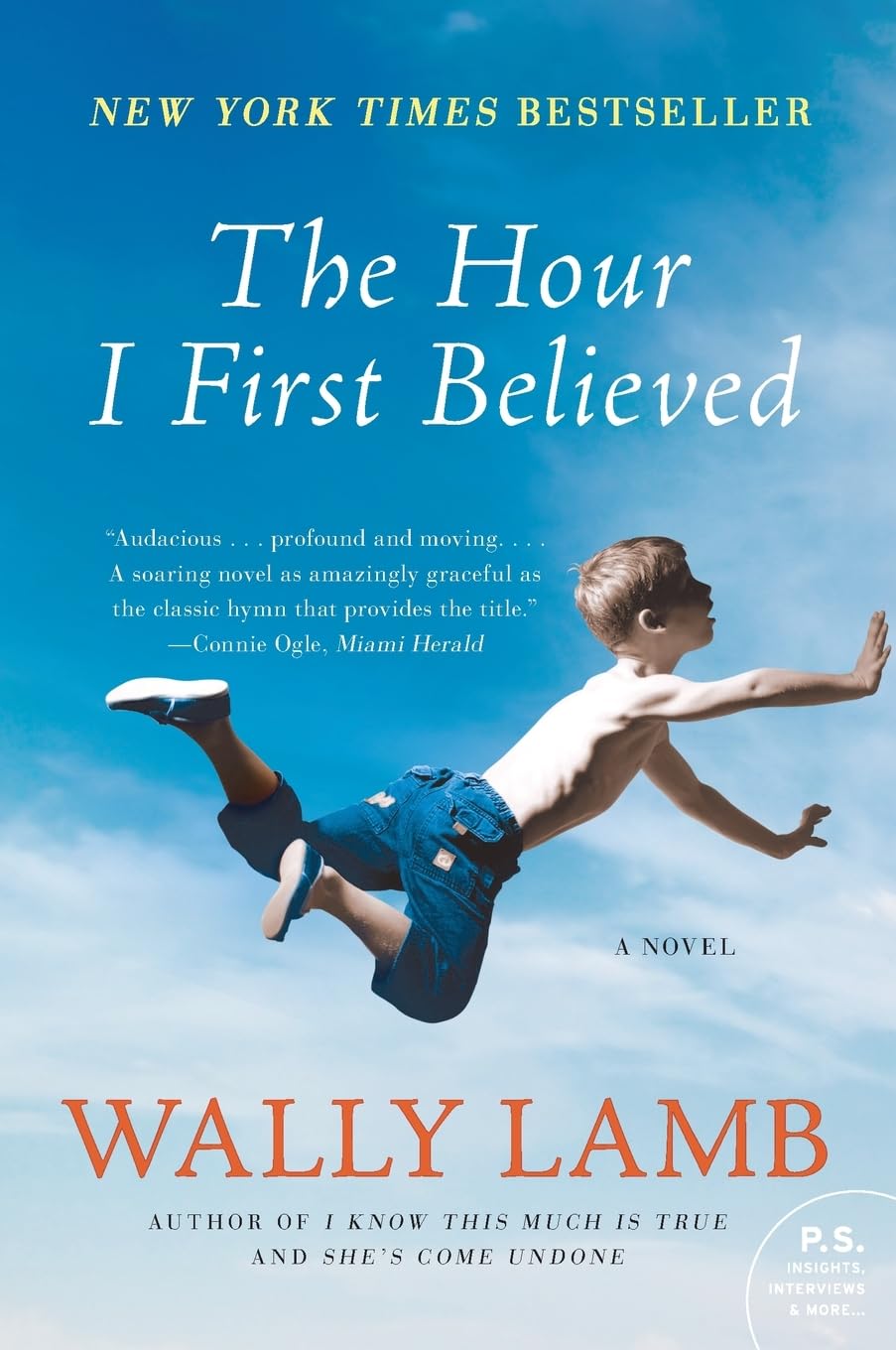
  • The Day I First Believed—Wally Lamb

    Former Oprah Book Club golden boy Wally Lamb took his time writing his third novel, The Day I First Believed, a harrowing look at violence and the effect it has on those caught in its collateral snare. Lamb’s much anticipated follow-up to 1998’s I Know This Much is True is an engaging, terrifying, and at times, nauseating rollercoaster ride, even going as far as to include the feeling when the ride suddenly stops and you kind of lurch out toward the parking lot, dizzy, discombobulated, and trying not to hurl.

    The first half of The Day I First Believed deals with the real world events of the 1999 massacre at Columbine High School. The novel’s protagonist, Caelum Quirk and his wife Maureen both work at the school, although Caelum is called away by the imminent death of an aunt on the East Coast and Maureen is left to live through the shooting on her own. She does survive, but is seriously psychologically traumatized by the experience.

    I remember when the shooting happened, and like everyone, I was shaken up, but I had already been out of high school for 15 years at the time and I think the immediacy of what happened was a little lost on me. Ten years later, I found myself back on campus, this time as a teacher, and the impact of Lamb’s narration scared the living shit out of me.

    Lamb uses snatches of diary entries, news reports, and transcripts of the taunting videos the two gunmen made before going on their rampage to good effect in the first half of the book, it’s in the second half when he resorts to a similar technique to introduce side plots dealing with the Quirk family history that the whole thing lurches to a halt.

    Dana and I saw Lamb speak at Corte Madera’s Book Passage after I had finished the novel, but she hadn’t. I was hoping to glean some sort of insight into what Lamb was trying to do with the second half of this novel, without standing up and asking him straight up, “What the hell?”

    We both found Lamb to be very personable, engaging, and a great storyteller. He mentioned the idea of the labyrinth as the story’s overarching metaphor, and personally, I think he became a little lost in his own maze.

    He mentioned how he inhabits his characters when he is writing, and if what I experienced just reading the first half of the novel is any indication of what that must have been like, perhaps he wandered a little off the reservation. I hope he makes it back.

  • Superworse—Ben Greenman

    If there is one thing you could say about this slowly aging, psychedelically dented, slightly cynical romantic, it’s that I likes me some metafiction. When Dave Eggers and his crew started up McSweeney’s back in ’98, I thought I had died and gone to a well-lighted, non-denominational heaven (which for some reason, looked a lot like Portland).

    Author Ben Greenman is an editor at the New Yorker and apparently indulges his non-monocled side writing for indie cred publications like McSweeney’s and Nerve. His 2004 novel, Superworse, is supposedly a paperback “remix” of his 2001 hardback effort, Superbad. It’s hard to know to what extent this is true as the novel itself is a Gordian knot of self-reference and too-clever-by-half literary winks and nods. Just the way I like ’em.

    Without giving too much away, the conceit of Superworse is that an old instructor of Greenman’s, one Laurence Onge, is asked to edit the original novel for the soft cover release by Soft Skull Press. Onge is a bit of a megalomaniac and sees references to his history with the author under every well-turned phrase. Onge had gone as far to impose a series of Greenman’s musical numbers onto the earlier version of the book, which have been removed here “at the request of the author.”

    When Greenman quits shuffling the cards and playing with the intricate structure of the 19 chapters of the book, he writes a good short story. Pieces like the twice-removed western, The Theft of a Knife, or the 13th century Florintine political drama, No Friend of Mine, show Greenman’s gift for set and setting, as well as psychological abstraction. Even the more traditionally structured stories in Superworse all leave the reader with a faint sense of unease. Nothing in Greenman’s stories is ever really resolved; we are only seeing as much of the drama as the author thinks we need to see.

    The feeling of vertigo is muted in shorter, McSweenyesque, sketches like, Notes on Revising Last Night’s Dream, and the superlative, What 100 People, Real, and Fake, Believe about Dolores, which masterfully maps the rise and fall of a relationship through short observations from friends, historical and literary figures, and… Superman, who simply believes “that the underwear she wore was the same as the underwear that Lois Lane wore.”

    To illustrate the extent that Greenman, or Onge, or Greenman/Onge has gone to tie all this together, the first nine chapters and the last nine are separated by a pivotal 10th chapter entitled Notes to a Paper You Wouldn’t Understand in which a series of footnotes thematically echo their corresponding chapters while they ostensibly relate minutiae about an absent piece about… well, who really cares, you get the idea. If this all sounds like your cup of mud, well, I’ll see you at the bar.

    Also by this author:
    What He’s Poised to Do: Stories

  • Gun, with Occasional Music—Jonathan Lethem

    One of my favorite things about Jonathan Lethem’s work is the sense of fun he imparts when playing with the expectations of genre. His first novel, Gun with Occasional Music, takes the noir of Dashiell Hammett and Raymond Chandler and fuses it with the dystopian science fiction of Philip K. Dick and William Gibson, with a little William S. Burroughs thrown in for leavening.

    The life of Gun’s protagonist, futuristic flat foot Conrad Metcalf, gets complicated when his client on a simple peep job ends up murdered. The problem compounds exponentially when the number one suspect, after Metcalf himself, shows up to hire the detective to find the real killer.

    This brings unwanted heat from the Inquisitor’s Office, an all-seeing, not-so-secret police force that has the power to remove “karma points” from citizens as they see fit. To let one’s karma fall to zero is to become a non-person and awards the unlucky a trip to the (literal) freezer. Further complicating matters, is the fact that everyone is hooked on the government-supplied drugs “Forgettol” and “Acceptol” which makes getting a straight answer from anyone an interesting challenge.

    Not satisfied with a run-of-the-mill paranoid run through one of our possible paths, Lethem ups the ante with super-evolved talking animals, including a gun-toting kangaroo (inspired by a Chandler quote reproduced at the top of the story), a concubine sheep, and disturbing “babyheads,” human toddlers who have had the same mutagenic fast-forward applied to them, making them little alcoholic fatalist assholes. Which tracks.

    In 2020, literally moments before COVID fucked everything sideways, the movie trades were abuzz with news that the book was under development for a television series. Johan Renck, best known for his harrowing Chernobyl, was named as director, with Jason Bateman’s Aggregate Films producing. It has been crickets since then, however.

    Talking kangaroos and the like are tricky to pull off without looking ridiculous, and like the creatures in David Cronenberg’s 1991 take on Burroughs’ Naked Lunch, perhaps left to the individual widescreens in our heads.

    Also by this author:
    Chronic City: A Novel
    The Wall of the Sky, the Wall of the Eye

  • What He’s Poised to Do: Stories—Ben Greenman

    Ben Greenman’s wistful collection of short stories, What He’s Poised to Do, begins at a remove. For a book that both posits and ponders the importance of interpersonal communication, Greenman chooses to keep readers at arm’s length—at least until he’s gotten to know you better. His use of characters identified only by third-person pronouns in the title piece underlines the faceless isolation that an unhappy businessman out on the road feels as he engages in a cool affair with a woman who works at his hotel.

    There is an echo of the relationship between Lydia and Ricardo Reis in Jose Saramago’s The Year of the Death of Ricardo Reis in that even within an ongoing carnal relationship, Greenman’s guest remains alienated from everyone to a debilitating extent. The businessman’s one remaining open conduit of exchange is the series of postcards he writes the woman, his wife, and his son. Even this method of expressing his feelings stumps him at the end of the story, revealing that Greenman’s title is, if not ironic, then overly optimistic.

    “He sits down at the desk, finds a pen, and holds it over a postcard, uncertain exactly what he’s poised to do.”

    Greenman underscores this theme throughout the collection by postmarking the first page of each story, indicating the date and place from which it was sent. Even a cursory glance at the contents page gives the reader a pretty good idea of the breadth of Greenman’s stages for his universal passion play; settings range from North Africa, in 1851, to Atlanta, in 2015, and everywhere (and when) in between—including the imagined Lunar City, in 1989, and the confounding Australindia, in 1921.

    One standout piece, To Kill the Pink, is written from Harlem in 1964 at a time when both racial and personal boundaries were burning. Greenman writes as an African-American man who, after a tragic incident, decides to travel to Malawi to better understand his heritage and the extraordinary woman he loves. When he asks her how a “twenty-four-year-old black girl who’s never been out of New York City” knows so much about the world, she replies, “I always paid attention… while you were busy studying the human comedy, I was trying to figure out the human drama.”

    “You’re the sad mask; I’m the happy mask,” he answers. “Takes both of us to put on a play.”

    While Greenman’s gift for whimsy does surface from time-to-time, owing perhaps to the impossibility to cage such a formidable beast, he is wearing his sad mask for much of What He’s Poised to Do.

    “I write often about sadness and loneliness … the only cure, I think, is intimacy,” Greenman writes in About the Author, “which is what the people in my stories are struggling to achieve.”

    It is telling that Greenman’s stories revolve around written correspondence, a form of communication quite possibly in danger of becoming archaic. How will future generations understand us, or how will we ultimately understand ourselves, if our written interactions diminish to texts scattered on the digital wind?

    If there is a lesson to be had from this book, it’s this: Go write a letter to someone you love.

    Also by this author:
    Superworse

  • Genesis Angels: The Saga of Lew Welch & the Beat Generation—Aram Saroyan

    At the behest of poet Ted Berrigan, a young Aram Saroyan interviewed a becalmed and nearly forgotten Jack Kerouac in 1967 for the Paris Review. Saroyan describes this meeting much later in an article for The Poetry Foundation. It is a watershed moment, one generation testing the next, and Saroyan walks away with Jack’s benediction, “You’ll do, Saroyan.”

    I doubt that Kerouac had in mind for the young writer to go forth and pen the History of the Beats, but 12 years later, Saroyan attempted just that. Perhaps the tired Kerouac recognized a comrade-in-arms, as Saroyan’s sensibilities would have fit right in with the tea-loving, electrified wordslingers of the past. His official biography for his collected papers at the University of Connecticut Libraries reads, “In the late 1960s Saroyan experimented with marijuana and began to develop a career as a poet.” Sounds about right; let’s go!

    Genesis Angels is no straight-ahead biography, but a long prose poem in its own right. Saroyan attempts to capture the feeling of the era, the mad rush toward an uncertain future and away from a stifling mid-century American mindset that had all but disappeared by the time he started his journey.

    Saroyan identifies the Eisenhower years with the monster movies that were throwing their own existential warnings up on the screens of the ’50s and early ’60s. “We were being condemned to endure a complete rescheduling of human experience: our routines no longer in any relation to the planet or the landscape or our neighbors. We had willingly locked ourselves up with comfort and convenience and suffered an immediate transformation. It was we ourselves who had become The Thing, The Blob, inside our private Houses of Wax.”

    The degree that Saroyan is successful in capturing the Beat gestalt, from the far remove of 1979, depends on how susceptible you are to that particular brand of amphetamine-driven patter. Me? I can’t get enough.

    On Jack Kerouac meeting Neal Cassidy: “Now this is where it did combust because what happened was Jack saw Neal and listened to his wild, never-get-a-word-in-edgewise, spontaneous patte… this man was a rapid, word chasing man chasing word chasing man chasing time chasing space—lookout! just like his driving—saved by exposure and the rare posture of ecstatic brotherhood.”

    On Allen Ginsburg: “Allen had the conceptual center of the universe in his belly and breath… so that then he could inhale and exhale planets, and snow storms, windows, and paper towels, Mickey Mouse and Hollywood, tits, and cocks, ambushes, and semesters, toothbrushes, and Coca-Cola—the whole litterbug earth with Indians and business man and women giving birth, inside his nature, and available.”

    Strangely absent from this cluttered stage is Welch himself. Whether outshined by the titanic personalities around him, or just a quiet guy whose poems did the speaking for him, I didn’t come away with any better sense of the man than when I started. This isn’t a deficit in research; the University of Connecticut’s Saroyan collection contains a recorded interview with Welch and David Meltzer from 1969, and Saroyan himself interviewed poet Joanne Kryger about Welch in 1977, presumably while doing research for the book.

    Perhaps the problem is that—like a total eclipse, or some other natural rarity—Welch began disappearing as soon as he appeared. You have to catch these things when they happen or you’re out of luck. Until next time.

    Saroyan best captures Welch’s spirit in a few throw away lines describing the importance of becoming a poet:

    Be a poet and save the world forever.
    And don’t forget to take a sweater.
    Put this flower in the peanut bottle with some cold water.
    It’ll be here when you get home.
    That’s the way the universe works.

  • Always Something—Jim Dodge

    I am always hoping that Jim Dodge will surprise us all and finally announce the novel he has long been threatening to finish; his most recent, Stone Junction, dropped in the far-distant reality of 1990. A collection of poetry, Rain on the River: New and Selected Poems and Short Prose, followed twelve years later in 2002, but only served to whet our appetite for his deft wordplay and masterful use and abuse of the English language.

    Whenever I get the itch, now that the all-mighty algorithms know everything, I’ll check in to see what the good ol’ apple picker has been up to. Imagine my surprise when I discovered that Idaho’s Limberlost Press, a beautifully archaic letterpress printer of chapbooks, broadsides, and I’m guessing… manifestos, had published a new collection of poems, Always Something, in 2023.

    Limberlost’s publications are artifacts from an anachronistic world of archival-quality papers and hand-sewn assembly—not a shout against the digital darkness, but more of a whispered word of kinship in a sun-dappled meadow, but I digress.

    I recognized one of the poems, the sublime, Owl Feather, from a broadside that Dodge was gracious enough to send me upon the publication of my first novel, welcoming me into the guild ten years ago, so this collection has been simmering for a minute, all the better to let the flavors infuse.

    I have no doubt there are powers far beyond us
    Because the grey-and-brown barred wing feather
    From a Great Horned Owl that I found this afternoon
    While walking the old logging road above McKenzie Creek
    Seemed beautiful beyond the ability to behold it…

    Dodge’s capacity for wonder has always been a feature of his personality and his work, it’s in evidence here as is his prankster’s sense of humor. In A Manual of Sabotage, he incites delightful mischief.

    Of course, only a heartfelt kiss can derail a munitions train,
    Explode the tube in a color TV,
    Destroy a computer’s mother board,
    And get you so exited
    You want to feel completely totaled and totally complete.

    Further imaginings should be enough
    To get us together to wreck more stuff.


    I, for one, am ready.

    Limberlost Press


    Also by this author:

    Rain on the River: New and Selected Poems and Short Prose

  • Gentleman of the Road: A Tale of Adventure—Michael Chabon

    Since he left the smoky environs of Pittsburg behind, transplanted Berkeley author Michael Chabon has evolved into quite a chameleon—trying out genres in the same way the rest of us might try on hats. His preceding novel, The Yiddish Policemen’s Union, was all about the fedora. With Gentlemen of the Road, Chabon was looking for something a little more… exotic.

    With a scant page count of 200-and-change, Gentlemen is no more than a palate cleanser by Chabonian standards. Its brevity does give the book a momentum that carries its relatively thin conceit forward, whereas a heavier tome may have collapsed under its own weight.

    Chabon’s inspiration for the story was outlined in his working title for the book: Jews with Swords. With Gentlemen, Chabon shoots for an adventure in the old-school style of Robert Lewis Stevenson or Burroughs (Edgar Rice, that is—decidedly not William S. or Augusten).

    The wonderfully rendered illustrations by Prince Valiant artist Gary Gianni help make that classic connection. His depiction of the gaunt, chapeau-obsessed Zelikman with his sword-sized surgical tool (since Jews, by Frankish law, weren’t allowed to bear arms in 950), and his partner in crime—the massive Abyssinian Amram and his ever-present Viking battle axe—took me back to the hours I spent lost in vintage editions of Treasure Island and Defoe’s Robinson Crusoe that my grandmother had stashed in her basement.

    My only complaint with Gentlemen is that Chabon seems to be writing by-the-numbers at times. Whereas, I have often been flat-out amazed by his imaginative plot twists, this project seems satisfied to inhabit an exotic landscape and then defer to the dictates of genre. Unless, and I don’t think this was hinted at, the spiritual leader of the Khazars foresaw the entire chain of events—from the fall of the original leader, or bek, onward—and orchestrated them to ensure… well, you’ll just have to read it yourself.

    Random House Books

    Also by this author:
    The Yiddish Policemen’s Union: A Novel

  • The Wall of the Sky, the Wall of the Eye—Jonathan Lethem

    This collection of short stories from Berkeley-by-way-of-Brooklyn writer Jonathan Lethem explores the same sort of absurdist science fiction landscape as his novel Amnesia Moon. These seven pieces show the depth and breadth of Lethem’s creativity as he explores the outer reaches of genre.

    The stories that were previously printed in Asimov’s Science Fiction magazine are among the standouts in this collection and speak both to the editor’s catholic (small c) tastes and Lethem’s ability to inhabit vastly different worlds and report back with chilling clarity.

    The Happy Man—the lead off tale of a guy who spends half his time in Hell and the other half trying to make up with his increasingly distant wife and troubled teenage son—sets the tone for the volume. In this troubling story, the reappearance of a ne’er-do-well uncle in his Earth-bound life begins to draw the two worlds into closer proximity. Lethem telegraphs his final blow but it is devastating all the same. The story stays with the reader and reveals the barely-disguised malice in our classic fairy tales.

    Vanilla Dunk, is a slightly futuristic story of professional basketball in a time where the sport is in an advanced state of atrophy and has begun to consume itself like a snake eating its own tail. Powered exosuits give players the sampled skills of the greatest athletes of all time, turning the game into a live fantasy league.

    Lethem uses the post-sport spectacle to probe the issues of race (when a white hotshot draws the much-vaunted skills of Michael Jordan) and fame like a tongue returning to the socket of a broken tooth. This is quite a different tale than The Happy Man and it’s a testament to Lethem’s deft touch that one doesn’t need an understanding, or fondness for that matter, of basketball to enjoy it.

    Not every story in The Wall of the Eye is a slam dunk, but the penultimate tale, The Hardened Criminals, shows what an incredible imagination Lethem possesses. To give away the story’s main conceit would be a crime in and of itself, but it ends up being a chilling indictment of the prison industry and the way that it is designed to strip away the humanity of those stupid, crazy, or unlucky enough to fall under its purview.

    Lethem is a prolific novelist as well as short story writer and at times his prose reads dangerously close to poetry as in this introduction of the prison in The Hardened Criminals:

    The prison was an accomplishment, a monument to human ingenuity, like a dam or an aircraft carrier. At the same time the prison was a disaster, something imposed by nature on the helpless city, a pit gouged by a meteorite, or a forest-fire scar.

    Harcourt Brace & Co.

    Also by this author:
    Chronic City: A Novel
    Gun with Occasional Music

  • The Implacable Order of Things—Jose Luis Peixoto

    I had been on a bit of a discovery voyage of Portuguese literature, riding waves of Saramago, Camões, and Pessoa, when I happened across José Luís Piexoto’s first novel, The Implacable Order of Things, which suddenly and effectively sank it.

    It’s not that Piexoto, a poetical author of great skill and dexterity, is not a good writer; he is. This musing of one of his characters is one of the most beautiful ideas I’ve read in a long time: “I think: perhaps the sky is a huge sea of fresh water and we, instead of walking under it, walk on top of it; perhaps we see everything upside down and earth is a kind of sky, so that when we die, when we die, we fall and sink into the sky.”

    It’s not that I was unfamiliar with the fatalistic tendencies of my peeps, either; I am. Intimately. After all, the Portuguese invented fado, the saddest music on the whole planet. The space that Piexoto creates, however, is a whole ’nother sun-scorched ball of dirt.

    In Piexoto’s world, the Sun itself is more than the beneficent stellar body that we know and love, it is an omnipresent, malicious torturer, drying up even the smallest hope in an oppressive blast furnace of despair.

    In this dying—grindingly poor—village, even the devil seems trapped, forced to downscale his machinations to petty manipulations of the insecurities and jealousies of simple villagers. God himself has already caught the last ass out of town, abandoning the church and ecclesiastical duties to the devil who, to his credit, attends to all weddings and funerals with a huge grin, knowing all too well that no matter what people do, they are fated only to become more miserable as the days drag on.

    Peixoto employs a bit of magical realism that gives the whole book the feel of fable or of some sort of black scripture. The story starts out with the devil hinting very strongly to a shepherd that his wife is having an affair with a giant (who in reality has been raping her since her father died). The shepherd tells him to let the giant know that if he sees him around, he is going to smash in his face. This leads, predictably, to the shepherd getting beaten to within an inch of his life.

    As soon as the shepherd is well enough to walk again, he is right back downtown looking for trouble, and the giant, once again, beats him within an inch of his life. The miserable denizens of Peixoto’s world are lacking any sense of free will and often are dragged toward their unhappy fates by limbs that seem to be driven by nothing but a howling sense of entropy. The only character who takes matters into its own… well, teeth, in this case, is the shepherd’s faithful dog.

    When its master finally confronts the horror of his situation and hangs himself, the dog rounds up all the other dogs in the village and tears the giant limb from limb. Score one for the dog. By the second half of the book, we have burned through the first generation and are on to watching their progeny wither in the brutal heat.

    When we get to the one-legged, one-armed carpenter who grasps at happiness by marrying a blind prostitute after getting her pregnant—only to lose them both in childbirth, saw off his own leg, and burn down his (now no-legged) self and his shop for good measure—I started to get the sense that this book had become no more than misery porn. How much worse could things get? Worse. Implacably worse. Worse until the world itself (mercifully for the reader, but without a shred of pity for anyone else) grinds to a halt.

    Score one for the devil.

    Knopf Doubleday Publishing Group

  • Memory Wall: Stories—Anthony Doerr

    One of the elusive pleasures of reading is discovering an author that has somehow slipped through your own personal cracks, a writer that once found, seems to have been working just for you all along, you were just too busy or preoccupied to notice.

    The best part of finally finding each other, even if unbeknownst to the other party, is much the same as in any new relationship; there are stories to be told, histories to be learned—the literary equivalent of a new continent to be explored.

    In Anthony Doerr’s case, the quest covers the entire globe—poking into corners of the world you may have missed. Doerr’s collection of short stories, Memory Wall, wanders from South Africa to Wyoming, from a Korean no man’s land to a soon-to-be flooded Chinese village, and from post-Soviet Lithuania to the horror of World War II Germany.

    As far-flung as his narratives may be, there remains a common human thread that keeps all places from seeming alien, or so very different from home.

    This collection is bookended by two novellas dealing with two very different women at the end of their respective lives. The title piece carefully extends a toe into the realm of science fiction as a suburban Cape Town resident—suffering from Alzheimer’s—desperately tries to hang on to her memories by having them recorded on discs to be played back at will.

    The “memory wall” is both the disorganized map-cum-art project that she constructs in an attempt to make sense of a life quickly becoming a series of digitized vignettes as well as the literal rock cliffs that her late amateur paleontologist husband prowled, searching for proof of a deeper permanence.

    The story takes an unexpected turn when two men break into the woman’s house to play through her memories looking for clues to a major find that her husband may have made right before he died. The men soon figure out that it’s pretty easy to burglarize someone who isn’t going to remember that you were there. The subtext of a cultural power imbalance becomes glaringly apparent as the younger of the two men experiences the woman’s disconnected memories.

    We soon learn that she wasn’t all that nice of a person, which was an interesting way for Doerr to go since, up until then, we were feeling quite sorry for the woman. At that point, loyalties realign, and the young man becomes the hero/sacrificial lamb to root for.

    The final story, Afterworld, is a ghost story of sorts and deals with a Holocaust survivor whose epileptic fits have given her a window into another world that has both sustained and haunted her throughout her life. A Jewish orphan in Hamburg at the worst possible time to be either of those things, Esther Gramm’s out-of-body experiences afford her insights that the other orphan girls don’t fully appreciate until it is much too late.

    While having a fit, she has a vision of the bleak future and brings back an explanation of how other people’s memories keep us tethered to this world, “In another world, folded inside the living world, we wait. We wait until everyone who knew us as children has died. And when the last one of them dies, we finally die our third death.”

    Not everything is grim, however, as Esther also catches a glimpse of those ready to move on, an encampment of pilgrims in tents on the edge of a great forest, and sharing this vision ultimately saves her life. Of course, since she remains living, the girls who were murdered by the Nazis are stuck waiting around in a bombed-out limbo, trying in vain to contact her.

    Alone with the aged Esther, her nephew Robert gets her to share her memories of the war for a thesis project he is supposed to be working on, and finally becomes a hero in his own right at the end of the story and Esther’s life.

    Memory is the thread that connects all of the stories in Doerr’s book in much the same way it connects everyone in real life. Whether you cherish them, are losing them, or are haunted by them, memories are what make us who we are as well as what makes the world itself.

    “Every hour, Robert thinks, all over the globe, an infinite number of memories disappear, whole glowing atlases dragged into graves. But during that same hour children are moving about, surveying territory that seems to them entirely new. They push back the darkness; they scatter memories behind them like bread crumbs. The world is remade.” Poetry.

    Scribner

  • Chronic City: A Novel—Jonathan Lethem

    Jonathan Lethem, Brooklyn native and de-facto chronicler of life in the borough, caught a lot of flak for placing his novel Don’t Love Me Yet (gasp!) in Los Angeles. In Chronic City he casts his gaze back to the city that never sleeps, although his version of Manhattan is, as you might imagine, a little off beam.

    Lethem has a gift for blending literary genres. His fiction always has a smattering of science fiction; his noir, a shadow of the metaphysical. In between 2007’s geographically-maligned book and this novel, he even took a stab at reviving the forgotten superhero, Omega the Unknown for Marvel Comics, and it is the comic book that informs this novel; it’s characters are, by choice, two-dimensional, and play out all the necessary New York archetypes against a flat back drop of apartments, diners, taxi cabs, and improbable not-so-random violence.

    The novel’s protagonist is an empty vessel named Chase Insteadman, a former child actor who lives off of royalties and making the scene with Manhattan’s rich and even richer. His latest claim to fame, and the one that instills him at all the important parties, is his engagement to an astronaut who is marooned on the International Space Station due to a carpet of space mines that have been sowed underneath its orbit by the Chinese.

    Like a lot of things in the novel, this is taken for granted and nobody seems that interested in doing anything about it. Perhaps, and just perhaps, this is Lethem’s dig at the place the international community finds itself in relation to China’s rising prominence on the world stage. At this point, what could we do if they decided to mine the heavens? Write a strongly worded letter? Stop buying… oh, I don’t know, everything? Tariffs?

    Insteadman’s “lostronaut” writes him letters that are reproduced in The New York Times (albeit in the War-Free edition that seems to be favored by most) so that most people know more about what is going on than he does. Insteadman’s problem is that he can’t quite remember his fiancé or how he became an ornamental table setting.

    There are clues from the beginning that all is not right with Lethem’s island, for one, Lower Manhattan has been enveloped in a mysterious dense fog that never dissipates. Like Don DeLillo’s “air-borne toxic event,” there is a disconnect between what’s real and what is simulated. Infinite Jest by David Foster Wallace (whose position, as the Roy E. Disney Professor in Creative Writing at Pomona, Lethem inherited) has become Obstinate Dust by Ralph Warden Meeker, another overly long book that no one finishes.

    The Muppets have become Gnuppets, which may just be a wink at Gnosticism, loosely defined by Wikipedia as “consisting of various belief systems generally united in the teaching that the material cosmos was created by an imperfect god.” The root of Gnostic belief, gnosis, is further defined as “a form of mystic, revealed, esoteric knowledge through which the spiritual elements of humanity are reminded of their true origins within the superior Godhead, being thus permitted to escape materiality.”

    Insteadman’s catalyst, and a fount of esoteric knowledge, is Perkus Tooth, a stand-in for an aspect of Lethem’s own personality in much the same way as Kilgore Trout took the heat for Kurt Vonnegut. Tooth is a twitchy, well-stoned cartoon in the Lester Bangs mold, and although he bristles at being called a rock critic, is as remembered for a stint at Rolling Stone than for a series of intellectual commando-style broadsides that papered the Bowery back in the day.

    The chronic in the novel’s title, is an allusion to the high-grade marijuana that Tooth, Insteadman, and a former activist-turned-mayoral-fixer, Richard Abneg, imbibe with stunning regularity. The trio’s pot-driven cultural insights and conspiracy theorizing are either the best parts of the book, or the worst, depending on one’s own proclivities. I, for one, loved Tooth’s Marlon Brando obsession and manic drive to “connect the dots.”

    Almost exactly halfway through the book, a game-changing possibility is introduced that ties directly into Gnostic belief and, like religion, either explains everything or nothing at all. Tooth’s homeless associate, Biller, finds work designing “treasure” for a virtual universe called Yet Another World, created in turn by Linus Carter, a brilliant but socially inept designer—an imperfect god.

    A description of Carter’s online universe reads like a Lonely Planet guide to Manhattan itself, a “… paraphrase of reality which welcomed role-players, entrepreneurs, sexual trollers, whatever.” The line between real and unreal becomes even more blurred as Insteadman realizes that “Yet Another World wasn’t the only reality that was expansible. Money has its solvent powers…”

    In the end, our empty hero comes to realize it doesn’t really matter if the island that he knows is indeed real, or if anything actually exists on the other side of the Lincoln Tunnel. He learns the hard way that what is important is the real relationships that we form with other travelers.

    As for Tooth, he is finally permitted to escape the Material World through losing everything and finally finding a kindred spirit, in this case a massive three-legged pit bull named Ava. The dog continues to work healing magic on Insteadman after his own collapse into his own footprint.

    Having inherited the responsibility of walking her, he finally abandons Manhattan’s ubiquitous taxis for a street-level view of his realm. “… it occurred to me how Ava’s paces, her bold and patient pissings, must have been immensely comforting to Perkus, and in a sense familiar. Ava’s a kind of broadsider herself, famous within a circle of correspondents, invisible to those who don’t care.”

    Knopf Doubleday Publishing Group

    Also by this author:
    Gun with Occasional Music
    The Wall of the Sky, the Wall of the Eye

  • When That Rough God Goes Riding: Listening to Van Morrison—Greil Marcus

    Funnily enough, considering the subject and theme of this book, reading übercritic Greil Marcus is a lot like listening to Van Morrison. The experience can be illuminating, frustrating, transcendent, and solipsistic—often in the same paragraph or song.

    Like Morrison, Marcus has been following his own path for quite some time, and anyone who has a passing familiarity with either of them will always be able to find the gold hidden down a backstreet or way up top a flight of fancy.

    My struggle with Marcus is that his exhortations can be the definition of pedantic, referencing far-flung obscure artists and works in order to make a point that no one can truly argue with, having no idea who or what he’s is talking about.

    On the other hand, like listening to Morrison himself, if you’re willing to put in the work, you can be turned on to artists, books, movies, etc. that may later become indispensable to your life. What Marcus does here is doubly off-putting, as he spends a great deal of time extolling the virtues of tracks and performances of Morrison’s that are unavailable anywhere but bootlegs, a stream that Morrison spends a great deal of energy to dam, enlisting the services of Web Sheriff to scour the internet of any traces of illicit music.

    I was lucky enough to have a copy of the 1971 KSAN Pacific High Studios show which is referenced pretty heavily, but as far as Caledonia Soul Music, which according to Marcus is the key to the whole thing, I’ll just have to take his word for it.

    In this book, Marcus eschews most biographical information, much, I can imagine to Morrison’s relief, only pointing out pertinent signposts along the way. The whole focus is on those moments of unforced transcendence that Marcus believes paint a secret map through the jungle of Morrison’s work. As with any great artist—and to put my cards on the table, I believe Morrison to be one of the greatest singers of the last 40 years—what pieces resonate with your soul at any given time is completely subjective.

    I think Marcus is either trying to be cute, or is just being lazy to discount in one fell swoop everything Morrison put out between Common One in 1980, and Tell Me Something in 1996. Marcus talks about looking for the “yarragh” in Morrison’s performances, that moment that transcends language and artifice to, as Morrison once sang, “get down to the real soul, I mean the real soul, people.”

    To take a page from Marcus’ book if I may refer to a performance now out-of-print and unavailable, as a child of the ’70s I knew Morrison primarily as an AM radio hit maker and it wasn’t until PBS ran Van Morrison The Concert, recorded at New York’s Beacon Theater in 1989, that I was exposed to Morrison the mystic.

    I don’t recall which number he used to launch himself into the “yarragh,” but all of a sudden, he was growling and barking, not like a madman, but like a genius. I remember standing in front of the TV just slack-jawed; this was someone who warranted further investigation. All of a sudden I understood why someone like Morrison would rankle against cheap stardom. It wasn’t the fucking point. This, this is the point. And although Marcus’ examples are personal to his own experience, as far as catching the desperately vital point of it all, we really do see eye-to-eye.

    PublicAffairs

  • The Sirens of Titan: A Novel—Kurt Vonnegut

    I have to admit that the main reason I was aware of Vonnegut’s second novel, written in 1959 right after the launch of the space age, was the trivia night nugget that Jerry Garcia of the Grateful Dead owned the movie rights for years and had actually worked up a script with SNL alum Tom Davis.

    After discovering what an amazing feat of imagination this book is, I can see why self-styled hippie intellectuals like Garcia and Davis were drawn to it. It was quite unlike any other novel, even other Vonnegut books, I have read. At no time while devouring The Sirens of Titan could I ever say to myself, “Oh, I know where this is going.”

    Vonnegut sends up the whims of capitalism with the main character Malachi Constant, the richest man in the world. Constant is a playboy/bon vivant who, for reasons to be revealed, was born with the luck to maintain his lifestyle with very little effort on his part.

    At the beginning of the novel, he is summoned to the mansion of Winston Niles Rumfoord, the first man to fly a private rocket to Mars. Rumfoord is also, or so it’s understood, one of the last—having unwittingly flown into a chrono-synclastic infundibulum, which effectively spread his (and his dog’s) existence throughout sort of a wormhole between the Sun and Betelgeuse. (Now you can start to imagine the types of conversations Garcia and Davis must have had.)

    When Earth happens to transect the glitch, once every 59 days, Rumfoord and his dog materialize at the mansion for a short period of time where he alienates his wife, predicts the future (since he happens to actually be everywhere and when), and generally makes everyone uncomfortable.

    Vonnegut’s description of the first meeting of the two men is a good example of his wonderful use of language in this novel: “Winston Niles Rumfoord’s smile and handshake dismantled Constant’s high opinion of himself as efficiently as carnival roustabouts might dismantle a Ferris wheel.” Granted, this all takes place within the first 20 pages or so.

    Rumfoord (and I couldn’t stop substituting Rumsfeld, especially when we begin to find out how his motives, while being altruistic from his viewpoint, are seriously fucked up) goes on to tell Constant that he will end up traveling to Mars, Mercury, Titan, and end up having a son with Mrs. Rumfoord. Awkward.

    Vonnegut’s savaging of organized religion at the back end of this novel counterbalances his having peeled back the curtain hiding the machinations of the free market in the front. Along the way, Mars attacks, a shipwrecked alien manipulates all of human history in an attempt to get a part, and… just read the damned thing.

    I, for one, don’t need some infundibulated asshat to tell me that I will be revisiting this one again and again.

    Random House Publishing Group

  • Refusing Heaven—Jack Gilbert

    Poet Jack Gilbert, who passed in 2012, was 80 years old when he published this collection of poems in 2005. That’s a long time to observe how life works and Gilbert has spent much of it in introspection. He was there in San Francisco during the first flowering of the Beats, yet he never really became one of the gang.

    To read Gilbert is to realize that he is a man who relishes his space; many of the poems in Refusing Heaven paint a picture of self-imposed exile, whether physically, as in a remote Greek island, or spiritually—hence the title. This tendency to separate himself from his peers does not paint him as a curmudgeon; quite the opposite is true. It seems that Gilbert appreciates the contrast between company and isolation so that each might stand out more clearly in relief.

    In the Buddhist-inflected poem, Happening Apart From What’s Happening Around It, Gilbert starts out by giving practical examples of his philosophy. There is a vividness to eleven years of love because it is over. A clarity of Greece now because I live in Manhattan or New England. Later in the poem he observes a spiritual aspect to this clarity. When I was walking in the mountains with the Japanese man and began to hear the water, he said, “What is the sound of the waterfall?” “Silence,” he finally told me. The stillness I did not notice until the sound of water falling made apparent the silence I had been hearing long before.

    After absorbing this bit of enlightenment, Gilbert then gets to the crux of the matter by positing one of the greatest questions of all time. I ask myself what is the sound of women? What is the word for that still thing I have hunted inside them for so long? In the poem, Moreover, Gilbert finally reveals what he suspects that transitory and elusive thing to be. We are given the trees so we can know what God looks like. And rivers so we might understand Him. We are allowed women so we can get into bed with the Lord, however partial and momentary that is.

    Perhaps it is only with the wisdom that 80 years affords that one can strive to understand women one moment while deftly distilling poetry’s worth and reason down to its essence the next. We lose everything, but make harvest of the consequence it was to us. Memory builds this kingdom from the fragments and approximation. We are gleaners who fill the barn for the winter that comes on.

    Refusing Heaven is a rare chance to experience a poet still in bold command of his powers looking back at what was a long life full of achievement and adversity in equal measure. In the sublime, Failing and Flying, he reminds us that although we tend to focus on the cautionary aspect of the Icarus myth, we forget that he actually did fly quite well. For awhile.

    Gilbert seems to be summing up his feelings about his own looming mortality when he writes: I believe Icarus was not failing as he fell, but just coming to the end of his triumph.

    Knopf Doubleday Publishing Group

  • A Supposedly Fun Thing I’ll never Do Again—David Foster Wallace

    While some authors make you feel stupid for even trying to read them, I’m looking at you, James Joyce, others seem to immediately give the ol’ noggin a boost. While working through this collection of “essays and arguments” by the late David Foster Wallace—sometimes referred to as our generation’s Joyce for his long and obtuse novel Infinite Jest—I made a list of 20 words I had been lamentably unaware of, as well as two that, apparently, he made up: ablated, anaclitic, appurtenance, belletristic, commissure, decoct, enfilade, erumpent, espial, exergue, frottage, hieratic, lalations, otiose, preterite, sedulous, threnody, titivation, ventricose, weltschmerz

    Of those 20 words, I have to say that the most amusing discovery for me was frottage, which I’m sure that some of you already know means, “the act of obtaining sexual stimulation by rubbing against a person or object.” I’m not here to judge; I’m just sayin’. Erumpent is also pretty fun to say, and could actually be onomatopoetic if you were to listen very, very closely.

    As for the two Wallacisms that don’t seem to exist in the English language, some DFW obsessives have pointed out that katexic could be derived from Freud’s katexis referring to “the process by means of which libido energy is tied or placed into the mental representation of a personality, idea, or thing.” In this respect, Wallace’s writing in toto could be viewed as katexic. The energy that must have gone into building such a vocabulary and the means to swing it around as effectively as he did—the creation and subsequent projection of “David Foster Wallace” as a literary force—could easily be imagined as a gloriously sublimated primal urge.

    Plumeocide is another matter. Wordnik member vbogard22 has postulated that “plumeo- could come from the Latin pluma, which means feather or pen [when] added to -cide (Latin, kill) would come to mean something along the lines of ‘death of the pen.’”

    Given Wallace’s tragic end by his own hand, the fact that he may have coined a word for the silencing of a writer is a bit prescient, although I am buoyed by the acknowledgment that the only way to get a writer to shut the hell up is by resorting to plumeocide.

    I was also beguiled, beleaguered, and besotted by Wallace’s use of language, often all at the same time. In much the same way that Wallace thought he was a decent tennis player until he got the opportunity to view the pros in action, I thought that I could, on occasion, craft a clever line. Now I’m reminded that there are players out there operating on a whole different plane.

    I almost forgot to mention that the book is really funny. Cheers to you, DFW, wherever you are.

    Now, about that Goddamned Jest

    Back Bay Books

  • (Not That You Asked): Rants, Exploits, and Obsessions—Steve Almond


    I picked up this collection of essays from Boston writer (and Bay Area native) Steve Almond on a total whim and found it to be one of the explosively funny books I’ve read since Ozzy’s autobiography. Almond is just nuts—and honest to a fault—which may or may not be a product of his insanity.

    Not that You Asked is organized thematically with the chapter entitled About My Sexual Failure (Not that You Asked) being the most cringe-worthy of the bunch. In the extended piece Shame On Me (Why My Adolescence Sucked Donkey Cock), we are regaled with tales of his late-blooming sexuality via the water jets in the Almond family hot tub; hand jobs con sharp, inexperienced, fingernails; the family dog’s rooting out of a used condom from the trash and subsequent tug-of-war with Almond’s mother leading to predictable, but no less horrifying results; and getting publicly busted for shoplifting condoms and Sta-Hard gel from Longs Drugs.

    Chestfro Agoniste and My First Fake Tits reveal waxing and breast implants to both be somewhat less wonderful than advertised, the former resulting in this conversation painfully recounted by Almond. “Me: Ow! Please. Please, don’t—Fuck! Her: It’s almost out. Me: You have to do it faster, really—No! Ow! Fuck! Please move to another—that part really—Owwww! Her: Stop being a baby. Me: Please, sweetie. Please, I’m not joking. Her: Lie still. Just fucking lie still and let me— Me: Owwwww! You fucking bitch! You mean fucking bitch!”

    For every writer who has attempted to wince his or her way through a sex scene, Almond offers a 12-step program that lays out some pretty good (and common sense) advice, such as, Step 5 (Real people do not talk in porn clichés): “Most of the time, real people say all kinds of weird, funny things during sex, such as ‘I think I’m losing circulation,’ and ‘I’ve got a cramp in my foot,’ and ‘Oh, sorry!’”

    Given my utter lack of interest in the sport of baseball, it took me awhile to battle my way through one of the longer essays in the collection, Red Sox Anti-Christ, which ended up having some interesting and insightful things to say about sport and its place in a war-loving society such as our own. He equates the coverage of the kick off to the invasion of Iraq with a major sporting event. “Nightly highlight reels charted the day’s major offensive drives. Correspondents offered sand swept on-the-field interviews with our burly combatants, while generals served up bromides fit for a head coach.”

    Almond goes further and takes part of the blame for the unnecessary war onto his own shoulders. “As a fan, I had helped foster a culture governed by the sports mentality, in which winning mattered above all else, and the application of violence was seen as a necessary means to that end rather than a betrayal of our democratic standards.”

    In a chapter entitled In Tribute to My Republican Homeys, Almond turns on the vitriol. Demagogue Days, Or How the Right-Wing Hateocracy Chewed Me Up and Spat Me Out spins the story of how Almond, an adjunct professor at Boston College at the time, resigns over the school’s invitation of Condoleezza Rice to give the commencement speech. Almond uses the format of Dante’s descent into hell to map out all of the insidious devils of punditry that all wanted a piece of him for a brief, terrifying moment.

    With the ability to ride out ridiculous situations with the artistry of a Mavericks surfer (see How Reality TV Ate My Life), one starts to wonder just what would really get to Almond, what would crack his smooth, white chocolate exterior and let the creamy nougat pour forth?

    That force majeure comes in the form of a baby girl, the arrival of whom is hilariously recounted in 10 Ways I Killed My Infant Daughter in Her First 72 Hours of Life. It is this window into the hopes and fears that people have shared from time immemorial, that saves Not That You Asked from being simple a collection of ravings from another smart ass cynic. Not that there’s anything wrong with that.

    Random House

    Also by this author:
    Which Brings Me to You

  • The Romantic Dogs—Roberto Bolaño

    By the time an English translation of Chilean author Roberto Bolaño’s novel The Savage Detectives was finally released in 2007, he had already passed like a glowing comet, having succumbed to a failing liver in 2003. Bolaño’s novel followed every drunken debauch and whim of a group of young Mexico City poets calling themselves visceral realists, but while the prose was beautifully crafted, the book was starkly short on actual poems.

    His biographers make a point of saying that Bolaño’s first love was poetry. Supposedly he only turned to writing novels at the age of 40 after the birth of his son forced him to give up a more bohemian lifestyle. This collection spans his career from 1980 through 1998, the year The Savage Detectives was first published.

    There are many allusions to the novel and, as in much of his work, some of the same territories are traveled, making this a good companion piece to the novel, or visa versa. Several poems deal with the enigmatic figure of a detective, questioning but never solving the seemingly random and unending violence of South America.

    I dreamt of frozen detectives; Latin American detectives who were trying to keep their eyes open in the middle of the dream. I dreamt of hideous crimes and of careful guys who were wary not to step in pools of blood while taking in the crime scene with a single sweeping glance.

    His fascination with forensics would find full flower in 2666, by many accounts, his crowning achievement. At nearly 900 pages, the book is a mammoth project that Bolaño struggled to finish before he died. It is rumored that he even went as far as to postpone a much-needed liver transplant so as to not break stride on his defining work. This struggle is reflected in one of the most moving poems near the end of The Romantic Dogs.

    Muse, wherever you might go I go. I follow your radiant trail across the long night. Not caring about years or sickness. Not caring about the pain or the effort I must make to follow you.

    New Directions

    Also by this author:
    The Insufferable Gaucho
    The Return
    Savage Detectives: A Novel

  • The Yiddish Policemen’s Union: A Novel—Michael Chabon

    I always feel a little sad upon finishing one of Michael Chabon’s novels. The Berkeley author weaves such wonderfully detailed tapestries of language and imagery that a feeling of loss is inevitable once the Big Finish has come and gone.

    That same feeling pervades The Yiddish Policemen’s Union from the jump as the world the characters have inhabited for 60 years is about to be flung on the trash heap of history. The alternative-history conceit is as follows: after the horror of World War II, and a collapse of the stillborn State of Israel, Jewish refugees were settled in an American Federal District hastily carved out of the Alaskan wilderness—and now the lease is up.

    As alcoholic policeman Meyer Landsman begins the search for who may have killed a fellow tenant of his own down-at-the-heels hotel, he heads toward the basement and this throw-away bit of narration: “[Landsman] checks behind the hot-water tanks, lashed to one another with scraps of steel like comrades in a doomed adventure.” The metaphor could be stretched to represent Landsman himself and his ex-wife/new-supervisor Bina Gelbfish who has been sent to tidy up all the loose ends at Sitka Central, and Landman’s investigation is one big throbbing nerve of a loose end.

    Drowning in the machinations of the District’s Hasidic mafia and a cold ocean of slivovitz, Landsman is haunted by a complex chess problem left by the dead tenant. Is it a clue? Is it just a reflection of his own hang-up caused by his chess champion father’s disappointment in him and resultant suicide? Chabon has explored these themes before. He revels in the arcane details of modern Judaica, and I was waiting past the 200-page mark for his patented Big Gay Character to show (he does, although posthumously).

    As Chabon has repeatedly shown—in his on-going bid to become a one-man Coen Brothers of the literary world, chewing up and spitting out genre after genre—it’s not the materials, plot points, or archetypes you start with, it’s how you play the familiar pieces that wins the game.

    Harper Perennial

    Also by this author:
    Gentleman of the Road: A Tale of Adventure

  • The Inexorable March [ficção]

    Jerome Michael Gonçalo parked his beater Toyota pick-up in the Vallejo Ferry Terminal garage, made the sign of the cross, and hustled off to the kiosk to pay. He always chuckled to himself when the machine asked how many days you wanted to stay; as if he would ever leave the vehicle—beat-up or not—overnight.

    Shit, only thing left would be the paint, he mused before the boat to San Francisco let out a warning blast that carried across the four lanes of Mare Island Way, telling all around that they had better get their asses in gear.

    Parking receipt in hand, Gonçalo checked for traffic—knowing that he, himself, was often coming in hot this time of morning—before sprinting across the expanse of asphalt against the light.

    “Jamoke! You almost missed it, brah,” an African-American ferryman half again his size shouted out from behind the aluminum plinth whose only discernible function was to shore up the man’s bulk as he pointed toward the waiting hydrofoil bobbing on the tide.

    One morning, Gonçalo made the mistake of introducing himself as “J-Mike,” which was immediately misconstrued as “Jamoke,” an appellation that gave the older, and much larger, man no end of amusement.

    “Devánte,” Gonçalo panted, disturbingly out-of-breath, “I knew you’d hold it for me, even if you had to grab that rope!”

    “No way, brah,” the man laughed, “we’re on a schedule. Very tight. Like your mom.”

    “Keep it professional, D.,” Gonçalo half-heartedly protested as he reached for the lanyard that held his transit card, only to realize that he wasn’t wearing it. He glanced toward the now-shuttered ticket windows at the terminal. Closed signs announced the inexorable march toward having every human interaction removed from one’s day. And yet, he silently bemoaned, Devánte persists.

    Gonçalo wondered what the folks that had worked those windows were waking up to today, having been replaced by a phone app. He weighed the odds of rushing back to the house for the card but quickly calculated that he’d never make it back in time for the next boat. That would mean driving into the City, a trip that took two maddening hours just days before.

    He had already come to terms with the fact that he would rather be skinned alive than undergo that ordeal again as he had barely made it to work the last time without pissing himself in traffic. Gonçalo had briefly thought about drinking less coffee in the morning and immediately realized that it would never actually happen. Public urination verses the murder charge that would surely follow going cold turkey was a steep, but manageable, price to pay.

    “Use the app, brah,” Devánte, having astutely read the situation, advised. “Your phone, Jamoke.”

    Gonçalo pivoted to attempting to use the very cell phone application that resulted in the sacking of the station agents and felt badly for a moment. The moment passed as the intended exchange failed with an abrasive electronic bleat.

    “Y-eaz-ou l-eaz-ose,” Devánte intoned, revealing a probable past spent somewhere on the midway. “Jump on, Jamoke. This cross must move.”

    Devánte’s counterpart on board the craft rattled off some half-heard, less-understood, instructions. Gonçalo stared blankly at the black rectangle in his hand as he moved toward an open seat and plopped down with a certain resignation.

    All morning, Cassandras on the local news gleefully warned of power blackouts and the possible closure of outdoor public spaces as an impending heatwave threatened to blanket the entire West. Gonçalo had chosen to wear a leaf-patterned Hawaiian shirt in a light fabric, although now he was feeling that perhaps it was sending the wrong message about his mood.

    As the engines below the craft begin to churn the cold morning waters of the Bay, he thought about stepping outside in the quickly warming air and slipping unseen over the rail, his cell phone dropping from his hand and sinking to the muddy bottom even quicker than he himself would.

  • The World Without Us—Alan Weisman

    Mr. McGuire: I just want to say one word to you—just one word.
    Ben: Yes sir.
    Mr. McGuire: Are you listening?
    Ben: Yes, I am.
    Mr. McGuire: Plastics.
    Ben: Exactly how do you mean?
    Mr. McGuire: There’s a great future in plastics. Think about it. Will you think about it?
    Ben: Yes, I will.

    While reading Alan Weisman’s fascinating book, The World Without Us, that scene from The Graduate kept playing in my head. Plastics. It turns out that there is a great, or at the very least, long future for all one billion tons of it as it never really breaks down—pieces just become smaller and smaller and by doing so can be swallowed by organisms at the very bottom of the food chain. Which is bad.

    It was frightening to read how quickly plastics have permeated every aspect of our lives (they’ve only been around since the end of World War II), and just how badly we manage what happens to them when we’re done using them. Weisman describes in detail the great wastes of floating plastic that circle the center of each of the world’s oceans.

    There was something about growing up in the waning years of the Cold War that left an indelible mark on the collective imagination of my fellow Gen Xers and myself. We are suckers for stories of our own destruction. Maybe it was the sight of the Statue of Liberty sticking out of the sand at the end of Planet of the Apes, or just the constant fear of nuclear destruction, but as kids, I think most of us had spent some time thinking about what would happen to the world once all of us were gone.

    Weisman looks at all of the things that may benefit from our demise (almost all other species except those that have been domesticated), and all of the things that will simply go to hell without us here to manage them (it turns out that nuclear reactors, refineries, and power plants don’t really run themselves for very long).

    As we all learned in science class and/or the Discovery Channel, water is the one unstoppable force on Earth. You can try to dam it, pump it, or redirect it, but whatever you choose to try and force it to do, you’ve created yourself a full-time job. Without us around to maintain the infrastructure, it will just be a matter of time before rivers undermine and retake the streets of New York, the delta washes away Houston, and, well, we’ve already seen what could happen to New Orleans.

    The book isn’t all doom and gloom, there are very interesting scientific tidbits scattered throughout that I have not encountered anywhere else. His glimpses of the last remaining piece of the primeval forest that once covered Europe made me want to book a flight to the border of Poland and Belarus.

    The human narrative emerging from the Eastern African Rift Valley really points up how we are all really the same, like it or not. For those that will never wrap their minds around that fact, there is the cold comfort that war is actually beneficial for some species, if only by reducing the number of people degrading the environment.

    The amazing return of several endangered animals to the Korean peninsula’s DMZ echoes an idea by environmentalists from The Rewilding Institute who are committed to developing naturalized corridors crossing each of the continents where wildlife could live, migrate, and hopefully, thrive.

    As for humankind, well… we had better get our house in order. To paraphrase Weisman, we choose not to see the biggest elephant in the planet-sized room, although it’s harder and harder to ignore it. Perhaps the last great hope for us is to reduce current population trends before we experience total environmental collapse. It wouldn’t be the first time the Earth has pushed the reset button, and it won’t be the last, it’s just that we are supposed to be the smart ones.

    Every four days, the population of our small planet rises by one million people. If things continue at the current rate of projection, we should reach a mind-blowing total of nine billion people by the middle of this century. According to Dr. Sergei Scherbov from the Vienna Institute of Demography of the Austrian Academy of Sciences and the World Population Program, if families were limited to having only one child, we would be back down to 19th century levels by 2100.

    However, with pronatalism promoters like Elon Musk—14 kids and counting—and Vice President JD Vance pushing the idea that (white) people should have more babies on behalf of the nation, I’m not going to hold my breath.

    Picador Paper

  • Rain on the River: New and Selected Poems and Short Prose—Jim Dodge

    Once and a while, if you’re lucky, you just might run into someone who seems like they have it all figured out; someone who by virtue of example shows you another way of looking at the world and your place in it.

    If you casually told them that you were tempted to follow his or her example (and that person wasn’t driven by ego or fanaticism) that person might look at you like you were crazy, then maybe laugh, and try to talk you out of it. That person might even explain to you why you shouldn’t write in second person narrative. For me that person was Jim Dodge.

    I had the extreme pleasure of taking Jim’s creative writing class at Humboldt State back in the early ’90s, and in retrospect, I should have dropped all my other classes and just hung out with him all day. Oh well, live and learn—which is also the message of much of Dodge’s output: any one of his three novels or the flurry of chapbooks and loose poems that follow in his literary wake might teach you that.

    Rain on the River collects Dodge’s short-form musings from the late ’80s through when it was published in 2002, and during which time, Dodge married his long-time companion and became a father. Many of the later poems deal with the incredible sense of amazement he seemed to be dialed into at that point in his life.

    Dodge’s poetry combines the wonder of some of Richard Brautigan’s more innocent works and the natural familiarity of Gary Snyder, a fellow traveler who Dodge attributes with changing the direction of his life. Dodge, a Humboldt fisheries major at the time, went multi-disciplinarian after reading Snyder’s Hay for the Horses. Dodge’s mixture of Zen awareness and working class perception mirrors Snyder’s own sensibilities.

    In Fishing Devil’s Hole at the Peak of Spring, Dodge relates an archetypical steep downhill battle through briar and bramble (and occasional unexpected flower-strewn meadow) to reach a secret fishing hole, only to lose his fish and end up ass-over-teakettle in the freezing water to which he exclaims:

    “Yarrrrrggggggggaaaaaahhhhhhhhhhh!”
    Yes. Yes by everything holy, yes!
    Even better.

    He writes at his most beatific in a bone-deep closing triptych/manifesto, Holy Shit.

    I believe every atom of creation
    is indelibly printed with divinity.
    I believe in the warm peach
    rolled in the palm of my hand.
    I believe God plays saxophone
    and the Holy Ghost loves to dance.

    Grove Press

    Also by this author:
    Always Something

  • The Confessions of Rick James “Memoirs of a Super Freak”—Rick James

    Jeesus. You cannot accuse Rick James of false advertising, although you probably could have charged him with just about anything else at anytime, and the charges would have stuck.

    It was hard to keep from copy editing James’ autobiography as I read along. Although after a while, the awkward repetition of sentences—and entire paragraphs—began to seem like part of the experience. It was easy to imagine him telling a story and adding the same crazy bit several times in a row.

    Me: “Erm, Mr. James, you just said that.”

    The imaginary Rick James that lives in my head: “Cocaine’s a hell of a drug.”

    The most interesting part of the book for me was the Zelig-like way that James was involved with so many of the people and bands that came to embody the late-’60s rock scene. Who knew?

    Rest in peace, super freak.

    Amber Communications Group

  • The Savage Detectives: A Novel—Roberto Bolaño

    The release of an English translation of Chilean author Roberto Bolaño’s novel The Savage Detectives went head-to-head with the appearance of Denis Johnson’s Tree of Smoke for 2007’s literary news of the year.

    Lucky for us, Bolaño’s novel turned out to be every bit as great as the hype. Long known and respected by Latin American readers, Bolaño was a bit of mystery for most English monolinguists who, if hip to his writings at all, had to subsist on a few slim volumes published by New Directions.

    With the heavyweight house of Farrar, Straus and Giroux picking up the mantle and feature-length articles in the New Yorker and The New York Review of Books touting the novel’s many charms, Bolaño was the toast of the literary world—four years after his death in Spain of liver failure.

    The Savage Detectives begins in a mid-1970s Mexico City where a young poet, Juan García Madero, is invited to join a mysterious fraternity of writers calling themselves “visceral realists.” To call the group a movement is a bit of a stretch as no one, García Madero especially, knows (or is willing to say) exactly what visceral realism is. This doesn’t stop the group’s leaders, Ulises Lima and Arturo Belano (a thin, thinly disguised Bolaño) from conducting purges that would make a Maoist nervous.

    The writers prowl the streets and back alleys of Mexico City, constantly writing, having sex, getting drunk, and ultimately running afoul of a killer pimp and his corrupt police buddies. As one does. Of course, this encapsulation does rough injustice to Bolaño’s kaleidoscope of richly drawn characters, some of which—like rare desert flowers—bloom once, fade, and are never seen again.

    The middle of the book picks up after the poets have returned from the desert where they had been searching for the mysterious poet who started the original visceral realism movement in the 1920s. For the next 400 pages, we see Lima and Belano through the eyes of people who cross paths with them in a 20-year span ending in 1996. This fractured faux-oral biography plays with the notion of identity while giving the disorienting, yet thrilling, feeling of looking at the pair through a many-faceted diamond.

    The final third returns to the Sonoran Desert to tell the story of what happened to Lima, Belano, García Madero, and wayward prostitute Lupe on their search for the elusive Cesárea Tinajero. To paraphrase García Madero: When it was all over, I felt like I knew every inch of that f’ing country. Even more, I felt I was born there.

    Picador

    Also by this author:
    The Insufferable Gaucho
    The Return
    The Romantic Dogs

  • The Insufferable Gaucho—Roberto Bolaño

    In death, Chilean writer Roberto Bolaño has become the Tupac Shakur of the literary world. Since succumbing to liver failure in 2003, he consistently released books for years (including the 900-page masterpiece, 2666). I realize that this incredible feat is due more to the slow process of translation than any powers Bolaño may have developed from beyond the grave, but I really wouldn’t put anything past him.

    The Insufferable Gaucho is a slim but powerful offering of short stories as well as a pair of essays in which he elliptically explores his own approaching mortality and place in the pantheon of Latin American literature. Bolaño’s Police Rat revisits Franz Kafka’s hidden world of Josephine the Singer, or the Mouse Folk. Pepe the Cop, a nephew of Josephine’s who, like his famous aunt, has a sensitivity that raises him a cut above the common rat, is on the tail of a killer in their midst.

    Unfortunately for Pepe—and as we have learned through countless police stories—individuality isn’t necessarily a trait that is appreciated by superior officers. As Josephine’s star wanes, Kafka’s narrator muses, “She is a small episode in the eternal history of our people, and the people will get over the loss of her.”

    One has to wonder if Bolaño was winking at us from his own position as a singing rat of some renown and one fully aware of his own demise. Perhaps it was a poke back at his own growing fame in the years right before he died when he chose the epigram for this book from the end of Kafka’s story: “So perhaps we shall not miss so very much at all.”

    If Martin Scorsese ever decides to direct an animated movie for Pixar, I’d like to see Police Rat on the big screen. I could just imagine Robert De Niro doing the voice-over for Pepe: “Have you ever taken on a weasel? Are you ready to be torn apart by a weasel?” Maybe it’s time for the studio to leave behind Lady and the Trampist fare like Ratatouille, and get fucking real. But I digress.

    In Literature + Illness = Illness, a many-faceted facing of the terminal disease that cut his life short at 50, Bolaño writes, “Books are finite, sexual encounters are finite, but the desire to read and fuck is infinite; it surpasses our own deaths, our fears, our hopes for peace.” It is a shout back from the ragged edge of things, and about as true as anything I’ve ever heard.

    New Directions

    Also by this author:
    The Return
    The Romantic Dogs
    Savage Detectives: A Novel

  • Sunset Park—Paul Auster

    New Yorker book critic James Wood once wrote an article about quintessential—and now sadly lamented—New York author Paul Auster that masqueraded as a synopsis of a new novel before revealing itself as a parody using the tropes that the writer was known for.

    Intellectual male protagonist with a dark sense of loss? Check. Violent accident? Check. Doppelgangers akimbo? Check Check.

    The back-and-forth argument as to whether Auster was merely doing what postmodernist writers do, i.e., borrow liberally from popular culture as to point out the foibles of modern life and paucity of new ideas in the face of existential crisis, or has succumbed to the greasy but comforting business of slinging familiar fare like a grizzled line cook on the graveyard shift had all but killed my desire to read another Auster novel ever since taking all that in. That was a shame.

    I discovered Auster late and had jumped into the deep end quite quickly, devouring In the Country of Last Things, Leviathan, The Book of Illusions, and Oracle Night in short order. Maybe Wood was right, and Auster had become somewhat of a one-trick pony, but if it’s a good trick, what the hell? The weird thing? Wood’s parody actually sounded pretty good. Which brings us to Sunset Park.

    Auster’s novel starts out like a parody of the parody, sort of a literary “fuck you” to the critics. We find twenty-eight-year-old Miles Heller mucking out foreclosures in Florida in his seventh year of self-imposed exile from his family after dropping out of college. Heller’s dark sense of loss stems from accidentally pushing his stepbrother in front of a speeding car while arguing on the side of a winding road in the Berkshires.

    Heller is pretty screwed up, and although characters male and female seem to be powerless before his supposed charms, he’s not a sympathetic enough protagonist to hang a novel upon. He may have actually offed his brother on purpose, and he is carrying on with—that is to say, sodomizing—a seventeen-year-old Cuban girl.

    It’s easy to see how Heller could have been emotionally stunted by his brother’s death, and the girl, Pilar Sanchez, is about the same age as he was when the break occurred. As hard as Auster tries to give their relationship credibility, gifting Sanchez with above-average intelligence and insatiable curiosity, it is unseemly when she refers to her various orifices as the off-limits mommy hole, and the A-OK funny hole.

    Given that this is an Auster book, this strange relationship is mirrored in the backstory of one of Heller’s roommates once he’s forced to retreat back to New York by a greedy, and possibly jealous, older Sanchez girl upon threat of incarceration for statutory rape.

    An old friend of Heller’s, the bearish Bing Nathan, and a group of like-minded twenty-somethings have opened up a squat in the seedy Sunset Park district just in time for Heller’s exile.

    Ellen Brice, a woman who “projected an aura of anxiety and defeat,” had been impregnated at twenty by a sixteen-year-old who she had supposed to be watching. Brice, while physically and emotionally understated, is perhaps the key to Sunset Park.

    Auster’s novel is ultimately about depression, both national and personal, and the poor judgment that can arise from being in that state of mind. He has placed his box of broken crayons smack down in the financial meltdown of 2008; the national malaise mirrors the feeling of Heller’s peers who have burned through their initial promise, and are now adrift.

    The third squatmate, Alice Bergstrom, is neck deep in her dissertation for Columbia. She has become obsessed by William Wyler’s 1946 film, The Best Years of Our Lives; a film that examines the difficulties soldiers returning from WWII had relating to domestic life once again.

    Heller and company don’t have the monolithic bummer of a world at war, but they do have the collapse of a system that was to provide each and every one of them a chance at the American Dream. It is interesting that among his peers, only the vindictive Sanchez sister, a recent immigrant, has the balls to grab a hold and squeeze what she can out of what little she is presented with.

    Within all this, Auster weaves a thematic thread involving baseball pitchers; especially those who showed great promise then flamed out, often tragically. For my money, if you’re a New York author and you’re going to use baseball as a metaphor to describe the human condition, then you’re going to have to go up against Don DeLillo’s masterful set piece that opens Underworld.

    That masterwork transcended any interest one might, or might not have, in the detailed ephemera of the national sport. In the shadow of DeLillo’s big game, Auster’s pitch falls low and outside. Or maybe that’s the point.

    Henry Holt and Co.

  • Which Brings Me to You—Steve Almond & Julianna Baggott

    After coming dangerously close to blowing hot coffee out of my nose while reading Steve Almond’s Not That You Asked, I decided to dive a little deeper into his (sure to be twisted) oeuvre. Swimming around, I bumped into this book, a novel of letters co-written by sometime (and, as quickly becomes apparent, sometimes not) children’s book author Julianna Baggott.

    It’s a conceit that could have ended up too clever by half, but is so well handled that I kicked myself for not thinking of it first. The story begins—like most Hugh Grant movies—at a wedding. I was hooked after the very first line, “I know my own kind. We’re obvious to each other. I suppose this is true of other kinds, too: military brats, for example, anarchists, mattress salesmen, women who got ponies as birthday gifts.”

    Jane ruminates while spying John standing under a white crepe paper wedding bell, “My own kind. I’m not sure there’s a name for us. I suspect we’re born this way: our hearts screwing in tight, already a little broken. We hate sentimentality and yet we’re deeply sentimental.” Sound like anyone you know?

    The two are drawn to each other like cracked magnets—repelling those they should be attracting, yet powerless to avoid the collision with their harmonious defect.

    After a furtive and aborted liaison in a cloakroom—the pair pulls apart long enough to realize that hooking up with a stranger under a bunch of outerwear would be a mutual mistake in two long, sad trains of mistakes—they hatch a plan to exchange letters confessing their respective tragic love lives. The sense that both of them know that this encounter just may be their last best chance permeates the already stuffy coat check.

    “No e-mail.”

    “Absolutely,” he says. “Real letters. Ink. Paper. The whole deal. We’ll be like the pioneers, waiting by our windows for the Pony Express. In bonnets.”

    John kicks things off with the story of Jodi Dunne, his first love at sixteen. Almond nails the tentative stirrings of romance fighting against the poison tide of peer and familial pressure, social awkwardness, and “erotic incompetence” that make up everyone’s high school years.

    Almond’s doppelganger proves his commitment to the spirit of full disclosure by recounting an unfortunate (and nearly geometrically impossible) incident wherein he ejaculates into his own mouth and gives himself, “as known in porn circles,” the Pirate Eye.

    Now, if I hadn’t read Almond’s harrowing tales of his own sexual awakening, I would have called gratuitous bullshit and might have given up on this character, but that would have been a mistake.

    Jane fires back with her tale of Asbury Park boys and a brooding and doomed muscle car driving boyfriend, and we’re off to the races. “Michael Hanrahan was something that I hoped would happen. In fact, I hoped he’s gone off like a bomb in my life, obliterating most everything except me, still standing, albeit charred and dizzy.”

    By the time we find them back at the wedding, “charred and dizzy” describes the state of both characters having weathered romantic disaster after romantic disaster. Will they be able to put it all behind them and start anew, one more time? Or are their respective personnel files too stuffed with abject failure to recommend advancement? Come to think of it, get Hugh Grant’s agent on the phone!

    Algonquin Books of Chapel Hill

    Also by this author:
    (Not That You Asked): Rants, Exploits, and Obsessions

  • The Return—Roberto Bolaño

    This collection of the late Chilean author Roberto Bolaño’s short stories reads like a Cliff Notes introduction to the world he traveled in, and in his literature, populated. The Return is stuffed with whores and hit men, poets and porn stars, Communists and black marketers, ghosts and conjurers, and (obviously) detectives.

    The book kicks off with a pair of stories about misplaced foreigners in Russia, one by choice, and the other by bureaucratic snafu. In Snow, a Chilean ex-pat living in Barcelona tells the story of when he was “a trainer’s assistant for a man of dubious and disconcerting moral character” in post-Soviet Moscow.

    Rogelio Estrada falls in with a gangster called “Billy the Kid” Misha Pavlov and ends up procuring young women for him. “Pavlov’s taste in women was for athletes: long jumpers, sprinters, middle-distance runners, triple jumpers… but his real favorites were the high jumpers. He said they were like gazelles, ideal women, and he wasn’t wrong.”

    Herein lies the rub: one Natalia Chuikova, who Estrada lovingly describes as “five-foot-ten and can’t have weighed more than 120 pounds. She had brown hair, and her simple ponytail gathered all the grace in the world. Her eyes were jet black and she had, I swear, the longest, most beautiful legs I have ever seen.” Let’s just say, that’s not the healthiest attention to detail for a hired goon to have.

    Another Russian Tale follows a Spaniard captured while fighting with the Nazi Germans in a World War II footnote that I was completely unaware of. The Spanish Blue Division was a volunteer force sent by fellow fascist Franco on (according to Wikipedia) “condition they would exclusively fight against Bolshevism (Soviet Communism) on the Eastern Front, and not against the Western Allies or any Western European occupied populations.”

    Within such a historical anomaly lies the kernel of a tragic novel in its own right, but Bolaño purposefully crash lands the premise, turning the man’s fate on a linguistic misunderstanding of a sputtered epithet.

    Detectives, the piece in this collection that best shows off Bolaño’s singular talent is written entirely as an extended dialogue between two policemen pulling duty in a Chilean jail. Bolaño slips in exposition, politics, and world history all without letting the conversation seem forced or false.

    His own literary counterpart, Arturo Belano—co-founder of Visceral Realism and co-hero of The Savage Detectives—makes an appearance as little more than an apparition, but one real enough to shake one of the detectives out of his comfortable stupor.

    In one of the most heartfelt examples of Bolaño’s ability to bring the seedy underbelly of society to life and make it seem as valid a way to live as any other—perhaps even more valid, as hypocrisy must be one of the first vices to burn away in the fires of Earth-bound hell—he chronicles the story of an Italian porn star, Joanna Silvestri, who returns to Los Angeles in 1990 after AIDS has run rampant and rocked the industry. Its “biggest” star, a barely-disguised John Holmes, still haunts the valley, a walking shell of his former self.

    Silvestri knows “Jack” from the old days and looks him up in a tender scene that stands out no less for being surrounded by work-a-day debauchery. Her matter-of-fact accounting of her chosen trade is at first shocking but soon begins to make sense.

    Porn, for the professional who makes it, must end up being just another day at the office, and in the end (no pun intended) don’t we all whore ourselves out in search of the all-mighty dollar?

    And while we’re on the subject, Murdering Whores paints the gruesome picture of a prostitute who singles out a guy coming out of a soccer match, kidnaps him, and tortures him to death. I read somewhere that this collection was originally named after this story: Putas Asesinas. I think it sounds better in Spanish.

    Ghosts real and imagined flit thematically throughout these tales, some of them merely glimpsed and some of them fully present and pissed off. The way that the specter of death hangs over this book, one can’t help but wonder if Bolaño was working through his own approaching mortality, picking it up and observing it from every angle.

    One hopes that he didn’t become like the ghost that narrates the title piece. “I have good news and bad news,” he begins. “The good news is that there is life (of a kind) after this life. The bad news is that Jean-Claude Villeneuve is a necrophiliac.”

    I’ll leave it to the porn star to sum up what Bolaño finally discovered while turning his imminent death into The Return. “I’m tempted to tell him that we are all ghosts, that all of us have gone too soon into the world of ghost movies, but he’s a good man and I don’t want to hurt him, so I keep it to myself. Anyway, who’s to say he doesn’t already know?”

    New Directions

    Also by this author:
    The Insufferable Gaucho
    The Romantic Dogs
    Savage Detectives: A Novel

  • Radio Free Albemuth—Philip K. Dick

    In 1974, science fiction writer Philip K. Dick had what he would come to understand as a religious experience, or more specifically, a Platonic anamnesis—a loss of forgetfulness.

    Triggered by exposure to an ichthys, what is commonly known as a “Jesus fish,” he had a flash of the continued existence of Rome circa 70 AD and felt the certainty of the early Christians that their messiah had just left and would be right back. This experience was followed by several nighttime visions where a beam of pink light beamed information into his head from an alien satellite.

    Dick struggled to understand what had happened to him and wrestled with these themes, most comprehensively in the writing of his exegesis, the VALIS trilogy, and, in 1976, the creation of Radio Free Albemuth. Those that have read VALIS, The Divine Invasion, and The Transmigration of Timothy Archer will recognize this novel as a tentative first crack at the material that would define and consume Dick until his death in 1982.

    This is not to say that this book doesn’t stand on its own, in many ways it is the more down-to-earth take on a very complex and singular cosmology, however, the VALIS mythos did become richer as a result of the extra effort. A lot of the underlying schema in this early draft is pitched in the form of manic exposition.

    Dick would later recast himself as Horselover Fat/Phil and kept the gist of Radio Free Albemuth intact as the experimental film that forms the centerpiece of VALIS. Some characters, however, lose something in the translation. Cancer survivor Sadassa Silvia Aramchek comes across as a better-realized and motivated person than her later incarnation, Sherri Solvig.

    The thinly disguised Richard M. Nixon stand-in, Ferris F. Fremont, is a delightfully evil antagonist, doubly chilling as the portrait rings true in hindsight. All in all, Albemuth is not the place to start exploring later-period PKD, but it is a worthwhile read as well as a fascinating example of what a rewrite/re-imagining can do.

    Mariner Books Classics