Tag: books

  • Kingdoms of the Radio: Karoline Rosenda 1 [ficção]

    I was right out of college and living with a couple of roommates in a flat over the Communist Bookstore in the Mission. A friend of mind had wrangled me a job working for Zev Avidan—we all called him “Z”—over at Celestial Records. This was back when their offices were still on Irving, out in the Avenues.

    Celestial had somehow gotten the North American distribution rights for Lucious Cole’s new solo album, A-OK; sort of a Syd Barrett meets Van Morrison at a Captain Beefheart clusterfuck in Golden Gate Park sort of thing. To tell the truth, I thought it was a hot mess, but you have to understand the times. The labels were a lot more willing to take a chance on some crazy act because you just didn’t know what was going to catch on.

    Cole still had some star power left over from his years with the National Loaf, and whatever self-destructive thing he did to land himself in the papers on any given day only helped our situation. It’s a sad fact that dying is one of the best career moves you can make when you consider the back catalog.

    I got involved because was Cole was coming to town for a string of shows at Winterland. I think Albert King was opening for him and all three nights were completely sold out. This was the summer of ’71, right after Morrison woke up dead over in Paris, and the company was understandably a little concerned about their investment.
    Z asked me to keep an eye on their boy; you know, keep him out of major trouble, and make sure he found his way to the venue at a decent hour and in reasonable shape. I have to admit, I was a little star struck. I was young and still susceptible to British charm back then. Cole would soon cure me of that. Permanently.

    Despite all the drugs and booze, or probably because of them, our man had the sexy lure of the disaffected poet about him. I have to admit when I saw him strolling up the jet way at SFO’s International Terminal, a pretty blonde stewardess on each arm, that I was a little smitten and maybe just a little jealous.

    Safely delivered by Pan Am’s fit yet curvaceous handlers, Cole made a rather elliptical beeline toward me. As he got closer, I could tell he was sloshed, but he still tried to double down on his remaining charisma.

    “Hello, darling,” he purred, or slurred, I couldn’t yet tell which. Perhaps both.

    I said something to the effect of “Mr. Cole, I presume, how did you know I was waiting for you?”

    “Because, darling,” he buzzed (yea, it was both), “who else would such a beautiful woman wait for?” And with that, we were set to launch.

    Follow the story:
    Kingdoms of the Radio: Serafina’s Gift
    Kingdoms of the Radio: Charlie Perigo 1
    Kingdoms of the Radio: Zongo Kumalo 1
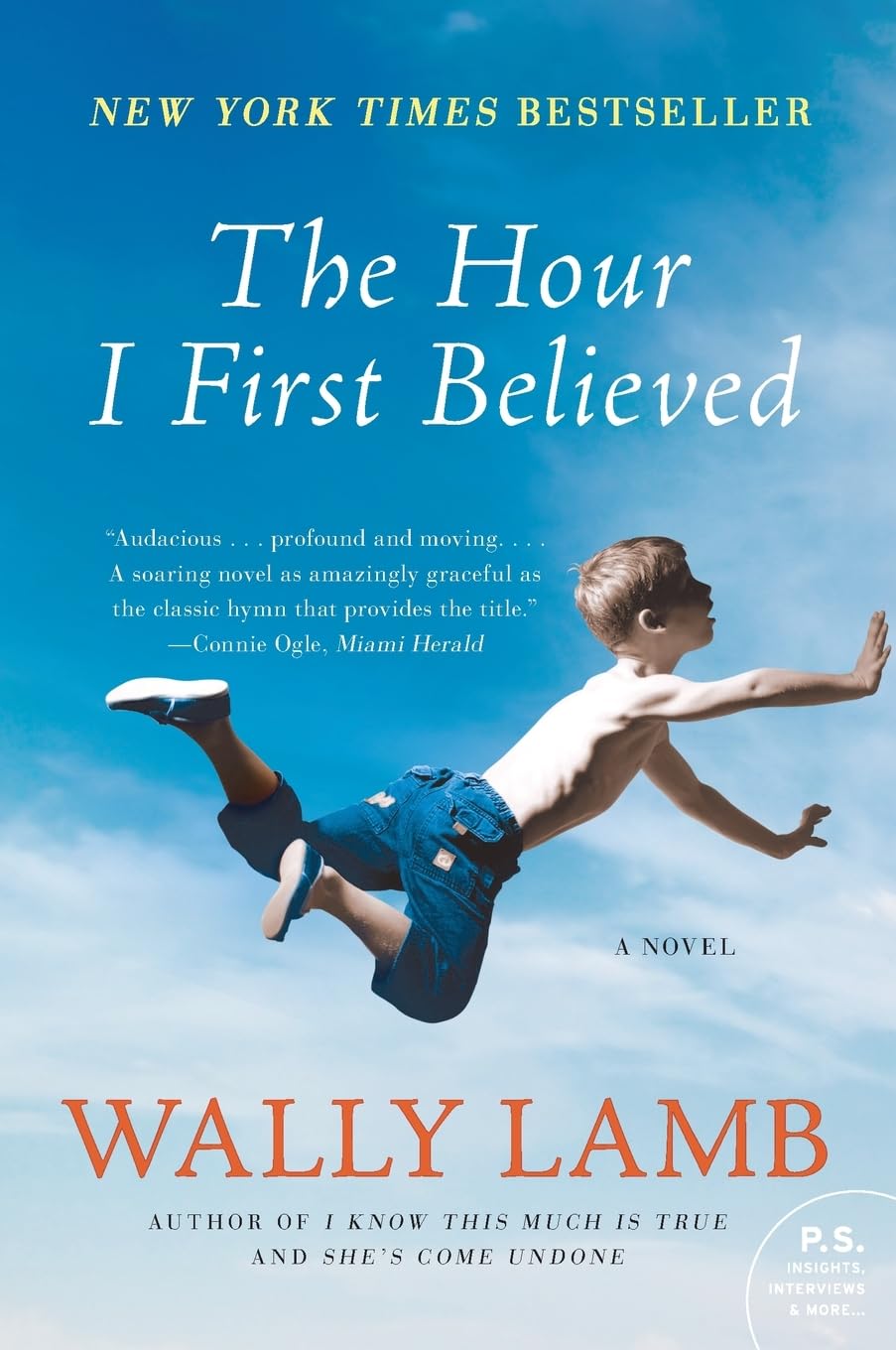
  • The Day I First Believed—Wally Lamb

    Former Oprah Book Club golden boy Wally Lamb took his time writing his third novel, The Day I First Believed, a harrowing look at violence and the effect it has on those caught in its collateral snare. Lamb’s much anticipated follow-up to 1998’s I Know This Much is True is an engaging, terrifying, and at times, nauseating rollercoaster ride, even going as far as to include the feeling when the ride suddenly stops and you kind of lurch out toward the parking lot, dizzy, discombobulated, and trying not to hurl.

    The first half of The Day I First Believed deals with the real world events of the 1999 massacre at Columbine High School. The novel’s protagonist, Caelum Quirk and his wife Maureen both work at the school, although Caelum is called away by the imminent death of an aunt on the East Coast and Maureen is left to live through the shooting on her own. She does survive, but is seriously psychologically traumatized by the experience.

    I remember when the shooting happened, and like everyone, I was shaken up, but I had already been out of high school for 15 years at the time and I think the immediacy of what happened was a little lost on me. Ten years later, I found myself back on campus, this time as a teacher, and the impact of Lamb’s narration scared the living shit out of me.

    Lamb uses snatches of diary entries, news reports, and transcripts of the taunting videos the two gunmen made before going on their rampage to good effect in the first half of the book, it’s in the second half when he resorts to a similar technique to introduce side plots dealing with the Quirk family history that the whole thing lurches to a halt.

    Dana and I saw Lamb speak at Corte Madera’s Book Passage after I had finished the novel, but she hadn’t. I was hoping to glean some sort of insight into what Lamb was trying to do with the second half of this novel, without standing up and asking him straight up, “What the hell?”

    We both found Lamb to be very personable, engaging, and a great storyteller. He mentioned the idea of the labyrinth as the story’s overarching metaphor, and personally, I think he became a little lost in his own maze.

    He mentioned how he inhabits his characters when he is writing, and if what I experienced just reading the first half of the novel is any indication of what that must have been like, perhaps he wandered a little off the reservation. I hope he makes it back.

  • Superworse—Ben Greenman

    If there is one thing you could say about this slowly aging, psychedelically dented, slightly cynical romantic, it’s that I likes me some metafiction. When Dave Eggers and his crew started up McSweeney’s back in ’98, I thought I had died and gone to a well-lighted, non-denominational heaven (which for some reason, looked a lot like Portland).

    Author Ben Greenman is an editor at the New Yorker and apparently indulges his non-monocled side writing for indie cred publications like McSweeney’s and Nerve. His 2004 novel, Superworse, is supposedly a paperback “remix” of his 2001 hardback effort, Superbad. It’s hard to know to what extent this is true as the novel itself is a Gordian knot of self-reference and too-clever-by-half literary winks and nods. Just the way I like ’em.

    Without giving too much away, the conceit of Superworse is that an old instructor of Greenman’s, one Laurence Onge, is asked to edit the original novel for the soft cover release by Soft Skull Press. Onge is a bit of a megalomaniac and sees references to his history with the author under every well-turned phrase. Onge had gone as far to impose a series of Greenman’s musical numbers onto the earlier version of the book, which have been removed here “at the request of the author.”

    When Greenman quits shuffling the cards and playing with the intricate structure of the 19 chapters of the book, he writes a good short story. Pieces like the twice-removed western, The Theft of a Knife, or the 13th century Florintine political drama, No Friend of Mine, show Greenman’s gift for set and setting, as well as psychological abstraction. Even the more traditionally structured stories in Superworse all leave the reader with a faint sense of unease. Nothing in Greenman’s stories is ever really resolved; we are only seeing as much of the drama as the author thinks we need to see.

    The feeling of vertigo is muted in shorter, McSweenyesque, sketches like, Notes on Revising Last Night’s Dream, and the superlative, What 100 People, Real, and Fake, Believe about Dolores, which masterfully maps the rise and fall of a relationship through short observations from friends, historical and literary figures, and… Superman, who simply believes “that the underwear she wore was the same as the underwear that Lois Lane wore.”

    To illustrate the extent that Greenman, or Onge, or Greenman/Onge has gone to tie all this together, the first nine chapters and the last nine are separated by a pivotal 10th chapter entitled Notes to a Paper You Wouldn’t Understand in which a series of footnotes thematically echo their corresponding chapters while they ostensibly relate minutiae about an absent piece about… well, who really cares, you get the idea. If this all sounds like your cup of mud, well, I’ll see you at the bar.

    Also by this author:
    What He’s Poised to Do: Stories

  • Gun, with Occasional Music—Jonathan Lethem

    One of my favorite things about Jonathan Lethem’s work is the sense of fun he imparts when playing with the expectations of genre. His first novel, Gun with Occasional Music, takes the noir of Dashiell Hammett and Raymond Chandler and fuses it with the dystopian science fiction of Philip K. Dick and William Gibson, with a little William S. Burroughs thrown in for leavening.

    The life of Gun’s protagonist, futuristic flat foot Conrad Metcalf, gets complicated when his client on a simple peep job ends up murdered. The problem compounds exponentially when the number one suspect, after Metcalf himself, shows up to hire the detective to find the real killer.

    This brings unwanted heat from the Inquisitor’s Office, an all-seeing, not-so-secret police force that has the power to remove “karma points” from citizens as they see fit. To let one’s karma fall to zero is to become a non-person and awards the unlucky a trip to the (literal) freezer. Further complicating matters, is the fact that everyone is hooked on the government-supplied drugs “Forgettol” and “Acceptol” which makes getting a straight answer from anyone an interesting challenge.

    Not satisfied with a run-of-the-mill paranoid run through one of our possible paths, Lethem ups the ante with super-evolved talking animals, including a gun-toting kangaroo (inspired by a Chandler quote reproduced at the top of the story), a concubine sheep, and disturbing “babyheads,” human toddlers who have had the same mutagenic fast-forward applied to them, making them little alcoholic fatalist assholes. Which tracks.

    In 2020, literally moments before COVID fucked everything sideways, the movie trades were abuzz with news that the book was under development for a television series. Johan Renck, best known for his harrowing Chernobyl, was named as director, with Jason Bateman’s Aggregate Films producing. It has been crickets since then, however.

    Talking kangaroos and the like are tricky to pull off without looking ridiculous, and like the creatures in David Cronenberg’s 1991 take on Burroughs’ Naked Lunch, perhaps left to the individual widescreens in our heads.

    Also by this author:
    Chronic City: A Novel
    The Wall of the Sky, the Wall of the Eye

  • What He’s Poised to Do: Stories—Ben Greenman

    Ben Greenman’s wistful collection of short stories, What He’s Poised to Do, begins at a remove. For a book that both posits and ponders the importance of interpersonal communication, Greenman chooses to keep readers at arm’s length—at least until he’s gotten to know you better. His use of characters identified only by third-person pronouns in the title piece underlines the faceless isolation that an unhappy businessman out on the road feels as he engages in a cool affair with a woman who works at his hotel.

    There is an echo of the relationship between Lydia and Ricardo Reis in Jose Saramago’s The Year of the Death of Ricardo Reis in that even within an ongoing carnal relationship, Greenman’s guest remains alienated from everyone to a debilitating extent. The businessman’s one remaining open conduit of exchange is the series of postcards he writes the woman, his wife, and his son. Even this method of expressing his feelings stumps him at the end of the story, revealing that Greenman’s title is, if not ironic, then overly optimistic.

    “He sits down at the desk, finds a pen, and holds it over a postcard, uncertain exactly what he’s poised to do.”

    Greenman underscores this theme throughout the collection by postmarking the first page of each story, indicating the date and place from which it was sent. Even a cursory glance at the contents page gives the reader a pretty good idea of the breadth of Greenman’s stages for his universal passion play; settings range from North Africa, in 1851, to Atlanta, in 2015, and everywhere (and when) in between—including the imagined Lunar City, in 1989, and the confounding Australindia, in 1921.

    One standout piece, To Kill the Pink, is written from Harlem in 1964 at a time when both racial and personal boundaries were burning. Greenman writes as an African-American man who, after a tragic incident, decides to travel to Malawi to better understand his heritage and the extraordinary woman he loves. When he asks her how a “twenty-four-year-old black girl who’s never been out of New York City” knows so much about the world, she replies, “I always paid attention… while you were busy studying the human comedy, I was trying to figure out the human drama.”

    “You’re the sad mask; I’m the happy mask,” he answers. “Takes both of us to put on a play.”

    While Greenman’s gift for whimsy does surface from time-to-time, owing perhaps to the impossibility to cage such a formidable beast, he is wearing his sad mask for much of What He’s Poised to Do.

    “I write often about sadness and loneliness … the only cure, I think, is intimacy,” Greenman writes in About the Author, “which is what the people in my stories are struggling to achieve.”

    It is telling that Greenman’s stories revolve around written correspondence, a form of communication quite possibly in danger of becoming archaic. How will future generations understand us, or how will we ultimately understand ourselves, if our written interactions diminish to texts scattered on the digital wind?

    If there is a lesson to be had from this book, it’s this: Go write a letter to someone you love.

    Also by this author:
    Superworse

  • Genesis Angels: The Saga of Lew Welch & the Beat Generation—Aram Saroyan

    At the behest of poet Ted Berrigan, a young Aram Saroyan interviewed a becalmed and nearly forgotten Jack Kerouac in 1967 for the Paris Review. Saroyan describes this meeting much later in an article for The Poetry Foundation. It is a watershed moment, one generation testing the next, and Saroyan walks away with Jack’s benediction, “You’ll do, Saroyan.”

    I doubt that Kerouac had in mind for the young writer to go forth and pen the History of the Beats, but 12 years later, Saroyan attempted just that. Perhaps the tired Kerouac recognized a comrade-in-arms, as Saroyan’s sensibilities would have fit right in with the tea-loving, electrified wordslingers of the past. His official biography for his collected papers at the University of Connecticut Libraries reads, “In the late 1960s Saroyan experimented with marijuana and began to develop a career as a poet.” Sounds about right; let’s go!

    Genesis Angels is no straight-ahead biography, but a long prose poem in its own right. Saroyan attempts to capture the feeling of the era, the mad rush toward an uncertain future and away from a stifling mid-century American mindset that had all but disappeared by the time he started his journey.

    Saroyan identifies the Eisenhower years with the monster movies that were throwing their own existential warnings up on the screens of the ’50s and early ’60s. “We were being condemned to endure a complete rescheduling of human experience: our routines no longer in any relation to the planet or the landscape or our neighbors. We had willingly locked ourselves up with comfort and convenience and suffered an immediate transformation. It was we ourselves who had become The Thing, The Blob, inside our private Houses of Wax.”

    The degree that Saroyan is successful in capturing the Beat gestalt, from the far remove of 1979, depends on how susceptible you are to that particular brand of amphetamine-driven patter. Me? I can’t get enough.

    On Jack Kerouac meeting Neal Cassidy: “Now this is where it did combust because what happened was Jack saw Neal and listened to his wild, never-get-a-word-in-edgewise, spontaneous patte… this man was a rapid, word chasing man chasing word chasing man chasing time chasing space—lookout! just like his driving—saved by exposure and the rare posture of ecstatic brotherhood.”

    On Allen Ginsburg: “Allen had the conceptual center of the universe in his belly and breath… so that then he could inhale and exhale planets, and snow storms, windows, and paper towels, Mickey Mouse and Hollywood, tits, and cocks, ambushes, and semesters, toothbrushes, and Coca-Cola—the whole litterbug earth with Indians and business man and women giving birth, inside his nature, and available.”

    Strangely absent from this cluttered stage is Welch himself. Whether outshined by the titanic personalities around him, or just a quiet guy whose poems did the speaking for him, I didn’t come away with any better sense of the man than when I started. This isn’t a deficit in research; the University of Connecticut’s Saroyan collection contains a recorded interview with Welch and David Meltzer from 1969, and Saroyan himself interviewed poet Joanne Kryger about Welch in 1977, presumably while doing research for the book.

    Perhaps the problem is that—like a total eclipse, or some other natural rarity—Welch began disappearing as soon as he appeared. You have to catch these things when they happen or you’re out of luck. Until next time.

    Saroyan best captures Welch’s spirit in a few throw away lines describing the importance of becoming a poet:

    Be a poet and save the world forever.
    And don’t forget to take a sweater.
    Put this flower in the peanut bottle with some cold water.
    It’ll be here when you get home.
    That’s the way the universe works.

  • Always Something—Jim Dodge

    I am always hoping that Jim Dodge will surprise us all and finally announce the novel he has long been threatening to finish; his most recent, Stone Junction, dropped in the far-distant reality of 1990. A collection of poetry, Rain on the River: New and Selected Poems and Short Prose, followed twelve years later in 2002, but only served to whet our appetite for his deft wordplay and masterful use and abuse of the English language.

    Whenever I get the itch, now that the all-mighty algorithms know everything, I’ll check in to see what the good ol’ apple picker has been up to. Imagine my surprise when I discovered that Idaho’s Limberlost Press, a beautifully archaic letterpress printer of chapbooks, broadsides, and I’m guessing… manifestos, had published a new collection of poems, Always Something, in 2023.

    Limberlost’s publications are artifacts from an anachronistic world of archival-quality papers and hand-sewn assembly—not a shout against the digital darkness, but more of a whispered word of kinship in a sun-dappled meadow, but I digress.

    I recognized one of the poems, the sublime, Owl Feather, from a broadside that Dodge was gracious enough to send me upon the publication of my first novel, welcoming me into the guild ten years ago, so this collection has been simmering for a minute, all the better to let the flavors infuse.

    I have no doubt there are powers far beyond us
    Because the grey-and-brown barred wing feather
    From a Great Horned Owl that I found this afternoon
    While walking the old logging road above McKenzie Creek
    Seemed beautiful beyond the ability to behold it…

    Dodge’s capacity for wonder has always been a feature of his personality and his work, it’s in evidence here as is his prankster’s sense of humor. In A Manual of Sabotage, he incites delightful mischief.

    Of course, only a heartfelt kiss can derail a munitions train,
    Explode the tube in a color TV,
    Destroy a computer’s mother board,
    And get you so exited
    You want to feel completely totaled and totally complete.

    Further imaginings should be enough
    To get us together to wreck more stuff.


    I, for one, am ready.

    Limberlost Press


    Also by this author:

    Rain on the River: New and Selected Poems and Short Prose

  • Gentleman of the Road: A Tale of Adventure—Michael Chabon

    Since he left the smoky environs of Pittsburg behind, transplanted Berkeley author Michael Chabon has evolved into quite a chameleon—trying out genres in the same way the rest of us might try on hats. His preceding novel, The Yiddish Policemen’s Union, was all about the fedora. With Gentlemen of the Road, Chabon was looking for something a little more… exotic.

    With a scant page count of 200-and-change, Gentlemen is no more than a palate cleanser by Chabonian standards. Its brevity does give the book a momentum that carries its relatively thin conceit forward, whereas a heavier tome may have collapsed under its own weight.

    Chabon’s inspiration for the story was outlined in his working title for the book: Jews with Swords. With Gentlemen, Chabon shoots for an adventure in the old-school style of Robert Lewis Stevenson or Burroughs (Edgar Rice, that is—decidedly not William S. or Augusten).

    The wonderfully rendered illustrations by Prince Valiant artist Gary Gianni help make that classic connection. His depiction of the gaunt, chapeau-obsessed Zelikman with his sword-sized surgical tool (since Jews, by Frankish law, weren’t allowed to bear arms in 950), and his partner in crime—the massive Abyssinian Amram and his ever-present Viking battle axe—took me back to the hours I spent lost in vintage editions of Treasure Island and Defoe’s Robinson Crusoe that my grandmother had stashed in her basement.

    My only complaint with Gentlemen is that Chabon seems to be writing by-the-numbers at times. Whereas, I have often been flat-out amazed by his imaginative plot twists, this project seems satisfied to inhabit an exotic landscape and then defer to the dictates of genre. Unless, and I don’t think this was hinted at, the spiritual leader of the Khazars foresaw the entire chain of events—from the fall of the original leader, or bek, onward—and orchestrated them to ensure… well, you’ll just have to read it yourself.

    Random House Books

    Also by this author:
    The Yiddish Policemen’s Union: A Novel

  • The Wall of the Sky, the Wall of the Eye—Jonathan Lethem

    This collection of short stories from Berkeley-by-way-of-Brooklyn writer Jonathan Lethem explores the same sort of absurdist science fiction landscape as his novel Amnesia Moon. These seven pieces show the depth and breadth of Lethem’s creativity as he explores the outer reaches of genre.

    The stories that were previously printed in Asimov’s Science Fiction magazine are among the standouts in this collection and speak both to the editor’s catholic (small c) tastes and Lethem’s ability to inhabit vastly different worlds and report back with chilling clarity.

    The Happy Man—the lead off tale of a guy who spends half his time in Hell and the other half trying to make up with his increasingly distant wife and troubled teenage son—sets the tone for the volume. In this troubling story, the reappearance of a ne’er-do-well uncle in his Earth-bound life begins to draw the two worlds into closer proximity. Lethem telegraphs his final blow but it is devastating all the same. The story stays with the reader and reveals the barely-disguised malice in our classic fairy tales.

    Vanilla Dunk, is a slightly futuristic story of professional basketball in a time where the sport is in an advanced state of atrophy and has begun to consume itself like a snake eating its own tail. Powered exosuits give players the sampled skills of the greatest athletes of all time, turning the game into a live fantasy league.

    Lethem uses the post-sport spectacle to probe the issues of race (when a white hotshot draws the much-vaunted skills of Michael Jordan) and fame like a tongue returning to the socket of a broken tooth. This is quite a different tale than The Happy Man and it’s a testament to Lethem’s deft touch that one doesn’t need an understanding, or fondness for that matter, of basketball to enjoy it.

    Not every story in The Wall of the Eye is a slam dunk, but the penultimate tale, The Hardened Criminals, shows what an incredible imagination Lethem possesses. To give away the story’s main conceit would be a crime in and of itself, but it ends up being a chilling indictment of the prison industry and the way that it is designed to strip away the humanity of those stupid, crazy, or unlucky enough to fall under its purview.

    Lethem is a prolific novelist as well as short story writer and at times his prose reads dangerously close to poetry as in this introduction of the prison in The Hardened Criminals:

    The prison was an accomplishment, a monument to human ingenuity, like a dam or an aircraft carrier. At the same time the prison was a disaster, something imposed by nature on the helpless city, a pit gouged by a meteorite, or a forest-fire scar.

    Harcourt Brace & Co.

    Also by this author:
    Chronic City: A Novel
    Gun with Occasional Music

  • The Implacable Order of Things—Jose Luis Peixoto

    I had been on a bit of a discovery voyage of Portuguese literature, riding waves of Saramago, Camões, and Pessoa, when I happened across José Luís Piexoto’s first novel, The Implacable Order of Things, which suddenly and effectively sank it.

    It’s not that Piexoto, a poetical author of great skill and dexterity, is not a good writer; he is. This musing of one of his characters is one of the most beautiful ideas I’ve read in a long time: “I think: perhaps the sky is a huge sea of fresh water and we, instead of walking under it, walk on top of it; perhaps we see everything upside down and earth is a kind of sky, so that when we die, when we die, we fall and sink into the sky.”

    It’s not that I was unfamiliar with the fatalistic tendencies of my peeps, either; I am. Intimately. After all, the Portuguese invented fado, the saddest music on the whole planet. The space that Piexoto creates, however, is a whole ’nother sun-scorched ball of dirt.

    In Piexoto’s world, the Sun itself is more than the beneficent stellar body that we know and love, it is an omnipresent, malicious torturer, drying up even the smallest hope in an oppressive blast furnace of despair.

    In this dying—grindingly poor—village, even the devil seems trapped, forced to downscale his machinations to petty manipulations of the insecurities and jealousies of simple villagers. God himself has already caught the last ass out of town, abandoning the church and ecclesiastical duties to the devil who, to his credit, attends to all weddings and funerals with a huge grin, knowing all too well that no matter what people do, they are fated only to become more miserable as the days drag on.

    Peixoto employs a bit of magical realism that gives the whole book the feel of fable or of some sort of black scripture. The story starts out with the devil hinting very strongly to a shepherd that his wife is having an affair with a giant (who in reality has been raping her since her father died). The shepherd tells him to let the giant know that if he sees him around, he is going to smash in his face. This leads, predictably, to the shepherd getting beaten to within an inch of his life.

    As soon as the shepherd is well enough to walk again, he is right back downtown looking for trouble, and the giant, once again, beats him within an inch of his life. The miserable denizens of Peixoto’s world are lacking any sense of free will and often are dragged toward their unhappy fates by limbs that seem to be driven by nothing but a howling sense of entropy. The only character who takes matters into its own… well, teeth, in this case, is the shepherd’s faithful dog.

    When its master finally confronts the horror of his situation and hangs himself, the dog rounds up all the other dogs in the village and tears the giant limb from limb. Score one for the dog. By the second half of the book, we have burned through the first generation and are on to watching their progeny wither in the brutal heat.

    When we get to the one-legged, one-armed carpenter who grasps at happiness by marrying a blind prostitute after getting her pregnant—only to lose them both in childbirth, saw off his own leg, and burn down his (now no-legged) self and his shop for good measure—I started to get the sense that this book had become no more than misery porn. How much worse could things get? Worse. Implacably worse. Worse until the world itself (mercifully for the reader, but without a shred of pity for anyone else) grinds to a halt.

    Score one for the devil.

    Knopf Doubleday Publishing Group