Tag: books

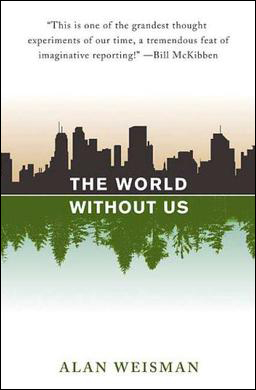
  • The World Without Us—Alan Weisman

    Mr. McGuire: I just want to say one word to you—just one word.
    Ben: Yes sir.
    Mr. McGuire: Are you listening?
    Ben: Yes, I am.
    Mr. McGuire: Plastics.
    Ben: Exactly how do you mean?
    Mr. McGuire: There’s a great future in plastics. Think about it. Will you think about it?
    Ben: Yes, I will.

    While reading Alan Weisman’s fascinating book, The World Without Us, that scene from The Graduate kept playing in my head. Plastics. It turns out that there is a great, or at the very least, long future for all one billion tons of it as it never really breaks down—pieces just become smaller and smaller and by doing so can be swallowed by organisms at the very bottom of the food chain. Which is bad.

    It was frightening to read how quickly plastics have permeated every aspect of our lives (they’ve only been around since the end of World War II), and just how badly we manage what happens to them when we’re done using them. Weisman describes in detail the great wastes of floating plastic that circle the center of each of the world’s oceans.

    There was something about growing up in the waning years of the Cold War that left an indelible mark on the collective imagination of my fellow Gen Xers and myself. We are suckers for stories of our own destruction. Maybe it was the sight of the Statue of Liberty sticking out of the sand at the end of Planet of the Apes, or just the constant fear of nuclear destruction, but as kids, I think most of us had spent some time thinking about what would happen to the world once all of us were gone.

    Weisman looks at all of the things that may benefit from our demise (almost all other species except those that have been domesticated), and all of the things that will simply go to hell without us here to manage them (it turns out that nuclear reactors, refineries, and power plants don’t really run themselves for very long).

    As we all learned in science class and/or the Discovery Channel, water is the one unstoppable force on Earth. You can try to dam it, pump it, or redirect it, but whatever you choose to try and force it to do, you’ve created yourself a full-time job. Without us around to maintain the infrastructure, it will just be a matter of time before rivers undermine and retake the streets of New York, the delta washes away Houston, and, well, we’ve already seen what could happen to New Orleans.

    The book isn’t all doom and gloom, there are very interesting scientific tidbits scattered throughout that I have not encountered anywhere else. His glimpses of the last remaining piece of the primeval forest that once covered Europe made me want to book a flight to the border of Poland and Belarus.

    The human narrative emerging from the Eastern African Rift Valley really points up how we are all really the same, like it or not. For those that will never wrap their minds around that fact, there is the cold comfort that war is actually beneficial for some species, if only by reducing the number of people degrading the environment.

    The amazing return of several endangered animals to the Korean peninsula’s DMZ echoes an idea by environmentalists from The Rewilding Institute who are committed to developing naturalized corridors crossing each of the continents where wildlife could live, migrate, and hopefully, thrive.

    As for humankind, well… we had better get our house in order. To paraphrase Weisman, we choose not to see the biggest elephant in the planet-sized room, although it’s harder and harder to ignore it. Perhaps the last great hope for us is to reduce current population trends before we experience total environmental collapse. It wouldn’t be the first time the Earth has pushed the reset button, and it won’t be the last, it’s just that we are supposed to be the smart ones.

    Every four days, the population of our small planet rises by one million people. If things continue at the current rate of projection, we should reach a mind-blowing total of nine billion people by the middle of this century. According to Dr. Sergei Scherbov from the Vienna Institute of Demography of the Austrian Academy of Sciences and the World Population Program, if families were limited to having only one child, we would be back down to 19th century levels by 2100.

    However, with pronatalism promoters like Elon Musk—14 kids and counting—and Vice President JD Vance pushing the idea that (white) people should have more babies on behalf of the nation, I’m not going to hold my breath.
    Picador Paper

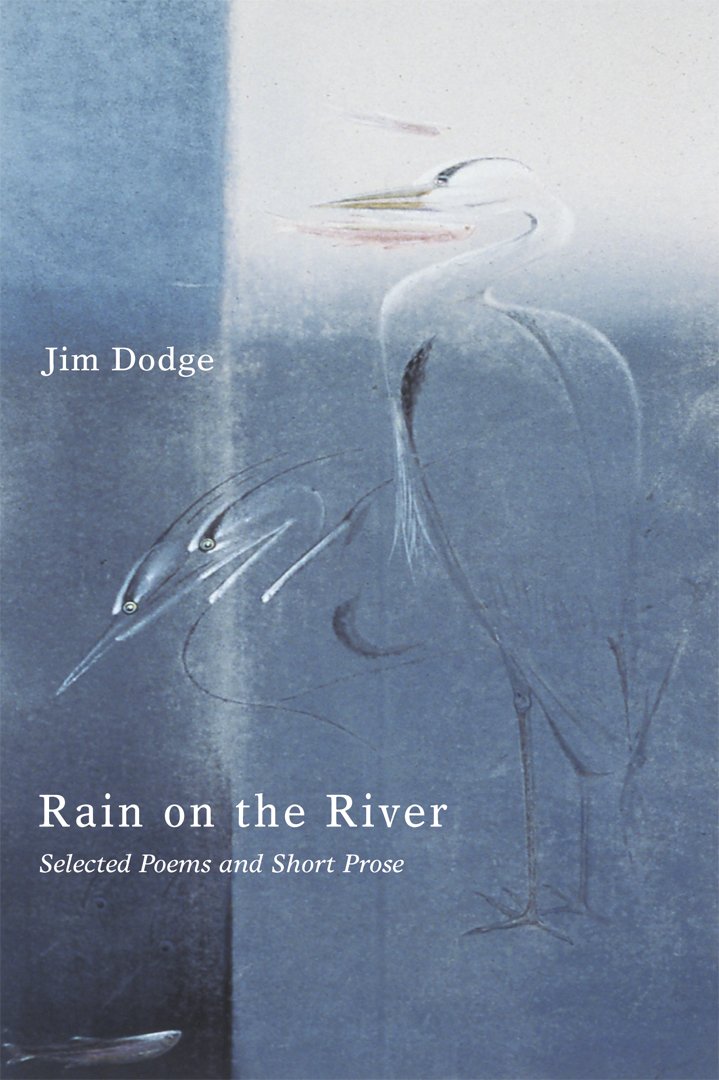
  • Rain on the River: New and Selected Poems and Short Prose—Jim Dodge

    Once and a while, if you’re lucky, you just might run into someone who seems like they have it all figured out; someone who by virtue of example shows you another way of looking at the world and your place in it.

    If you casually told them that you were tempted to follow his or her example (and that person wasn’t driven by ego or fanaticism) that person might look at you like you were crazy, then maybe laugh, and try to talk you out of it. That person might even explain to you why you shouldn’t write in second person narrative. For me that person was Jim Dodge.

    I had the extreme pleasure of taking Jim’s creative writing class at Humboldt State back in the early ’90s, and in retrospect, I should have dropped all my other classes and just hung out with him all day. Oh well, live and learn—which is also the message of much of Dodge’s output: any one of his three novels or the flurry of chapbooks and loose poems that follow in his literary wake might teach you that.

    Rain on the River collects Dodge’s short-form musings from the late ’80s through when it was published in 2002, and during which time, Dodge married his long-time companion and became a father. Many of the later poems deal with the incredible sense of amazement he seemed to be dialed into at that point in his life.

    Dodge’s poetry combines the wonder of some of Richard Brautigan’s more innocent works and the natural familiarity of Gary Snyder, a fellow traveler who Dodge attributes with changing the direction of his life. Dodge, a Humboldt fisheries major at the time, went multi-disciplinarian after reading Snyder’s Hay for the Horses. Dodge’s mixture of Zen awareness and working class perception mirrors Snyder’s own sensibilities.

    In Fishing Devil’s Hole at the Peak of Spring, Dodge relates an archetypical steep downhill battle through briar and bramble (and occasional unexpected flower-strewn meadow) to reach a secret fishing hole, only to lose his fish and end up ass-over-teakettle in the freezing water to which he exclaims:

    “Yarrrrrggggggggaaaaaahhhhhhhhhhh!”
    Yes. Yes by everything holy, yes!
    Even better.

    He writes at his most beatific in a bone-deep closing triptych/manifesto, Holy Shit.

    I believe every atom of creation
    is indelibly printed with divinity.
    I believe in the warm peach
    rolled in the palm of my hand.
    I believe God plays saxophone
    and the Holy Ghost loves to dance.

    Grove Press

    Also by this author:
    Always Something

  • The Confessions of Rick James “Memoirs of a Super Freak”—Rick James

    Jeesus. You cannot accuse Rick James of false advertising, although you probably could have charged him with just about anything else at anytime, and the charges would have stuck.

    It was hard to keep from copy editing James’ autobiography as I read along. Although after a while, the awkward repetition of sentences—and entire paragraphs—began to seem like part of the experience. It was easy to imagine him telling a story and adding the same crazy bit several times in a row.

    Me: “Erm, Mr. James, you just said that.”

    The imaginary Rick James that lives in my head: “Cocaine’s a hell of a drug.”

    The most interesting part of the book for me was the Zelig-like way that James was involved with so many of the people and bands that came to embody the late-’60s rock scene. Who knew?

    Rest in peace, super freak.

    Amber Communications Group

  • The Savage Detectives: A Novel—Roberto Bolaño

    The release of an English translation of Chilean author Roberto Bolaño’s novel The Savage Detectives went head-to-head with the appearance of Denis Johnson’s Tree of Smoke for 2007’s literary news of the year.

    Lucky for us, Bolaño’s novel turned out to be every bit as great as the hype. Long known and respected by Latin American readers, Bolaño was a bit of mystery for most English monolinguists who, if hip to his writings at all, had to subsist on a few slim volumes published by New Directions.

    With the heavyweight house of Farrar, Straus and Giroux picking up the mantle and feature-length articles in the New Yorker and The New York Review of Books touting the novel’s many charms, Bolaño was the toast of the literary world—four years after his death in Spain of liver failure.

    The Savage Detectives begins in a mid-1970s Mexico City where a young poet, Juan García Madero, is invited to join a mysterious fraternity of writers calling themselves “visceral realists.” To call the group a movement is a bit of a stretch as no one, García Madero especially, knows (or is willing to say) exactly what visceral realism is. This doesn’t stop the group’s leaders, Ulises Lima and Arturo Belano (a thin, thinly disguised Bolaño) from conducting purges that would make a Maoist nervous.

    The writers prowl the streets and back alleys of Mexico City, constantly writing, having sex, getting drunk, and ultimately running afoul of a killer pimp and his corrupt police buddies. As one does. Of course, this encapsulation does rough injustice to Bolaño’s kaleidoscope of richly drawn characters, some of which—like rare desert flowers—bloom once, fade, and are never seen again.

    The middle of the book picks up after the poets have returned from the desert where they had been searching for the mysterious poet who started the original visceral realism movement in the 1920s. For the next 400 pages, we see Lima and Belano through the eyes of people who cross paths with them in a 20-year span ending in 1996. This fractured faux-oral biography plays with the notion of identity while giving the disorienting, yet thrilling, feeling of looking at the pair through a many-faceted diamond.

    The final third returns to the Sonoran Desert to tell the story of what happened to Lima, Belano, García Madero, and wayward prostitute Lupe on their search for the elusive Cesárea Tinajero. To paraphrase García Madero: When it was all over, I felt like I knew every inch of that f’ing country. Even more, I felt I was born there.

    Picador

    Also by this author:
    The Insufferable Gaucho
    The Return
    The Romantic Dogs

  • The Insufferable Gaucho—Roberto Bolaño

    In death, Chilean writer Roberto Bolaño has become the Tupac Shakur of the literary world. Since succumbing to liver failure in 2003, he consistently released books for years (including the 900-page masterpiece, 2666). I realize that this incredible feat is due more to the slow process of translation than any powers Bolaño may have developed from beyond the grave, but I really wouldn’t put anything past him.

    The Insufferable Gaucho is a slim but powerful offering of short stories as well as a pair of essays in which he elliptically explores his own approaching mortality and place in the pantheon of Latin American literature. Bolaño’s Police Rat revisits Franz Kafka’s hidden world of Josephine the Singer, or the Mouse Folk. Pepe the Cop, a nephew of Josephine’s who, like his famous aunt, has a sensitivity that raises him a cut above the common rat, is on the tail of a killer in their midst.

    Unfortunately for Pepe—and as we have learned through countless police stories—individuality isn’t necessarily a trait that is appreciated by superior officers. As Josephine’s star wanes, Kafka’s narrator muses, “She is a small episode in the eternal history of our people, and the people will get over the loss of her.”

    One has to wonder if Bolaño was winking at us from his own position as a singing rat of some renown and one fully aware of his own demise. Perhaps it was a poke back at his own growing fame in the years right before he died when he chose the epigram for this book from the end of Kafka’s story: “So perhaps we shall not miss so very much at all.”

    If Martin Scorsese ever decides to direct an animated movie for Pixar, I’d like to see Police Rat on the big screen. I could just imagine Robert De Niro doing the voice-over for Pepe: “Have you ever taken on a weasel? Are you ready to be torn apart by a weasel?” Maybe it’s time for the studio to leave behind Lady and the Trampist fare like Ratatouille, and get fucking real. But I digress.

    In Literature + Illness = Illness, a many-faceted facing of the terminal disease that cut his life short at 50, Bolaño writes, “Books are finite, sexual encounters are finite, but the desire to read and fuck is infinite; it surpasses our own deaths, our fears, our hopes for peace.” It is a shout back from the ragged edge of things, and about as true as anything I’ve ever heard.

    New Directions

    Also by this author:
    The Return
    The Romantic Dogs
    Savage Detectives: A Novel

  • Sunset Park—Paul Auster

    New Yorker book critic James Wood once wrote an article about quintessential—and now sadly lamented—New York author Paul Auster that masqueraded as a synopsis of a new novel before revealing itself as a parody using the tropes that the writer was known for.

    Intellectual male protagonist with a dark sense of loss? Check. Violent accident? Check. Doppelgangers akimbo? Check Check.

    The back-and-forth argument as to whether Auster was merely doing what postmodernist writers do, i.e., borrow liberally from popular culture as to point out the foibles of modern life and paucity of new ideas in the face of existential crisis, or has succumbed to the greasy but comforting business of slinging familiar fare like a grizzled line cook on the graveyard shift had all but killed my desire to read another Auster novel ever since taking all that in. That was a shame.

    I discovered Auster late and had jumped into the deep end quite quickly, devouring In the Country of Last Things, Leviathan, The Book of Illusions, and Oracle Night in short order. Maybe Wood was right, and Auster had become somewhat of a one-trick pony, but if it’s a good trick, what the hell? The weird thing? Wood’s parody actually sounded pretty good. Which brings us to Sunset Park.

    Auster’s novel starts out like a parody of the parody, sort of a literary “fuck you” to the critics. We find twenty-eight-year-old Miles Heller mucking out foreclosures in Florida in his seventh year of self-imposed exile from his family after dropping out of college. Heller’s dark sense of loss stems from accidentally pushing his stepbrother in front of a speeding car while arguing on the side of a winding road in the Berkshires.

    Heller is pretty screwed up, and although characters male and female seem to be powerless before his supposed charms, he’s not a sympathetic enough protagonist to hang a novel upon. He may have actually offed his brother on purpose, and he is carrying on with—that is to say, sodomizing—a seventeen-year-old Cuban girl.

    It’s easy to see how Heller could have been emotionally stunted by his brother’s death, and the girl, Pilar Sanchez, is about the same age as he was when the break occurred. As hard as Auster tries to give their relationship credibility, gifting Sanchez with above-average intelligence and insatiable curiosity, it is unseemly when she refers to her various orifices as the off-limits mommy hole, and the A-OK funny hole.

    Given that this is an Auster book, this strange relationship is mirrored in the backstory of one of Heller’s roommates once he’s forced to retreat back to New York by a greedy, and possibly jealous, older Sanchez girl upon threat of incarceration for statutory rape.

    An old friend of Heller’s, the bearish Bing Nathan, and a group of like-minded twenty-somethings have opened up a squat in the seedy Sunset Park district just in time for Heller’s exile.

    Ellen Brice, a woman who “projected an aura of anxiety and defeat,” had been impregnated at twenty by a sixteen-year-old who she had supposed to be watching. Brice, while physically and emotionally understated, is perhaps the key to Sunset Park.

    Auster’s novel is ultimately about depression, both national and personal, and the poor judgment that can arise from being in that state of mind. He has placed his box of broken crayons smack down in the financial meltdown of 2008; the national malaise mirrors the feeling of Heller’s peers who have burned through their initial promise, and are now adrift.

    The third squatmate, Alice Bergstrom, is neck deep in her dissertation for Columbia. She has become obsessed by William Wyler’s 1946 film, The Best Years of Our Lives; a film that examines the difficulties soldiers returning from WWII had relating to domestic life once again.

    Heller and company don’t have the monolithic bummer of a world at war, but they do have the collapse of a system that was to provide each and every one of them a chance at the American Dream. It is interesting that among his peers, only the vindictive Sanchez sister, a recent immigrant, has the balls to grab a hold and squeeze what she can out of what little she is presented with.

    Within all this, Auster weaves a thematic thread involving baseball pitchers; especially those who showed great promise then flamed out, often tragically. For my money, if you’re a New York author and you’re going to use baseball as a metaphor to describe the human condition, then you’re going to have to go up against Don DeLillo’s masterful set piece that opens Underworld.

    That masterwork transcended any interest one might, or might not have, in the detailed ephemera of the national sport. In the shadow of DeLillo’s big game, Auster’s pitch falls low and outside. Or maybe that’s the point.

    Henry Holt and Co.

  • Which Brings Me to You—Steve Almond & Julianna Baggott

    After coming dangerously close to blowing hot coffee out of my nose while reading Steve Almond’s Not That You Asked, I decided to dive a little deeper into his (sure to be twisted) oeuvre. Swimming around, I bumped into this book, a novel of letters co-written by sometime (and, as quickly becomes apparent, sometimes not) children’s book author Julianna Baggott.

    It’s a conceit that could have ended up too clever by half, but is so well handled that I kicked myself for not thinking of it first. The story begins—like most Hugh Grant movies—at a wedding. I was hooked after the very first line, “I know my own kind. We’re obvious to each other. I suppose this is true of other kinds, too: military brats, for example, anarchists, mattress salesmen, women who got ponies as birthday gifts.”

    Jane ruminates while spying John standing under a white crepe paper wedding bell, “My own kind. I’m not sure there’s a name for us. I suspect we’re born this way: our hearts screwing in tight, already a little broken. We hate sentimentality and yet we’re deeply sentimental.” Sound like anyone you know?

    The two are drawn to each other like cracked magnets—repelling those they should be attracting, yet powerless to avoid the collision with their harmonious defect.

    After a furtive and aborted liaison in a cloakroom—the pair pulls apart long enough to realize that hooking up with a stranger under a bunch of outerwear would be a mutual mistake in two long, sad trains of mistakes—they hatch a plan to exchange letters confessing their respective tragic love lives. The sense that both of them know that this encounter just may be their last best chance permeates the already stuffy coat check.

    “No e-mail.”

    “Absolutely,” he says. “Real letters. Ink. Paper. The whole deal. We’ll be like the pioneers, waiting by our windows for the Pony Express. In bonnets.”

    John kicks things off with the story of Jodi Dunne, his first love at sixteen. Almond nails the tentative stirrings of romance fighting against the poison tide of peer and familial pressure, social awkwardness, and “erotic incompetence” that make up everyone’s high school years.

    Almond’s doppelganger proves his commitment to the spirit of full disclosure by recounting an unfortunate (and nearly geometrically impossible) incident wherein he ejaculates into his own mouth and gives himself, “as known in porn circles,” the Pirate Eye.

    Now, if I hadn’t read Almond’s harrowing tales of his own sexual awakening, I would have called gratuitous bullshit and might have given up on this character, but that would have been a mistake.

    Jane fires back with her tale of Asbury Park boys and a brooding and doomed muscle car driving boyfriend, and we’re off to the races. “Michael Hanrahan was something that I hoped would happen. In fact, I hoped he’s gone off like a bomb in my life, obliterating most everything except me, still standing, albeit charred and dizzy.”

    By the time we find them back at the wedding, “charred and dizzy” describes the state of both characters having weathered romantic disaster after romantic disaster. Will they be able to put it all behind them and start anew, one more time? Or are their respective personnel files too stuffed with abject failure to recommend advancement? Come to think of it, get Hugh Grant’s agent on the phone!

    Algonquin Books of Chapel Hill

    Also by this author:
    (Not That You Asked): Rants, Exploits, and Obsessions

  • The Return—Roberto Bolaño

    This collection of the late Chilean author Roberto Bolaño’s short stories reads like a Cliff Notes introduction to the world he traveled in, and in his literature, populated. The Return is stuffed with whores and hit men, poets and porn stars, Communists and black marketers, ghosts and conjurers, and (obviously) detectives.

    The book kicks off with a pair of stories about misplaced foreigners in Russia, one by choice, and the other by bureaucratic snafu. In Snow, a Chilean ex-pat living in Barcelona tells the story of when he was “a trainer’s assistant for a man of dubious and disconcerting moral character” in post-Soviet Moscow.

    Rogelio Estrada falls in with a gangster called “Billy the Kid” Misha Pavlov and ends up procuring young women for him. “Pavlov’s taste in women was for athletes: long jumpers, sprinters, middle-distance runners, triple jumpers… but his real favorites were the high jumpers. He said they were like gazelles, ideal women, and he wasn’t wrong.”

    Herein lies the rub: one Natalia Chuikova, who Estrada lovingly describes as “five-foot-ten and can’t have weighed more than 120 pounds. She had brown hair, and her simple ponytail gathered all the grace in the world. Her eyes were jet black and she had, I swear, the longest, most beautiful legs I have ever seen.” Let’s just say, that’s not the healthiest attention to detail for a hired goon to have.

    Another Russian Tale follows a Spaniard captured while fighting with the Nazi Germans in a World War II footnote that I was completely unaware of. The Spanish Blue Division was a volunteer force sent by fellow fascist Franco on (according to Wikipedia) “condition they would exclusively fight against Bolshevism (Soviet Communism) on the Eastern Front, and not against the Western Allies or any Western European occupied populations.”

    Within such a historical anomaly lies the kernel of a tragic novel in its own right, but Bolaño purposefully crash lands the premise, turning the man’s fate on a linguistic misunderstanding of a sputtered epithet.

    Detectives, the piece in this collection that best shows off Bolaño’s singular talent is written entirely as an extended dialogue between two policemen pulling duty in a Chilean jail. Bolaño slips in exposition, politics, and world history all without letting the conversation seem forced or false.

    His own literary counterpart, Arturo Belano—co-founder of Visceral Realism and co-hero of The Savage Detectives—makes an appearance as little more than an apparition, but one real enough to shake one of the detectives out of his comfortable stupor.

    In one of the most heartfelt examples of Bolaño’s ability to bring the seedy underbelly of society to life and make it seem as valid a way to live as any other—perhaps even more valid, as hypocrisy must be one of the first vices to burn away in the fires of Earth-bound hell—he chronicles the story of an Italian porn star, Joanna Silvestri, who returns to Los Angeles in 1990 after AIDS has run rampant and rocked the industry. Its “biggest” star, a barely-disguised John Holmes, still haunts the valley, a walking shell of his former self.

    Silvestri knows “Jack” from the old days and looks him up in a tender scene that stands out no less for being surrounded by work-a-day debauchery. Her matter-of-fact accounting of her chosen trade is at first shocking but soon begins to make sense.

    Porn, for the professional who makes it, must end up being just another day at the office, and in the end (no pun intended) don’t we all whore ourselves out in search of the all-mighty dollar?

    And while we’re on the subject, Murdering Whores paints the gruesome picture of a prostitute who singles out a guy coming out of a soccer match, kidnaps him, and tortures him to death. I read somewhere that this collection was originally named after this story: Putas Asesinas. I think it sounds better in Spanish.

    Ghosts real and imagined flit thematically throughout these tales, some of them merely glimpsed and some of them fully present and pissed off. The way that the specter of death hangs over this book, one can’t help but wonder if Bolaño was working through his own approaching mortality, picking it up and observing it from every angle.

    One hopes that he didn’t become like the ghost that narrates the title piece. “I have good news and bad news,” he begins. “The good news is that there is life (of a kind) after this life. The bad news is that Jean-Claude Villeneuve is a necrophiliac.”

    I’ll leave it to the porn star to sum up what Bolaño finally discovered while turning his imminent death into The Return. “I’m tempted to tell him that we are all ghosts, that all of us have gone too soon into the world of ghost movies, but he’s a good man and I don’t want to hurt him, so I keep it to myself. Anyway, who’s to say he doesn’t already know?”

    New Directions

    Also by this author:
    The Insufferable Gaucho
    The Romantic Dogs
    Savage Detectives: A Novel

  • Radio Free Albemuth—Philip K. Dick

    In 1974, science fiction writer Philip K. Dick had what he would come to understand as a religious experience, or more specifically, a Platonic anamnesis—a loss of forgetfulness.

    Triggered by exposure to an ichthys, what is commonly known as a “Jesus fish,” he had a flash of the continued existence of Rome circa 70 AD and felt the certainty of the early Christians that their messiah had just left and would be right back. This experience was followed by several nighttime visions where a beam of pink light beamed information into his head from an alien satellite.

    Dick struggled to understand what had happened to him and wrestled with these themes, most comprehensively in the writing of his exegesis, the VALIS trilogy, and, in 1976, the creation of Radio Free Albemuth. Those that have read VALIS, The Divine Invasion, and The Transmigration of Timothy Archer will recognize this novel as a tentative first crack at the material that would define and consume Dick until his death in 1982.

    This is not to say that this book doesn’t stand on its own, in many ways it is the more down-to-earth take on a very complex and singular cosmology, however, the VALIS mythos did become richer as a result of the extra effort. A lot of the underlying schema in this early draft is pitched in the form of manic exposition.

    Dick would later recast himself as Horselover Fat/Phil and kept the gist of Radio Free Albemuth intact as the experimental film that forms the centerpiece of VALIS. Some characters, however, lose something in the translation. Cancer survivor Sadassa Silvia Aramchek comes across as a better-realized and motivated person than her later incarnation, Sherri Solvig.

    The thinly disguised Richard M. Nixon stand-in, Ferris F. Fremont, is a delightfully evil antagonist, doubly chilling as the portrait rings true in hindsight. All in all, Albemuth is not the place to start exploring later-period PKD, but it is a worthwhile read as well as a fascinating example of what a rewrite/re-imagining can do.

    Mariner Books Classics