Tag: fiction

  • Chronic City: A Novel—Jonathan Lethem

    Jonathan Lethem, Brooklyn native and de-facto chronicler of life in the borough, caught a lot of flak for placing his novel Don’t Love Me Yet (gasp!) in Los Angeles. In Chronic City he casts his gaze back to the city that never sleeps, although his version of Manhattan is, as you might imagine, a little off beam.

    Lethem has a gift for blending literary genres. His fiction always has a smattering of science fiction; his noir, a shadow of the metaphysical. In between 2007’s geographically-maligned book and this novel, he even took a stab at reviving the forgotten superhero, Omega the Unknown for Marvel Comics, and it is the comic book that informs this novel; it’s characters are, by choice, two-dimensional, and play out all the necessary New York archetypes against a flat back drop of apartments, diners, taxi cabs, and improbable not-so-random violence.

    The novel’s protagonist is an empty vessel named Chase Insteadman, a former child actor who lives off of royalties and making the scene with Manhattan’s rich and even richer. His latest claim to fame, and the one that instills him at all the important parties, is his engagement to an astronaut who is marooned on the International Space Station due to a carpet of space mines that have been sowed underneath its orbit by the Chinese.

    Like a lot of things in the novel, this is taken for granted and nobody seems that interested in doing anything about it. Perhaps, and just perhaps, this is Lethem’s dig at the place the international community finds itself in relation to China’s rising prominence on the world stage. At this point, what could we do if they decided to mine the heavens? Write a strongly worded letter? Stop buying… oh, I don’t know, everything? Tariffs?

    Insteadman’s “lostronaut” writes him letters that are reproduced in The New York Times (albeit in the War-Free edition that seems to be favored by most) so that most people know more about what is going on than he does. Insteadman’s problem is that he can’t quite remember his fiancé or how he became an ornamental table setting.

    There are clues from the beginning that all is not right with Lethem’s island, for one, Lower Manhattan has been enveloped in a mysterious dense fog that never dissipates. Like Don DeLillo’s “air-borne toxic event,” there is a disconnect between what’s real and what is simulated. Infinite Jest by David Foster Wallace (whose position, as the Roy E. Disney Professor in Creative Writing at Pomona, Lethem inherited) has become Obstinate Dust by Ralph Warden Meeker, another overly long book that no one finishes.

    The Muppets have become Gnuppets, which may just be a wink at Gnosticism, loosely defined by Wikipedia as “consisting of various belief systems generally united in the teaching that the material cosmos was created by an imperfect god.” The root of Gnostic belief, gnosis, is further defined as “a form of mystic, revealed, esoteric knowledge through which the spiritual elements of humanity are reminded of their true origins within the superior Godhead, being thus permitted to escape materiality.”

    Insteadman’s catalyst, and a fount of esoteric knowledge, is Perkus Tooth, a stand-in for an aspect of Lethem’s own personality in much the same way as Kilgore Trout took the heat for Kurt Vonnegut. Tooth is a twitchy, well-stoned cartoon in the Lester Bangs mold, and although he bristles at being called a rock critic, is as remembered for a stint at Rolling Stone than for a series of intellectual commando-style broadsides that papered the Bowery back in the day.

    The chronic in the novel’s title, is an allusion to the high-grade marijuana that Tooth, Insteadman, and a former activist-turned-mayoral-fixer, Richard Abneg, imbibe with stunning regularity. The trio’s pot-driven cultural insights and conspiracy theorizing are either the best parts of the book, or the worst, depending on one’s own proclivities. I, for one, loved Tooth’s Marlon Brando obsession and manic drive to “connect the dots.”

    Almost exactly halfway through the book, a game-changing possibility is introduced that ties directly into Gnostic belief and, like religion, either explains everything or nothing at all. Tooth’s homeless associate, Biller, finds work designing “treasure” for a virtual universe called Yet Another World, created in turn by Linus Carter, a brilliant but socially inept designer—an imperfect god.

    A description of Carter’s online universe reads like a Lonely Planet guide to Manhattan itself, a “… paraphrase of reality which welcomed role-players, entrepreneurs, sexual trollers, whatever.” The line between real and unreal becomes even more blurred as Insteadman realizes that “Yet Another World wasn’t the only reality that was expansible. Money has its solvent powers…”

    In the end, our empty hero comes to realize it doesn’t really matter if the island that he knows is indeed real, or if anything actually exists on the other side of the Lincoln Tunnel. He learns the hard way that what is important is the real relationships that we form with other travelers.

    As for Tooth, he is finally permitted to escape the Material World through losing everything and finally finding a kindred spirit, in this case a massive three-legged pit bull named Ava. The dog continues to work healing magic on Insteadman after his own collapse into his own footprint.

    Having inherited the responsibility of walking her, he finally abandons Manhattan’s ubiquitous taxis for a street-level view of his realm. “… it occurred to me how Ava’s paces, her bold and patient pissings, must have been immensely comforting to Perkus, and in a sense familiar. Ava’s a kind of broadsider herself, famous within a circle of correspondents, invisible to those who don’t care.”

    Knopf Doubleday Publishing Group

    Also by this author:
    Gun with Occasional Music
    The Wall of the Sky, the Wall of the Eye

  • The Sirens of Titan: A Novel—Kurt Vonnegut

    I have to admit that the main reason I was aware of Vonnegut’s second novel, written in 1959 right after the launch of the space age, was the trivia night nugget that Jerry Garcia of the Grateful Dead owned the movie rights for years and had actually worked up a script with SNL alum Tom Davis.

    After discovering what an amazing feat of imagination this book is, I can see why self-styled hippie intellectuals like Garcia and Davis were drawn to it. It was quite unlike any other novel, even other Vonnegut books, I have read. At no time while devouring The Sirens of Titan could I ever say to myself, “Oh, I know where this is going.”

    Vonnegut sends up the whims of capitalism with the main character Malachi Constant, the richest man in the world. Constant is a playboy/bon vivant who, for reasons to be revealed, was born with the luck to maintain his lifestyle with very little effort on his part.

    At the beginning of the novel, he is summoned to the mansion of Winston Niles Rumfoord, the first man to fly a private rocket to Mars. Rumfoord is also, or so it’s understood, one of the last—having unwittingly flown into a chrono-synclastic infundibulum, which effectively spread his (and his dog’s) existence throughout sort of a wormhole between the Sun and Betelgeuse. (Now you can start to imagine the types of conversations Garcia and Davis must have had.)

    When Earth happens to transect the glitch, once every 59 days, Rumfoord and his dog materialize at the mansion for a short period of time where he alienates his wife, predicts the future (since he happens to actually be everywhere and when), and generally makes everyone uncomfortable.

    Vonnegut’s description of the first meeting of the two men is a good example of his wonderful use of language in this novel: “Winston Niles Rumfoord’s smile and handshake dismantled Constant’s high opinion of himself as efficiently as carnival roustabouts might dismantle a Ferris wheel.” Granted, this all takes place within the first 20 pages or so.

    Rumfoord (and I couldn’t stop substituting Rumsfeld, especially when we begin to find out how his motives, while being altruistic from his viewpoint, are seriously fucked up) goes on to tell Constant that he will end up traveling to Mars, Mercury, Titan, and end up having a son with Mrs. Rumfoord. Awkward.

    Vonnegut’s savaging of organized religion at the back end of this novel counterbalances his having peeled back the curtain hiding the machinations of the free market in the front. Along the way, Mars attacks, a shipwrecked alien manipulates all of human history in an attempt to get a part, and… just read the damned thing.

    I, for one, don’t need some infundibulated asshat to tell me that I will be revisiting this one again and again.

    Random House Publishing Group

  • A Supposedly Fun Thing I’ll never Do Again—David Foster Wallace

    While some authors make you feel stupid for even trying to read them, I’m looking at you, James Joyce, others seem to immediately give the ol’ noggin a boost. While working through this collection of “essays and arguments” by the late David Foster Wallace—sometimes referred to as our generation’s Joyce for his long and obtuse novel Infinite Jest—I made a list of 20 words I had been lamentably unaware of, as well as two that, apparently, he made up: ablated, anaclitic, appurtenance, belletristic, commissure, decoct, enfilade, erumpent, espial, exergue, frottage, hieratic, lalations, otiose, preterite, sedulous, threnody, titivation, ventricose, weltschmerz

    Of those 20 words, I have to say that the most amusing discovery for me was frottage, which I’m sure that some of you already know means, “the act of obtaining sexual stimulation by rubbing against a person or object.” I’m not here to judge; I’m just sayin’. Erumpent is also pretty fun to say, and could actually be onomatopoetic if you were to listen very, very closely.

    As for the two Wallacisms that don’t seem to exist in the English language, some DFW obsessives have pointed out that katexic could be derived from Freud’s katexis referring to “the process by means of which libido energy is tied or placed into the mental representation of a personality, idea, or thing.” In this respect, Wallace’s writing in toto could be viewed as katexic. The energy that must have gone into building such a vocabulary and the means to swing it around as effectively as he did—the creation and subsequent projection of “David Foster Wallace” as a literary force—could easily be imagined as a gloriously sublimated primal urge.

    Plumeocide is another matter. Wordnik member vbogard22 has postulated that “plumeo- could come from the Latin pluma, which means feather or pen [when] added to -cide (Latin, kill) would come to mean something along the lines of ‘death of the pen.’”

    Given Wallace’s tragic end by his own hand, the fact that he may have coined a word for the silencing of a writer is a bit prescient, although I am buoyed by the acknowledgment that the only way to get a writer to shut the hell up is by resorting to plumeocide.

    I was also beguiled, beleaguered, and besotted by Wallace’s use of language, often all at the same time. In much the same way that Wallace thought he was a decent tennis player until he got the opportunity to view the pros in action, I thought that I could, on occasion, craft a clever line. Now I’m reminded that there are players out there operating on a whole different plane.

    I almost forgot to mention that the book is really funny. Cheers to you, DFW, wherever you are.

    Now, about that Goddamned Jest

    Back Bay Books

  • The Romantic Dogs—Roberto Bolaño

    By the time an English translation of Chilean author Roberto Bolaño’s novel The Savage Detectives was finally released in 2007, he had already passed like a glowing comet, having succumbed to a failing liver in 2003. Bolaño’s novel followed every drunken debauch and whim of a group of young Mexico City poets calling themselves visceral realists, but while the prose was beautifully crafted, the book was starkly short on actual poems.

    His biographers make a point of saying that Bolaño’s first love was poetry. Supposedly he only turned to writing novels at the age of 40 after the birth of his son forced him to give up a more bohemian lifestyle. This collection spans his career from 1980 through 1998, the year The Savage Detectives was first published.

    There are many allusions to the novel and, as in much of his work, some of the same territories are traveled, making this a good companion piece to the novel, or visa versa. Several poems deal with the enigmatic figure of a detective, questioning but never solving the seemingly random and unending violence of South America.

    I dreamt of frozen detectives; Latin American detectives who were trying to keep their eyes open in the middle of the dream. I dreamt of hideous crimes and of careful guys who were wary not to step in pools of blood while taking in the crime scene with a single sweeping glance.

    His fascination with forensics would find full flower in 2666, by many accounts, his crowning achievement. At nearly 900 pages, the book is a mammoth project that Bolaño struggled to finish before he died. It is rumored that he even went as far as to postpone a much-needed liver transplant so as to not break stride on his defining work. This struggle is reflected in one of the most moving poems near the end of The Romantic Dogs.

    Muse, wherever you might go I go. I follow your radiant trail across the long night. Not caring about years or sickness. Not caring about the pain or the effort I must make to follow you.

    New Directions

    Also by this author:
    The Insufferable Gaucho
    The Return
    Savage Detectives: A Novel

  • The Yiddish Policemen’s Union: A Novel—Michael Chabon

    I always feel a little sad upon finishing one of Michael Chabon’s novels. The Berkeley author weaves such wonderfully detailed tapestries of language and imagery that a feeling of loss is inevitable once the Big Finish has come and gone.

    That same feeling pervades The Yiddish Policemen’s Union from the jump as the world the characters have inhabited for 60 years is about to be flung on the trash heap of history. The alternative-history conceit is as follows: after the horror of World War II, and a collapse of the stillborn State of Israel, Jewish refugees were settled in an American Federal District hastily carved out of the Alaskan wilderness—and now the lease is up.

    As alcoholic policeman Meyer Landsman begins the search for who may have killed a fellow tenant of his own down-at-the-heels hotel, he heads toward the basement and this throw-away bit of narration: “[Landsman] checks behind the hot-water tanks, lashed to one another with scraps of steel like comrades in a doomed adventure.” The metaphor could be stretched to represent Landsman himself and his ex-wife/new-supervisor Bina Gelbfish who has been sent to tidy up all the loose ends at Sitka Central, and Landman’s investigation is one big throbbing nerve of a loose end.

    Drowning in the machinations of the District’s Hasidic mafia and a cold ocean of slivovitz, Landsman is haunted by a complex chess problem left by the dead tenant. Is it a clue? Is it just a reflection of his own hang-up caused by his chess champion father’s disappointment in him and resultant suicide? Chabon has explored these themes before. He revels in the arcane details of modern Judaica, and I was waiting past the 200-page mark for his patented Big Gay Character to show (he does, although posthumously).

    As Chabon has repeatedly shown—in his on-going bid to become a one-man Coen Brothers of the literary world, chewing up and spitting out genre after genre—it’s not the materials, plot points, or archetypes you start with, it’s how you play the familiar pieces that wins the game.

    Harper Perennial

    Also by this author:
    Gentleman of the Road: A Tale of Adventure

  • The Inexorable March [ficção]

    Jerome Michael Gonçalo parked his beater Toyota pick-up in the Vallejo Ferry Terminal garage, made the sign of the cross, and hustled off to the kiosk to pay. He always chuckled to himself when the machine asked how many days you wanted to stay; as if he would ever leave the vehicle—beat-up or not—overnight.

    Shit, only thing left would be the paint, he mused before the boat to San Francisco let out a warning blast that carried across the four lanes of Mare Island Way, telling all around that they had better get their asses in gear.

    Parking receipt in hand, Gonçalo checked for traffic—knowing that he, himself, was often coming in hot this time of morning—before sprinting across the expanse of asphalt against the light.

    “Jamoke! You almost missed it, brah,” an African-American ferryman half again his size shouted out from behind the aluminum plinth whose only discernible function was to shore up the man’s bulk as he pointed toward the waiting hydrofoil bobbing on the tide.

    One morning, Gonçalo made the mistake of introducing himself as “J-Mike,” which was immediately misconstrued as “Jamoke,” an appellation that gave the older, and much larger, man no end of amusement.

    “Devánte,” Gonçalo panted, disturbingly out-of-breath, “I knew you’d hold it for me, even if you had to grab that rope!”

    “No way, brah,” the man laughed, “we’re on a schedule. Very tight. Like your mom.”

    “Keep it professional, D.,” Gonçalo half-heartedly protested as he reached for the lanyard that held his transit card, only to realize that he wasn’t wearing it. He glanced toward the now-shuttered ticket windows at the terminal. Closed signs announced the inexorable march toward having every human interaction removed from one’s day. And yet, he silently bemoaned, Devánte persists.

    Gonçalo wondered what the folks that had worked those windows were waking up to today, having been replaced by a phone app. He weighed the odds of rushing back to the house for the card but quickly calculated that he’d never make it back in time for the next boat. That would mean driving into the City, a trip that took two maddening hours just days before.

    He had already come to terms with the fact that he would rather be skinned alive than undergo that ordeal again as he had barely made it to work the last time without pissing himself in traffic. Gonçalo had briefly thought about drinking less coffee in the morning and immediately realized that it would never actually happen. Public urination verses the murder charge that would surely follow going cold turkey was a steep, but manageable, price to pay.

    “Use the app, brah,” Devánte, having astutely read the situation, advised. “Your phone, Jamoke.”

    Gonçalo pivoted to attempting to use the very cell phone application that resulted in the sacking of the station agents and felt badly for a moment. The moment passed as the intended exchange failed with an abrasive electronic bleat.

    “Y-eaz-ou l-eaz-ose,” Devánte intoned, revealing a probable past spent somewhere on the midway. “Jump on, Jamoke. This cross must move.”

    Devánte’s counterpart on board the craft rattled off some half-heard, less-understood, instructions. Gonçalo stared blankly at the black rectangle in his hand as he moved toward an open seat and plopped down with a certain resignation.

    All morning, Cassandras on the local news gleefully warned of power blackouts and the possible closure of outdoor public spaces as an impending heatwave threatened to blanket the entire West. Gonçalo had chosen to wear a leaf-patterned Hawaiian shirt in a light fabric, although now he was feeling that perhaps it was sending the wrong message about his mood.

    As the engines below the craft begin to churn the cold morning waters of the Bay, he thought about stepping outside in the quickly warming air and slipping unseen over the rail, his cell phone dropping from his hand and sinking to the muddy bottom even quicker than he himself would.

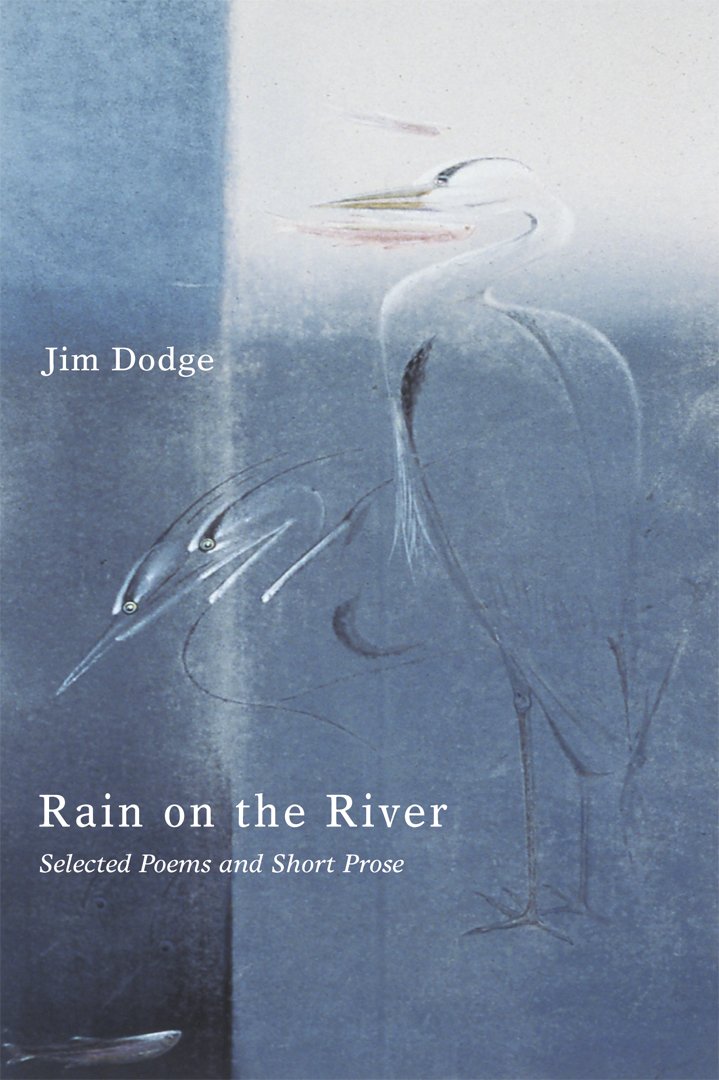
  • Rain on the River: New and Selected Poems and Short Prose—Jim Dodge

    Once and a while, if you’re lucky, you just might run into someone who seems like they have it all figured out; someone who by virtue of example shows you another way of looking at the world and your place in it.

    If you casually told them that you were tempted to follow his or her example (and that person wasn’t driven by ego or fanaticism) that person might look at you like you were crazy, then maybe laugh, and try to talk you out of it. That person might even explain to you why you shouldn’t write in second person narrative. For me that person was Jim Dodge.

    I had the extreme pleasure of taking Jim’s creative writing class at Humboldt State back in the early ’90s, and in retrospect, I should have dropped all my other classes and just hung out with him all day. Oh well, live and learn—which is also the message of much of Dodge’s output: any one of his three novels or the flurry of chapbooks and loose poems that follow in his literary wake might teach you that.

    Rain on the River collects Dodge’s short-form musings from the late ’80s through when it was published in 2002, and during which time, Dodge married his long-time companion and became a father. Many of the later poems deal with the incredible sense of amazement he seemed to be dialed into at that point in his life.

    Dodge’s poetry combines the wonder of some of Richard Brautigan’s more innocent works and the natural familiarity of Gary Snyder, a fellow traveler who Dodge attributes with changing the direction of his life. Dodge, a Humboldt fisheries major at the time, went multi-disciplinarian after reading Snyder’s Hay for the Horses. Dodge’s mixture of Zen awareness and working class perception mirrors Snyder’s own sensibilities.

    In Fishing Devil’s Hole at the Peak of Spring, Dodge relates an archetypical steep downhill battle through briar and bramble (and occasional unexpected flower-strewn meadow) to reach a secret fishing hole, only to lose his fish and end up ass-over-teakettle in the freezing water to which he exclaims:

    “Yarrrrrggggggggaaaaaahhhhhhhhhhh!”
    Yes. Yes by everything holy, yes!
    Even better.

    He writes at his most beatific in a bone-deep closing triptych/manifesto, Holy Shit.

    I believe every atom of creation
    is indelibly printed with divinity.
    I believe in the warm peach
    rolled in the palm of my hand.
    I believe God plays saxophone
    and the Holy Ghost loves to dance.

    Grove Press

    Also by this author:
    Always Something

  • The Savage Detectives: A Novel—Roberto Bolaño

    The release of an English translation of Chilean author Roberto Bolaño’s novel The Savage Detectives went head-to-head with the appearance of Denis Johnson’s Tree of Smoke for 2007’s literary news of the year.

    Lucky for us, Bolaño’s novel turned out to be every bit as great as the hype. Long known and respected by Latin American readers, Bolaño was a bit of mystery for most English monolinguists who, if hip to his writings at all, had to subsist on a few slim volumes published by New Directions.

    With the heavyweight house of Farrar, Straus and Giroux picking up the mantle and feature-length articles in the New Yorker and The New York Review of Books touting the novel’s many charms, Bolaño was the toast of the literary world—four years after his death in Spain of liver failure.

    The Savage Detectives begins in a mid-1970s Mexico City where a young poet, Juan García Madero, is invited to join a mysterious fraternity of writers calling themselves “visceral realists.” To call the group a movement is a bit of a stretch as no one, García Madero especially, knows (or is willing to say) exactly what visceral realism is. This doesn’t stop the group’s leaders, Ulises Lima and Arturo Belano (a thin, thinly disguised Bolaño) from conducting purges that would make a Maoist nervous.

    The writers prowl the streets and back alleys of Mexico City, constantly writing, having sex, getting drunk, and ultimately running afoul of a killer pimp and his corrupt police buddies. As one does. Of course, this encapsulation does rough injustice to Bolaño’s kaleidoscope of richly drawn characters, some of which—like rare desert flowers—bloom once, fade, and are never seen again.

    The middle of the book picks up after the poets have returned from the desert where they had been searching for the mysterious poet who started the original visceral realism movement in the 1920s. For the next 400 pages, we see Lima and Belano through the eyes of people who cross paths with them in a 20-year span ending in 1996. This fractured faux-oral biography plays with the notion of identity while giving the disorienting, yet thrilling, feeling of looking at the pair through a many-faceted diamond.

    The final third returns to the Sonoran Desert to tell the story of what happened to Lima, Belano, García Madero, and wayward prostitute Lupe on their search for the elusive Cesárea Tinajero. To paraphrase García Madero: When it was all over, I felt like I knew every inch of that f’ing country. Even more, I felt I was born there.

    Picador

    Also by this author:
    The Insufferable Gaucho
    The Return
    The Romantic Dogs

  • The Insufferable Gaucho—Roberto Bolaño

    In death, Chilean writer Roberto Bolaño has become the Tupac Shakur of the literary world. Since succumbing to liver failure in 2003, he consistently released books for years (including the 900-page masterpiece, 2666). I realize that this incredible feat is due more to the slow process of translation than any powers Bolaño may have developed from beyond the grave, but I really wouldn’t put anything past him.

    The Insufferable Gaucho is a slim but powerful offering of short stories as well as a pair of essays in which he elliptically explores his own approaching mortality and place in the pantheon of Latin American literature. Bolaño’s Police Rat revisits Franz Kafka’s hidden world of Josephine the Singer, or the Mouse Folk. Pepe the Cop, a nephew of Josephine’s who, like his famous aunt, has a sensitivity that raises him a cut above the common rat, is on the tail of a killer in their midst.

    Unfortunately for Pepe—and as we have learned through countless police stories—individuality isn’t necessarily a trait that is appreciated by superior officers. As Josephine’s star wanes, Kafka’s narrator muses, “She is a small episode in the eternal history of our people, and the people will get over the loss of her.”

    One has to wonder if Bolaño was winking at us from his own position as a singing rat of some renown and one fully aware of his own demise. Perhaps it was a poke back at his own growing fame in the years right before he died when he chose the epigram for this book from the end of Kafka’s story: “So perhaps we shall not miss so very much at all.”

    If Martin Scorsese ever decides to direct an animated movie for Pixar, I’d like to see Police Rat on the big screen. I could just imagine Robert De Niro doing the voice-over for Pepe: “Have you ever taken on a weasel? Are you ready to be torn apart by a weasel?” Maybe it’s time for the studio to leave behind Lady and the Trampist fare like Ratatouille, and get fucking real. But I digress.

    In Literature + Illness = Illness, a many-faceted facing of the terminal disease that cut his life short at 50, Bolaño writes, “Books are finite, sexual encounters are finite, but the desire to read and fuck is infinite; it surpasses our own deaths, our fears, our hopes for peace.” It is a shout back from the ragged edge of things, and about as true as anything I’ve ever heard.

    New Directions

    Also by this author:
    The Return
    The Romantic Dogs
    Savage Detectives: A Novel

  • Asylum (Padrão dos Descobrimentos) [poema]

    Even as children, we suspected our world
    was broken—as if our hometown had been lifted
    and dropped from a much higher place.
    Everyday during the long summers we explored
    the edges of the pieces—the spots
    where the pattern no longer matched up.

    Thirty years later, it’s harder to get up
    the motivation to get out and map the world,
    to find the forgotten corners and secret spots.
    The veil of mystery has been lifted,
    and the edge of the continent explored.
    The great unknown now muffled by a sense of place.

    From Yerba Buena to Eureka, I thought I had found the place
    to put down roots—and as many times—I pulled them up.
    A privateer, up and down the coast I wandered,
    only to miss the hidden parts of the world.
    No longer lost, my spirits are still lifted
    when I think about those magic spots.

    Days spent in rapture until our eyes saw spots,
    we rode from place to place.
    As we grew, our dreams were lifted,
    until too soon—we just grew up.
    It’s every man’s destiny to make his way in the world,
    and every boy’s to forget the land he conquered.

    Down in the creeks and ravines we explored,
    searching for those perfect spots
    away from the bustle of the world.
    We were driven to find a mystic place,
    somewhere where the rules were not put up,
    and our pirate banner could be lifted.

    With found bits of lumber are battlements yet lifted
    into treetops no longer noticed or surveyed?
    The old men below don’t bother to look up,
    knowing that gazing into the sun pays nothing but blindness.
    With everything marked and in its proper place,
    wonder fades into the background of the world.

    If only the veil of maturity could be lifted up,
    and we could again see the world as an enchanted place.
    The places we knew as youth could provide asylum
    even for the grown.

    Published in The Hot Air Quarterly, Number Sixteen

    Photo/Ray Larsen