Tag: non-fiction

  • (Not That You Asked): Rants, Exploits, and Obsessions—Steve Almond


    I picked up this collection of essays from Boston writer (and Bay Area native) Steve Almond on a total whim and found it to be one of the explosively funny books I’ve read since Ozzy’s autobiography. Almond is just nuts—and honest to a fault—which may or may not be a product of his insanity.

    Not that You Asked is organized thematically with the chapter entitled About My Sexual Failure (Not that You Asked) being the most cringe-worthy of the bunch. In the extended piece Shame On Me (Why My Adolescence Sucked Donkey Cock), we are regaled with tales of his late-blooming sexuality via the water jets in the Almond family hot tub; hand jobs con sharp, inexperienced, fingernails; the family dog’s rooting out of a used condom from the trash and subsequent tug-of-war with Almond’s mother leading to predictable, but no less horrifying results; and getting publicly busted for shoplifting condoms and Sta-Hard gel from Longs Drugs.

    Chestfro Agoniste and My First Fake Tits reveal waxing and breast implants to both be somewhat less wonderful than advertised, the former resulting in this conversation painfully recounted by Almond. “Me: Ow! Please. Please, don’t—Fuck! Her: It’s almost out. Me: You have to do it faster, really—No! Ow! Fuck! Please move to another—that part really—Owwww! Her: Stop being a baby. Me: Please, sweetie. Please, I’m not joking. Her: Lie still. Just fucking lie still and let me— Me: Owwwww! You fucking bitch! You mean fucking bitch!”

    For every writer who has attempted to wince his or her way through a sex scene, Almond offers a 12-step program that lays out some pretty good (and common sense) advice, such as, Step 5 (Real people do not talk in porn clichés): “Most of the time, real people say all kinds of weird, funny things during sex, such as ‘I think I’m losing circulation,’ and ‘I’ve got a cramp in my foot,’ and ‘Oh, sorry!’”

    Given my utter lack of interest in the sport of baseball, it took me awhile to battle my way through one of the longer essays in the collection, Red Sox Anti-Christ, which ended up having some interesting and insightful things to say about sport and its place in a war-loving society such as our own. He equates the coverage of the kick off to the invasion of Iraq with a major sporting event. “Nightly highlight reels charted the day’s major offensive drives. Correspondents offered sand swept on-the-field interviews with our burly combatants, while generals served up bromides fit for a head coach.”

    Almond goes further and takes part of the blame for the unnecessary war onto his own shoulders. “As a fan, I had helped foster a culture governed by the sports mentality, in which winning mattered above all else, and the application of violence was seen as a necessary means to that end rather than a betrayal of our democratic standards.”

    In a chapter entitled In Tribute to My Republican Homeys, Almond turns on the vitriol. Demagogue Days, Or How the Right-Wing Hateocracy Chewed Me Up and Spat Me Out spins the story of how Almond, an adjunct professor at Boston College at the time, resigns over the school’s invitation of Condoleezza Rice to give the commencement speech. Almond uses the format of Dante’s descent into hell to map out all of the insidious devils of punditry that all wanted a piece of him for a brief, terrifying moment.

    With the ability to ride out ridiculous situations with the artistry of a Mavericks surfer (see How Reality TV Ate My Life), one starts to wonder just what would really get to Almond, what would crack his smooth, white chocolate exterior and let the creamy nougat pour forth?

    That force majeure comes in the form of a baby girl, the arrival of whom is hilariously recounted in 10 Ways I Killed My Infant Daughter in Her First 72 Hours of Life. It is this window into the hopes and fears that people have shared from time immemorial, that saves Not That You Asked from being simple a collection of ravings from another smart ass cynic. Not that there’s anything wrong with that.

    Random House

    Also by this author:
    Which Brings Me to You
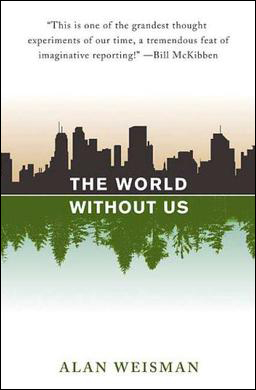
  • The World Without Us—Alan Weisman

    Mr. McGuire: I just want to say one word to you—just one word.
    Ben: Yes sir.
    Mr. McGuire: Are you listening?
    Ben: Yes, I am.
    Mr. McGuire: Plastics.
    Ben: Exactly how do you mean?
    Mr. McGuire: There’s a great future in plastics. Think about it. Will you think about it?
    Ben: Yes, I will.

    While reading Alan Weisman’s fascinating book, The World Without Us, that scene from The Graduate kept playing in my head. Plastics. It turns out that there is a great, or at the very least, long future for all one billion tons of it as it never really breaks down—pieces just become smaller and smaller and by doing so can be swallowed by organisms at the very bottom of the food chain. Which is bad.

    It was frightening to read how quickly plastics have permeated every aspect of our lives (they’ve only been around since the end of World War II), and just how badly we manage what happens to them when we’re done using them. Weisman describes in detail the great wastes of floating plastic that circle the center of each of the world’s oceans.

    There was something about growing up in the waning years of the Cold War that left an indelible mark on the collective imagination of my fellow Gen Xers and myself. We are suckers for stories of our own destruction. Maybe it was the sight of the Statue of Liberty sticking out of the sand at the end of Planet of the Apes, or just the constant fear of nuclear destruction, but as kids, I think most of us had spent some time thinking about what would happen to the world once all of us were gone.

    Weisman looks at all of the things that may benefit from our demise (almost all other species except those that have been domesticated), and all of the things that will simply go to hell without us here to manage them (it turns out that nuclear reactors, refineries, and power plants don’t really run themselves for very long).

    As we all learned in science class and/or the Discovery Channel, water is the one unstoppable force on Earth. You can try to dam it, pump it, or redirect it, but whatever you choose to try and force it to do, you’ve created yourself a full-time job. Without us around to maintain the infrastructure, it will just be a matter of time before rivers undermine and retake the streets of New York, the delta washes away Houston, and, well, we’ve already seen what could happen to New Orleans.

    The book isn’t all doom and gloom, there are very interesting scientific tidbits scattered throughout that I have not encountered anywhere else. His glimpses of the last remaining piece of the primeval forest that once covered Europe made me want to book a flight to the border of Poland and Belarus.

    The human narrative emerging from the Eastern African Rift Valley really points up how we are all really the same, like it or not. For those that will never wrap their minds around that fact, there is the cold comfort that war is actually beneficial for some species, if only by reducing the number of people degrading the environment.

    The amazing return of several endangered animals to the Korean peninsula’s DMZ echoes an idea by environmentalists from The Rewilding Institute who are committed to developing naturalized corridors crossing each of the continents where wildlife could live, migrate, and hopefully, thrive.

    As for humankind, well… we had better get our house in order. To paraphrase Weisman, we choose not to see the biggest elephant in the planet-sized room, although it’s harder and harder to ignore it. Perhaps the last great hope for us is to reduce current population trends before we experience total environmental collapse. It wouldn’t be the first time the Earth has pushed the reset button, and it won’t be the last, it’s just that we are supposed to be the smart ones.

    Every four days, the population of our small planet rises by one million people. If things continue at the current rate of projection, we should reach a mind-blowing total of nine billion people by the middle of this century. According to Dr. Sergei Scherbov from the Vienna Institute of Demography of the Austrian Academy of Sciences and the World Population Program, if families were limited to having only one child, we would be back down to 19th century levels by 2100.

    However, with pronatalism promoters like Elon Musk—14 kids and counting—and Vice President JD Vance pushing the idea that (white) people should have more babies on behalf of the nation, I’m not going to hold my breath.

    Picador Paper