
Tag: poems

  • The Song Mt. Tamalpais Sings—Lew Welch

    Scanning the used books over at the wonderful Book Passage in Corte Madera, I came across several faded paperbacks by Beat writer Lew Welch. One of the lesser-known Beats, Welch is probably best known as the other hopeless drunk in Jack Kerouac’s majestically depressing Big Sur.

    Flipping through his work, however, I found Welch to be a gifted poet with a value system more in line with the nascent hippie movement that was emerging in the mid-to-late-’60s. That Welch disappeared into the woods around Nevada City with his 30-30 after writing a goodbye note only adds to the mystery of this important writer I had somehow missed during my fascination with all things Beat.

    Welch’s brief, lyrical chapbook The Song Mt. Tamalpais Sings, originally published in 1969, and reprinted with three additional poems by Berkeley’s Sand Dollar in 1970, features a stunning wrap-around scratch board illustration of the Marin Headlands with a slightly more provincial San Francisco peeking (peaking?) over the hills.

    The title poem, the first in a pair of bookends that feature the mountain, intones the mantra: This is the last Place. There is nowhere else to go, as Welch boils down the western movement of humankind. Centuries and hordes of us, from every quarter of the earth, now piling up, and each wave going back to get some more. Buddy, you have no idea.

    The last poem, Song of the Turkey Buzzard, looks deeper into a riddle posed in a triptych of Zen-like koans (complete with commentary by Welsh’s literary alter−ego, the Red Monk): If you spend as much time on the Mountain as you should, She will always give you a Sentient Being to ride… What do you ride? (There is one right answer for every person, and only that person can really know what it is)

    Of course Welch, like anyone would, wishes for a cool totem animal like a mountain lion, but the mountain has other ideas: Praises, Tamalpais, Perfect in Wisdom and Beauty, She of the Wheeling Birds. Throughout the course of the poem, the mountain throws some pretty clear hints at him until in the second canto, he finally acquiesces, and given his final act two scant years later, it begs one to wonder if he hadn’t been planning it all along.

    With proper ceremony disembowel what I no longer need, that it might more quickly rot and tempt my new form NOT THE BRONZE CASKET BUT THE BRAZEN WING SOARING FOREVER ABOVE THEE O PERFECT O SWEETEST WATER O GLORIOUS WHEELING BIRD

    Sand Dollar

  • Genesis Angels: The Saga of Lew Welch & the Beat Generation—Aram Saroyan

    At the behest of poet Ted Berrigan, a young Aram Saroyan interviewed a becalmed and nearly forgotten Jack Kerouac in 1967 for the Paris Review. Saroyan describes this meeting much later in an article for The Poetry Foundation. It is a watershed moment, one generation testing the next, and Saroyan walks away with Jack’s benediction, “You’ll do, Saroyan.”

    I doubt that Kerouac had in mind for the young writer to go forth and pen the History of the Beats, but 12 years later, Saroyan attempted just that. Perhaps the tired Kerouac recognized a comrade-in-arms, as Saroyan’s sensibilities would have fit right in with the tea-loving, electrified wordslingers of the past. His official biography for his collected papers at the University of Connecticut Libraries reads, “In the late 1960s Saroyan experimented with marijuana and began to develop a career as a poet.” Sounds about right; let’s go!

    Genesis Angels is no straight-ahead biography, but a long prose poem in its own right. Saroyan attempts to capture the feeling of the era, the mad rush toward an uncertain future and away from a stifling mid-century American mindset that had all but disappeared by the time he started his journey.

    Saroyan identifies the Eisenhower years with the monster movies that were throwing their own existential warnings up on the screens of the ’50s and early ’60s. “We were being condemned to endure a complete rescheduling of human experience: our routines no longer in any relation to the planet or the landscape or our neighbors. We had willingly locked ourselves up with comfort and convenience and suffered an immediate transformation. It was we ourselves who had become The Thing, The Blob, inside our private Houses of Wax.”

    The degree that Saroyan is successful in capturing the Beat gestalt, from the far remove of 1979, depends on how susceptible you are to that particular brand of amphetamine-driven patter. Me? I can’t get enough.

    On Jack Kerouac meeting Neal Cassidy: “Now this is where it did combust because what happened was Jack saw Neal and listened to his wild, never-get-a-word-in-edgewise, spontaneous patte… this man was a rapid, word chasing man chasing word chasing man chasing time chasing space—lookout! just like his driving—saved by exposure and the rare posture of ecstatic brotherhood.”

    On Allen Ginsburg: “Allen had the conceptual center of the universe in his belly and breath… so that then he could inhale and exhale planets, and snow storms, windows, and paper towels, Mickey Mouse and Hollywood, tits, and cocks, ambushes, and semesters, toothbrushes, and Coca-Cola—the whole litterbug earth with Indians and business man and women giving birth, inside his nature, and available.”

    Strangely absent from this cluttered stage is Welch himself. Whether outshined by the titanic personalities around him, or just a quiet guy whose poems did the speaking for him, I didn’t come away with any better sense of the man than when I started. This isn’t a deficit in research; the University of Connecticut’s Saroyan collection contains a recorded interview with Welch and David Meltzer from 1969, and Saroyan himself interviewed poet Joanne Kryger about Welch in 1977, presumably while doing research for the book.

    Perhaps the problem is that—like a total eclipse, or some other natural rarity—Welch began disappearing as soon as he appeared. You have to catch these things when they happen or you’re out of luck. Until next time.

    Saroyan best captures Welch’s spirit in a few throw away lines describing the importance of becoming a poet:

    Be a poet and save the world forever.
    And don’t forget to take a sweater.
    Put this flower in the peanut bottle with some cold water.
    It’ll be here when you get home.
    That’s the way the universe works.

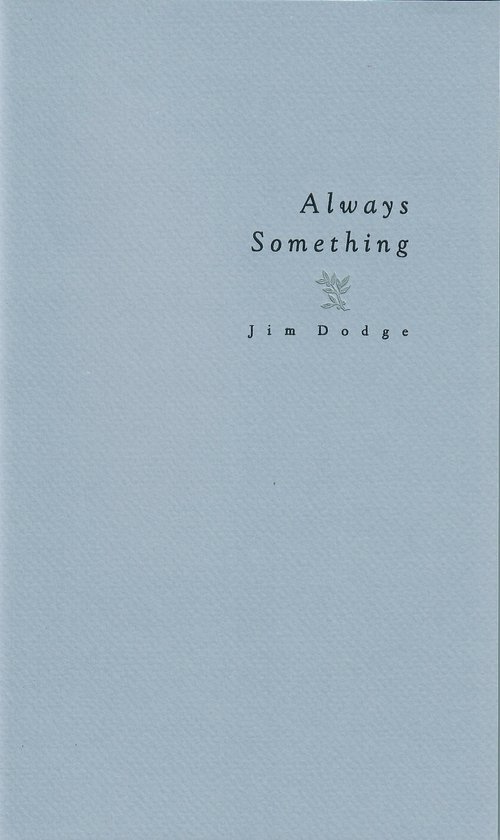
  • Always Something—Jim Dodge

    I am always hoping that Jim Dodge will surprise us all and finally announce the novel he has long been threatening to finish; his most recent, Stone Junction, dropped in the far-distant reality of 1990. A collection of poetry, Rain on the River: New and Selected Poems and Short Prose, followed twelve years later in 2002, but only served to whet our appetite for his deft wordplay and masterful use and abuse of the English language.

    Whenever I get the itch, now that the all-mighty algorithms know everything, I’ll check in to see what the good ol’ apple picker has been up to. Imagine my surprise when I discovered that Idaho’s Limberlost Press, a beautifully archaic letterpress printer of chapbooks, broadsides, and I’m guessing… manifestos, had published a new collection of poems, Always Something, in 2023.

    Limberlost’s publications are artifacts from an anachronistic world of archival-quality papers and hand-sewn assembly—not a shout against the digital darkness, but more of a whispered word of kinship in a sun-dappled meadow, but I digress.

    I recognized one of the poems, the sublime, Owl Feather, from a broadside that Dodge was gracious enough to send me upon the publication of my first novel, welcoming me into the guild ten years ago, so this collection has been simmering for a minute, all the better to let the flavors infuse.

    I have no doubt there are powers far beyond us
    Because the grey-and-brown barred wing feather
    From a Great Horned Owl that I found this afternoon
    While walking the old logging road above McKenzie Creek
    Seemed beautiful beyond the ability to behold it…

    Dodge’s capacity for wonder has always been a feature of his personality and his work, it’s in evidence here as is his prankster’s sense of humor. In A Manual of Sabotage, he incites delightful mischief.

    Of course, only a heartfelt kiss can derail a munitions train,
    Explode the tube in a color TV,
    Destroy a computer’s mother board,
    And get you so exited
    You want to feel completely totaled and totally complete.

    Further imaginings should be enough
    To get us together to wreck more stuff.


    I, for one, am ready.

    Limberlost Press


    Also by this author:

    Rain on the River: New and Selected Poems and Short Prose

  • Refusing Heaven—Jack Gilbert

    Poet Jack Gilbert, who passed in 2012, was 80 years old when he published this collection of poems in 2005. That’s a long time to observe how life works and Gilbert has spent much of it in introspection. He was there in San Francisco during the first flowering of the Beats, yet he never really became one of the gang.

    To read Gilbert is to realize that he is a man who relishes his space; many of the poems in Refusing Heaven paint a picture of self-imposed exile, whether physically, as in a remote Greek island, or spiritually—hence the title. This tendency to separate himself from his peers does not paint him as a curmudgeon; quite the opposite is true. It seems that Gilbert appreciates the contrast between company and isolation so that each might stand out more clearly in relief.

    In the Buddhist-inflected poem, Happening Apart From What’s Happening Around It, Gilbert starts out by giving practical examples of his philosophy. There is a vividness to eleven years of love because it is over. A clarity of Greece now because I live in Manhattan or New England. Later in the poem he observes a spiritual aspect to this clarity. When I was walking in the mountains with the Japanese man and began to hear the water, he said, “What is the sound of the waterfall?” “Silence,” he finally told me. The stillness I did not notice until the sound of water falling made apparent the silence I had been hearing long before.

    After absorbing this bit of enlightenment, Gilbert then gets to the crux of the matter by positing one of the greatest questions of all time. I ask myself what is the sound of women? What is the word for that still thing I have hunted inside them for so long? In the poem, Moreover, Gilbert finally reveals what he suspects that transitory and elusive thing to be. We are given the trees so we can know what God looks like. And rivers so we might understand Him. We are allowed women so we can get into bed with the Lord, however partial and momentary that is.

    Perhaps it is only with the wisdom that 80 years affords that one can strive to understand women one moment while deftly distilling poetry’s worth and reason down to its essence the next. We lose everything, but make harvest of the consequence it was to us. Memory builds this kingdom from the fragments and approximation. We are gleaners who fill the barn for the winter that comes on.

    Refusing Heaven is a rare chance to experience a poet still in bold command of his powers looking back at what was a long life full of achievement and adversity in equal measure. In the sublime, Failing and Flying, he reminds us that although we tend to focus on the cautionary aspect of the Icarus myth, we forget that he actually did fly quite well. For awhile.

    Gilbert seems to be summing up his feelings about his own looming mortality when he writes: I believe Icarus was not failing as he fell, but just coming to the end of his triumph.

    Knopf Doubleday Publishing Group