Tag: Van Morrison

  • Happy 80th, Van the Man!


    Belfast’s beloved son Van Morrison has been a recording artist longer than I’ve been alive. Them’s first, and penultimate, album—having dropped in ’65—preceded me by a full year. This is to say that the mystic blues shouter has always been around as far as I’m concerned.

    Growing up on AM radio, Dr. Don Rose on San Francisco’s KFRC must have introduced the first Morrison classic I fell in love with, probably 1970’s Domino from His Band and the Street Choir, still one of my all-time favorite records.

    Although our childhoods were separated by a good 21 years and the Atlantic Ocean, I have to think of him as a soul brother equally steeped in Blues and R&B from our respective impressionable ages. My father used to sit me down, when he wasn’t blaring Fats Domino or Little Richard’s Specialty catalog as loud as it would go, and explain what the drummers on Count Basie and Duke Ellington’s seminal First Time! The Count Meets The Duke were doing before continuing his ongoing dissertation on Jimmy Reed’s Live at Carnegie Hall.

    As a result of what the less-enlightened among us might consider prolonged polyrhythmic brainwashing, I have often felt that perhaps I was grown in a weird sonic test tube to be a Van Morrison fan. The way that our man can stretch a phrase so that it lands off the beat like a jazz singer, or drop into a shamanic trance state to rival John Lee Hooker, it was a language I was well familiar with by the time he began to eschew the easy radio hit.

    I can still remember watching Van Morrison: The Concert on PBS late one night in 1990. I think I was half paying attention, digging the traditional Irish songs that had been on his collaboration with the Chieftains a couple of years previous. A good hour into it, the band broke into In the Garden from 1986’s No Guru, No Method, No Teacher at a frenetic pace. My first thought was that they were disrespecting the elegiac beauty of the song, a meditative highlight of the album.

    And then, with the crack of a snare drum, as suddenly as we were launched into the firmament by the upward thrust of the band, we break gravity and jettison the boosters. Van touches the seventh verse (so lightly) and then slips into a gravity-free trance, repeating, “You fell, you fell, you fell,” tasting and twisting both syllables, recasting them, rejecting them, pacing the stage like a nervous panther in a cage, and finally placing them, “from the garden.” I remember walking toward the TV, and saying out loud, “What the fuck?”

    I had seen plenty of live music by then, but I had never seen someone so enraptured by the moment, in the moment, of the moment. And who the hell is he talking about? Is he singing to mankind or speaking to the angels that were cast out of heaven? Maybe he doesn’t even know. Maybe it doesn’t even matter. It’s fucking poetry, it is.

    That song still makes me tear up every time I hear and I don’t know why. Is there a primal longing to return to the proverbial garden that Morrison tapped into? I am sure that he would just remark, as he has many times, “It’s just a song. I’m just a songwriter.” I call bullshit, but OK, I get it. The creative arts, when one is open and lucky, exist in a realm of real magic. It is best not to piss off the muse by calling it out.

    I have always respected Morrison’s high regard of the muse and his willingness to follow it wherever it might lead. The two records he produced during the COVID pandemic, and subsequent lockdown, gave his critics plenty of raw meat to devour. However, after a good 60 years in a game he, himself, has eschewed in both in song and action, I felt, and still feel, that the man has well earned the right to respond to societal events however he might feel appropriate.

    One can’t be surprised that an artist who sang the following, nearly 55 years ago, might not give a shit what anyone has to say about his business one way or another: Don’t wannna discuss it / Think it’s time for a change / You may get disgusted / Start thinkin’ that I’m strange / In that case I’ll go underground / Get some / Heavy rest / Never have to worry / About what is worst or what is best

    A re-entrenchment along the lines of Bob Dylan’s two solo folk records of 1992–93, seem to have redirected Morrison’s inspiration. 2023’s Moving on Skiffle revisited the type of music he played in his youth, before the trap and trappings of fame; whereas Accentuate the Positive, from the same year, celebrated rock & roll at it’s earliest, and least calcified, incarnation.

    This summer’s Remembering Now reads at first as an aural CV of all of the genres that Morrison has explored over the years, with familiar places and themes bubbling up in the fragrant stew. The closest cousin in the Man’s deep catalog sounds to be 1991’s Hymns to the Silence, one of my all-time favorites.

    Eighty years on, Morrison’s voice sounds as strong as ever; age bringing, if anything, a resonance that was missing in the early days. Listening back, I hear the young, brash rocker of 1965–66 as a trumpet, blasting out the theme over the roar of the band, announcing the new world as it was unrolled before it. These days, Morrison’s instrument has become a tenor sax, deep and luxurious, able to evoke longing and defiance with equal strength and intention.

    Roll me over, Romeo.
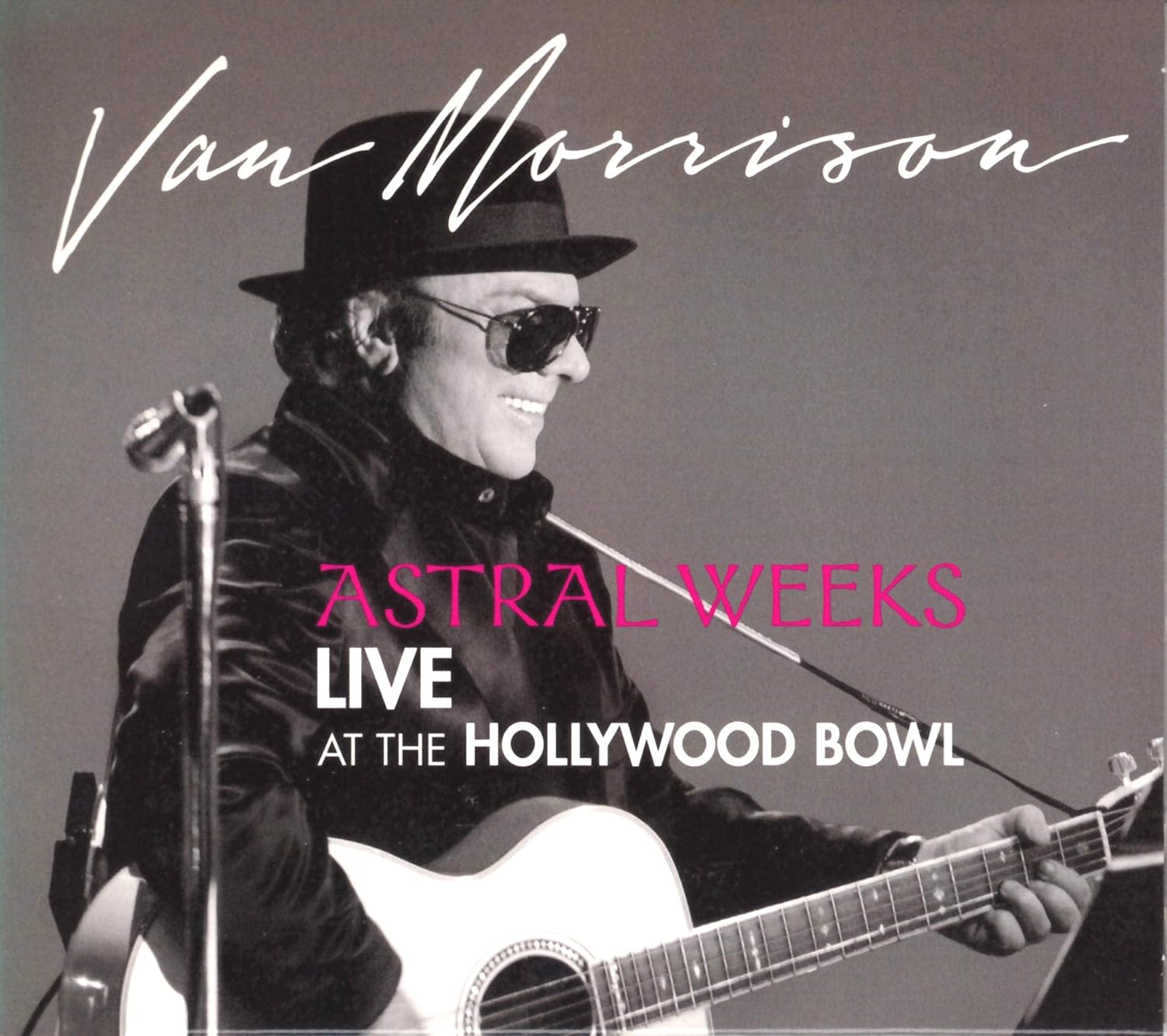
  • Put on This Record: Astral Weeks Live at the Hollywood Bowl—Van Morrison [2009]

    On the list of things I never thought I’d see (or hear), Van Morrison revisiting his seminal 1968 album, Astral Weeks, has lived at the top of the leaderboard for more years than I’d care to count.

    Over the years, the Man has developed a thick-skinned persona that holds stardom and the chasing of an easy buck at a disdainful arm’s length. He is not going to be your trained monkey, no matter how badly you might want it. You want another Moondance? Bollocks. I wouldn’t presume to ask Morrison to look backward any more than I’d ask for his autograph while getting ice cream at Fusco’s.

    However, a closer read of his journey reveals threads that tie disparate pieces of his career together, an ever-present turning toward certain tropes: the streets of Belfast, the green hills and mountain streams of an Irish dream state, a town called Paradise; it all weaves together to create one of the richest imaginary tapestries of any artist living or dead.

    Morrison has said he has always wanted to properly record this group of songs with a string section—the way he heard it in his head back in ’68. Right off the top, the violin prominently featured on the lead track, Astral Weeks, adds to the sonorous gravitas of the original.

    The master’s voice has deepened with age and has taken on more of the characteristics of a band instrument—at times honking like a tenor sax, at others, vibrating and humming low like a cello cradled between the legs of a ginger lass, or more appropriately, an aging Dublin transvestite.

    Which leads me to the most striking difference between the original album and the new performance: the sequence. Morrison has shifted around the order of songs, which fits the dream-like nature of the record. Astral Weeks always struck me as ephemeral, the more you tried to grab it on to it and put it in a box, the more likely it was to turn to smoke.

    To me, the two final songs after Madame George always felt like a coda, or a post-coital afterglow. In any case, coming right after such a masterful vision of humanity at its most exposed and fragile, they weren’t exactly in the best light to be recognized as the subtle masterpieces that they are.

    Slim Slow Slider and Ballerina are recast here as shamanistic trance state-inducing chants guiding the listener toward the heavy hitters of Sweet Thing and Madame George respectively and the state of bliss that Astral Weeks always promised.

    I’m not going to ruin the surprise of all of the little tweaks and changes that Morrison has made to these songs. The hungry 22-year-old singer-songwriter had become a 62-year-old veteran by this time, and some perspective was bound to creep in.

    Half the fun of diving into the updated versions is comparing them to old mental tapes earned from spinning the original record hundreds, or possibly thousands, of times over the years.

    It’s rare for an artist to fully grasp what a particular work means to its admirers—to be able to put his or herself outside a personal memory of the process and see what others see, hear what others hear. I’ve read interviews in which Morrison claimed to not know where these songs came from, and listening to these fresh interpretations, I tend to believe him.

  • When That Rough God Goes Riding: Listening to Van Morrison—Greil Marcus

    Funnily enough, considering the subject and theme of this book, reading übercritic Greil Marcus is a lot like listening to Van Morrison. The experience can be illuminating, frustrating, transcendent, and solipsistic—often in the same paragraph or song.

    Like Morrison, Marcus has been following his own path for quite some time, and anyone who has a passing familiarity with either of them will always be able to find the gold hidden down a backstreet or way up top a flight of fancy.

    My struggle with Marcus is that his exhortations can be the definition of pedantic, referencing far-flung obscure artists and works in order to make a point that no one can truly argue with, having no idea who or what he’s is talking about.

    On the other hand, like listening to Morrison himself, if you’re willing to put in the work, you can be turned on to artists, books, movies, etc. that may later become indispensable to your life. What Marcus does here is doubly off-putting, as he spends a great deal of time extolling the virtues of tracks and performances of Morrison’s that are unavailable anywhere but bootlegs, a stream that Morrison spends a great deal of energy to dam, enlisting the services of Web Sheriff to scour the internet of any traces of illicit music.

    I was lucky enough to have a copy of the 1971 KSAN Pacific High Studios show which is referenced pretty heavily, but as far as Caledonia Soul Music, which according to Marcus is the key to the whole thing, I’ll just have to take his word for it.

    In this book, Marcus eschews most biographical information, much, I can imagine to Morrison’s relief, only pointing out pertinent signposts along the way. The whole focus is on those moments of unforced transcendence that Marcus believes paint a secret map through the jungle of Morrison’s work. As with any great artist—and to put my cards on the table, I believe Morrison to be one of the greatest singers of the last 40 years—what pieces resonate with your soul at any given time is completely subjective.

    I think Marcus is either trying to be cute, or is just being lazy to discount in one fell swoop everything Morrison put out between Common One in 1980, and Tell Me Something in 1996. Marcus talks about looking for the “yarragh” in Morrison’s performances, that moment that transcends language and artifice to, as Morrison once sang, “get down to the real soul, I mean the real soul, people.”

    To take a page from Marcus’ book if I may refer to a performance now out-of-print and unavailable, as a child of the ’70s I knew Morrison primarily as an AM radio hit maker and it wasn’t until PBS ran Van Morrison The Concert, recorded at New York’s Beacon Theater in 1989, that I was exposed to Morrison the mystic.

    I don’t recall which number he used to launch himself into the “yarragh,” but all of a sudden, he was growling and barking, not like a madman, but like a genius. I remember standing in front of the TV just slack-jawed; this was someone who warranted further investigation. All of a sudden I understood why someone like Morrison would rankle against cheap stardom. It wasn’t the fucking point. This, this is the point. And although Marcus’ examples are personal to his own experience, as far as catching the desperately vital point of it all, we really do see eye-to-eye.

    PublicAffairs