Author: Román Leão

  • Put on This Record: Blows Against the Empire—Paul Kantner and Jefferson Starship [1970]

    Credited to Paul Kantner and Jefferson Starship before there was such a thing, Blows Against the Empire remains one of my all-time favorite albums, the centerpiece to the Planet Earth Rock ’n’ Roll Orchestra (PERRO) experience, itself a loose (very loose) confederation of Bay Area musicians that cross-pollinated David Crosby’s masterful If I Could Only Remember My Name, as well as Grateful Dead guitarist Jerry Garcia’s first solo project, Garcia, the first eponymous Graham Nash/David Crosby record, and Nash’s own Songs for Beginners.

    If that heady company doesn’t given you an idea of what’s going on here, Kantner provides some insightful notes along with the 2005 remastered Legacy release. By the end of the ’60s, Kantner’s band Jefferson Airplane had begun to come apart at the seams. After recording their seminal album, Volunteers, in 1969 and watching as the hippie dream was beaten to death with pool cues by the Hells Angels at Altamont, the center could not hold.

    Jorma Kaukonen and Jack Casady had recently become more interested in their side project, Hot Tuna, and Marty Balin, perhaps tired of being arrested and/or punched in the head for a while, had disappeared—leaving Kantner to indulge his space fantasies at Wally Heider’s Studio in San Francisco’s Tenderloin district. That’s where the story gets interesting.

    Kantner soon enlisted Grace Slick to help him sketch out some demos for the next Airplane album. According to Kantner’s notes, Slick had been really influenced by the playing of pianofighter-for-hire Nicky Hopkins on Volunteers. Slick’s rhythmic and dramatic grand piano work on Blows Against the Empire help to give the album a cohesive, timeless feel.

    Also wandering in and out of Heider’s at the time were various members of CSN, the Grateful Dead, Quicksilver Messenger Service, and Santana, as well as Jorma’s brother Peter Kaukonen, and Electric Flag bassist Harvey Brooks. Casady later joined the ad-hock group and added his heavier-than-God bass playing (most notably to Slick’s vocal tour de force, Sunrise).

    The new remastering job sounds fantastic, but beware: there is a very disappointing glitch four minutes into the first track, Mau Mau (Amerikon). I have to admit it took listening to the whole album three times in a row to notice it. The upside is that the record sounds so good that I was inspired to listen to it three times in row. Kantner’s dense lyrics helped hide the problem, as I often find myself drifting and riding the groove rather than hanging on every word. It’s a shame that an obnoxious digital goof mars such a great work of art.

    The good news is the bonus tracks help make it well worth upgrading your copy. The “original” version of Let’s Go Together has been restored to the running order whereas the alternate version that had been strangely slipped into the first CD offering is now a bonus track. Kanter’s question “Shall I go off and away to South America? / Shall I put out in my ships to the sea?” owe more to Crosby, Stills, and Kantner’s original vision of escape captured in the Airplane/CSN song, Wooden Ships, and it makes more sense in context of Kantner’s space opera for him to ask “Shall I go off and away to bright Andromeda?”

    Slick’s acoustic demo of Sunrise proves that it is her amazing voice and not the myriad of overdubs that bring on the chills whenever I hear that song. SFX is Garcia and Mickey Hart goofing with musique concrete in much the same way as what became X-M on the album and Spidergawd on Garcia.

    The final track is a live version of Starship from the Fillmore West later that year, although it sounds like latter-day Airplane, the notes don’t reveal what confederation is responsible. The Airplane would drift back together the next year for the uneven but shamefully out-of-print Bark, and hold together for one last primal hurrah, Long John Silver in 1972.

    To paraphrase Hunter S. Thompson, this is the high water mark where the crest of a beautiful wave broke and began to roll back.

    Go to the forest and move.

  • Put on This Record: Another Side of Bob Dylan—Bob Dylan [1964]

    I was 11 years old in 1977 and while punk was exploding elsewhere, I was in a backwater of the San Francisco Bay Area discovering Bob Dylan. My best friend’s dad was an ex-folkie with a guitar and a great collection of vinyl. Whereas my dad still loved and played Little Richard, Fats Domino, and Ray Charles at full volume (at all hours), to enter the neighbors’ house was to glean a small residual bit of the magic and late-night menace of New York and Greenwich Village. Red wine. Mysterious women of Gypsy origin. Bob Dylan.

    I seem to remember the gateway drug for us was Blonde on Blonde with its classic leadoff track Rainy Day Women #12 & 35, but like Bob himself said, we “started out on burgundy, but soon hit the harder stuff.” We were kids raised on AM rock radio, and as such, we understood Dylan after 1965. The classics were still in heavy rotation: Hendrix transforming All Along the Watchtower, The Byrds chiming about Mr. Tambourine Man, Dylan himself spitting out Like a Rolling Stone.

    It was the earlier records that were a revelation.

    The tracks on 1963’s The Freewheelin’ Bob Dylan painted a picture of that world we had only guessed at. Talkin’ World War III Blues introduced us to a world of Cold War paranoia filtered through Woody Guthrie, while Corrina, Corrina reached back to a deep well of traditional music that, even then, we sensed was the secret current; the hidden aquifer of American culture.

    The Times They Are a-Changin’ was a little intense for a couple of suburban kids. It would be a few years before we understood the power in Ballad of Hollis Brown and The Lonesome Death of Hattie Carroll; even the face staring out in disdainful sepia was off-putting. At the bottom of the pile, however, was a simple black and white cover with a photo that seemed almost like an afterthought. It showed a quite different person than the disapproving fundamentalist folkie from the year previous. This guy seemed to be comfortable in his own skin. This guy was cool.

    When the needle hit the first track, we knew something else was going on here. The Jimmy Rodgers yodel in All I Really Want to Do, along with the song’s platonic admonishments showed a fun side of Dylan that we had missed wading through the heavy hitters. Sure, Rainy Day Women had been fun, but to a 11-year-old, even a serious one, Sad Eyed Lady of the Lowlands was decidedly not.

    Spanish Harlem Incident laid out the bohemian mise-en-scène we had imagined was out there, but hadn’t yet experienced roaming our backyard kingdoms; but the track that totally captured out imaginations and ensured that we both would be life-long fanatics, was Motorpsycho Nitemare. Dylan’s ability to set a scene and tell a story was, and remains, unparalleled.

    For years, we called each other “unpatriotic rotten doctor commie rats.” Good times.

  • Shit From an Old Notebook: Dancing with Mr. D

    So, I’m sitting on the patio of a coffee shop in Arcata… and I know what you’re saying, “Of course weird shit is going to happen, it’s Arcata,” and that’s fair, but hold on.

    I’m outside with my wife and the pup, just kicking it after a stunner of a day, and who comes out, does an over-theatrical stretch, and stands there looking out at G Street? Death.

    It’s the most beautiful day I’ve ever seen in Humboldt County, I’m enjoying my coffee in the waning sunlight, and fucking Death shows up. Now, I’m well aware that it there’s a chance it was some person dressed like Death—the flowing robes, the big white skull for a noggin, gloves (which is surprising since I always had Death pegged for a hands-on kind of guy)—but I have to ask, yet again, would that any less weird?

    Being the curious—and occasionally not very bright—type, I ask, as many would, “What up, Death?” Big mistake. Big D was just waiting to tell someone that we were on the cusp of something called Walpurgis Night. Death read the blank look on my face and offered, “It’s like another Halloween.” Fair enough. Is there candy? “’Erm… no.”

    Death went on to explain that it’s more for witches than the more inclusive “All Spirits” kind of affair. Traditionally there are wild dances, bonfires, and orgies… and that’s when Death acknowledged the awkward conversational turn. “We probably won’t go that far tonight,” Death back-peddled.

    OK, Death, if you’re reading this, sorry we slipped out, but you know, shit to do and all that. As busy as you must be, I’m sure you understand. Catch you later (way later, I hope). I’m sure you’ll end up with the opportunity to screw me before it’s all said and done, just not right now.

    But, I’m sure that’s what they all say.

    Art/Praetorius Blocksberg Verrichtung, Johannes Praetorius, 1668

  • Shit From an Old Notebook: The Future of Music

    The music magazine where I used to work once received a questionnaire on the future of music from a group of college students doing some sort of art project. Somehow it fell to me to fill it out and send it back. I approached it in my usual flippant manner, but later realized that I had come pretty close to what I actually think.

    1) What is music?

    Music is our small attempt to tap into the power of the cosmic vibrations that make up all matter and reality. By imposing an agreed upon order to that small part of the spectrum that humans can sense, we can use these vibrations to mimic certain emotional states and thus communicate with each other via a deeper meta-language.

    2) What is your favorite song?

    “Beat on the Brat” by the Ramones

    3) Is Rock and Roll dead? Why?

    No. Jerry Lee Lewis still walks the earth.*

    4) How will music change in the future?

    I think “Western” music will rely less on false Eurocentric measurements and begin to get closer to true expression of individual soul states with little-to-no commercial value.

    At some point, the Rolling Stones will be replaced by cloned versions of themselves and people will still pay hundreds of dollars a ticket to see them.**

    5) How has music affected your life?

    It has made me taller.***

    *Tragically, this is no longer the case. Is it pure coincidence that everything has gone to total shit since we lost The Killer? You cannot convince me of that.

    **Hundreds? How innocent we once were.

    ***OK, not by much, but I am the same size as Bobs Dylan and Marley. In the words of Lindsey Buckingham, That’s Enough for Me.

  • Life—Keith Richards

    Whether or not you will be captivated by Rolling Stones guitarist and all-around bon vivant Keith Richards’ autobiography all the way to the end of its 547 pages swings on a couple of factors.

    Number one: How much do you still like and care about the Rolling Stones?

    Number two: How much you can stomach reading about the sordid intricacies of heroin addiction?

    If those two caveats check out, then this book has a lot to offer in the way of insightful musings on the emergence, “maturation,” and decline of rock ’n’ roll, as well as dispatches from the gutter as harrowing as anything William S. Burroughs phlegmatically coughed up in junk-sick reverie.

    Occasional partner-in-crime Tom Waits puts it best towards the end of the book when he describes Richards as “a frying pan made from one piece of metal. He can heat it up really high and it won’t crack, it just changes color.” Spiritually changing his color from pasty postwar English white to the richer tones of the blues artists he and his friends immortalized became an obsession early on, and one that somehow, against all odds, he managed to pull off.

    Richards recalls fondly of being accepted on the “other side of the tracks” much more openly than in the “Whites Only” areas of the still-segregated American South. Richards writes in his journal about coming to the United States for the first time, “Finally I’m in my element! An incredible band is wailing… so does the sweat and the ribs cooking out back. The only thing that makes me stand out is that I’m white! Wonderfully, no one notices this aberration. I am accepted. I’m made to feel so warm. I am in heaven!”

    This ability to fit in wherever he finds himself belies a truthfully warm and open heart on the part of a young Keith Richards. You never get the sense that this English kid is culture slumming, he has done his homework, paid his dues, and remains respectful and—as an outsider in an uptight society still struggling to shrug off the ’50s—simpatico. At least until the drugs kick in.

    Later in the narrative, Richards bemoans the way that the other half of his musical partnership has become too enamored with controlling all aspects of the now multi-million dollar business interest called the Rolling Stones. This is after spending most of the ’70s in a narcotic fog, forcing his band mates to practice, record, and exist on “Keith time.” He doesn’t seem to realize that he has passive-aggressively set the agenda for years by placing himself outside of the “normal” constrains of time, laws (local, Federal, and international), sleep, etc.

    What saves this tale from being just another tale of debauched rock royalty (not that there’s anything wrong with those) is Richards’ voice. Life is written very much in Keef’s voice, along with reeling asides, obscure English slang, and most of all, heart. As much as they squabble and moan about each other, the Rolling Stones have been tempered by a half-century of dealing with each other’s shit.

    Richards explains, “Mick and I may not be friends—too much wear and tear for that—but we’re the closest of brothers, and that can’t be severed… Best friends are best friends. But brothers fight… At the same time, nobody else can say anything against Mick that I can hear. I’ll slit their throat.” Judging from his track record, and the sticker in his boot, he may end up doing just that.

  • Shit From an Old Notebook: Somewhere Under the Rainbow

    It was our last morning on Kaua‘i and I was determined to get a photo of the sunrise over the beach at Kapa‘a. I set the alarm on several other occasions, only to awaken to the sound of rain—which, for Kaua‘i, is not wholly unprecedented, unexpected, or unwelcome.

    This was my last chance. I listened for a moment, and not hearing falling sheets of water, I pulled on a pair of shorts, grabbed my camera, and jogged down to greet the day. I staked out a spot on the sand and waited for the sun to break over the horizon.

    The dawn began to color the bottoms of the clouds pink, then orange, and then… an interloper, an older, bandy-legged gentleman with a massive camera setup, staggered down to the water’s edge just in time to stand right in front of me as the sun exploded into dazzling light.

    My first thought was, “What the… ? Buddy, you’re wrecking my shot!” To be quickly followed by, “He doesn’t look like he has many sunrises left, let him have this moment.” I ceded the beach and turned around to go grab a much-needed cup of coffee when I was given this gift.

    Everyone else on the strand was focused on the arrival of the Sun, and I stood facing the “wrong” way—basking in the spirit of aloha.

    Photo/Ray Larsen

  • Shit From an Old Notebook: Beset by Slugs

    I got home from band practice tonight and found that in the four short hours I was gone, one of the tomato plants I have growing in an EarthBox had fallen over on its side. Upon closer inspection, I found a friggin’ slug munching on the base of the plant.

    After picking it off and grinding it into the cement with my boot, I realized that I know absolutely nothing about the life cycle and habits of the the gray field slug; commonly called the gray garden slug, or Deroceras reticulatum.

    OK, I know one habit: munching tomato plants, but how the hell did it get there? The Earth Box is an outdoor hydroponic setup—totally contained, even down to the neoprene shower cap that completely covers the soil except for holes for the plants to poke though, and apparently, for slugs to munch at.

    The beauty of the self-contained nature of the box is that one could grow things anywhere, even on the second landing of a ’60s-era apartment building’s cement staircase.

    Which brings me to my question. Where the fuck did that slug come from? There was no slimy trail leading up the stairs, and anyway, wouldn’t climbing two flights of stairs take, like, two years in slug time?

    Having no empirical evidence, I felt like a medieval scientist trying to explain away things with magic, spontaneous generation, and evil curses. Have I been beset by slugs because of my errant ways?

    That’s gonna take a lot of stompin’.

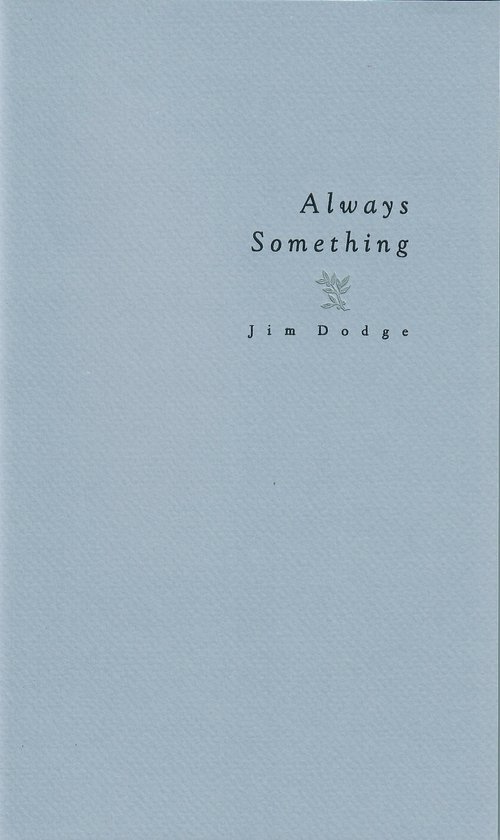
  • Always Something—Jim Dodge

    I am always hoping that Jim Dodge will surprise us all and finally announce the novel he has long been threatening to finish; his most recent, Stone Junction, dropped in the far-distant reality of 1990. A collection of poetry, Rain on the River: New and Selected Poems and Short Prose, followed twelve years later in 2002, but only served to whet our appetite for his deft wordplay and masterful use and abuse of the English language.

    Whenever I get the itch, now that the all-mighty algorithms know everything, I’ll check in to see what the good ol’ apple picker has been up to. Imagine my surprise when I discovered that Idaho’s Limberlost Press, a beautifully archaic letterpress printer of chapbooks, broadsides, and I’m guessing… manifestos, had published a new collection of poems, Always Something, in 2023.

    Limberlost’s publications are artifacts from an anachronistic world of archival-quality papers and hand-sewn assembly—not a shout against the digital darkness, but more of a whispered word of kinship in a sun-dappled meadow, but I digress.

    I recognized one of the poems, the sublime, Owl Feather, from a broadside that Dodge was gracious enough to send me upon the publication of my first novel, welcoming me into the guild ten years ago, so this collection has been simmering for a minute, all the better to let the flavors infuse.

    I have no doubt there are powers far beyond us
    Because the grey-and-brown barred wing feather
    From a Great Horned Owl that I found this afternoon
    While walking the old logging road above McKenzie Creek
    Seemed beautiful beyond the ability to behold it…

    Dodge’s capacity for wonder has always been a feature of his personality and his work, it’s in evidence here as is his prankster’s sense of humor. In A Manual of Sabotage, he incites delightful mischief.

    Of course, only a heartfelt kiss can derail a munitions train,
    Explode the tube in a color TV,
    Destroy a computer’s mother board,
    And get you so exited
    You want to feel completely totaled and totally complete.

    Further imaginings should be enough
    To get us together to wreck more stuff.


    I, for one, am ready.

    Limberlost Press


    Also by this author:

    Rain on the River: New and Selected Poems and Short Prose

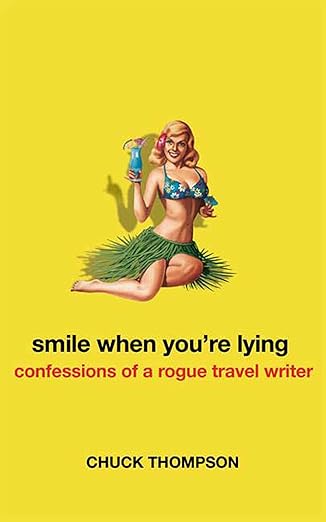
  • Smile When You’re Lying: Confessions of a Rogue Travel Writer—Chuck Thompson

    Former Maxim features editor and all-around bon vivant Chuck Thompson peels back the faux-bamboo veneer of the travel business in a scathing, often hysterically funny, exposé. Thompson bemoans the lack of any kind of authentic point of view in contemporary travel writing while explaining precisely why such a voracious growth industry likes it that way.

    With some clever tips, handy editing advice, and a career’s worth of self-effacing globetrotting disasters to draw from, he serves up some tasty travel tidbits (number one on Thompson’s list of things a writer should never do: describe anything other than food in culinary terms).

    As a former magazine designer, my favorite part of the book is Thompson’s whole-hearted yet utterly doomed attempt to manage a start-up magazine for Travelocity. The sense of dread when consultants show up two weeks before the first issue is due on press is palpable—and spot on. Consultants are like bubonic rats and only bring misery and grim death to any workplace.

    Unlike Holidays in Hell, wherein professional misanthrope P.J. O’Rourke simply reinforces American xenophobic attitudes toward the Third World, Thompson actually dispels many preconceived notions toward places we never go, and portrays the usual hot spots as the crap holes they usually are.

    Thompson and I see eye-to-eye on the questionable appeal of the Caribbean, Graceland, and Las Vegas. I also agree that Eric Clapton, while technically not a vacation destination is somewhat overrated. And thanks to Thompson’s detailed romp through Bangkok’s red-light district, I will never look at Ulysses S. Grant’s signature the same way again.

    Holt Paperbacks